


Autonomous vehicles, drones, healthcare... Ultimately, the key lies in the development of "smart sensors." Where are we now?
 Published2016.10.10 17:36
The role of sensor hubs that control sensors and collect data is also becoming important.
As future strategic industries such as future automobiles, healthcare, smart factories, robots, and drones emerge as hot topics, the importance of so-called "smart sensors" is growing day by day.
Smart sensors are intelligent, cutting-edge sensors in the IT convergence era, and as the types of sensors and their users increase, the role of sensor hubs that can control sensors and collect data with low power is also becoming more important.
The sensor industry is divided into a materials industry for sensor manufacturing, a component industry where unique functions are implemented using materials, a module industry where multiple parts are assembled to form a small device with a specific function, and a system industry where multiple sensors, input/output devices, and control devices are organically combined and operated.
In other words, if the acceleration, pressure, and temperature sensors are in the form of small units, there are pressure sensor modules, humidity sensor modules, and human body detection sensor modules made in the form of modules, and the system type includes tire pressure monitoring, radar sensors, and capsule endoscopes.
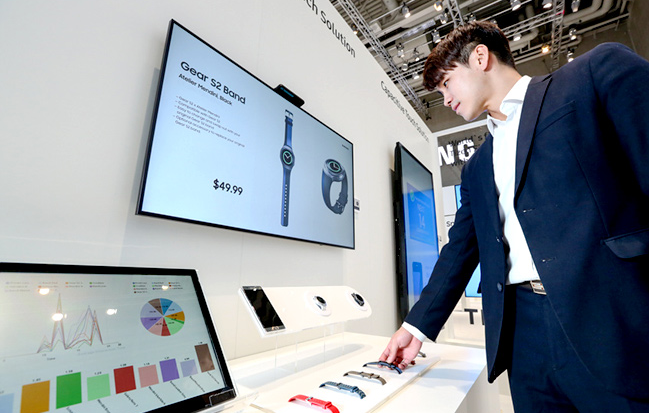
▲Motion sensor touch signage recognizes user movements through 3D sensors without electrical contact and provides the information users need. (Samsung Electronics Gear S2)
The important thing is that as sensors become smaller and more MEMS-based, single sensor modules are becoming composite sensors, which are then becoming more intelligent as one-chip composite sensors. Bosch, a leading company in the sensor field, offers a variety of complex sensors, including 3-axis sensors that support acceleration, gyro, and geomagnetic sensors, 9-axis sensors that incorporate eCompass, IMU, and application-specific sensors, as well as environmental sensors that integrate barometric and pressure sensors, and analog-digital integrated microphones.
First, the smart sensors used in smartphones are becoming increasingly diverse. Representative smart sensors include RGB sensors, light sensors, temperature and humidity sensors, barometric pressure sensors, camera sensors, proximity sensors, Hall sensors, gesture sensors, capacitive touch sensors, geomagnetic sensors, GPS sensors, gyroscopes, acceleration sensors, and gravity sensors, totaling approximately 14 types. In particular, environmental sensors, such as temperature and humidity sensors, which measure the temperature and humidity of the surrounding environment, and barometric pressure sensors, which measure the current atmospheric pressure, are expected to see a wide range of applications.
Lee Soon-hak, a researcher at Hanwha Investment & Securities, said, "The integration of touch sensors and fingerprint sensors is expected to bring about significant design changes. The fingerprint sensor, if placed under the glass, eliminates buttons and allows the entire screen to be used as a display."
High-precision 3D touch sensors and haptic feedback sensors applied to realistic touch sensors
Let's look at examples of smart sensors applied to smart devices. Realistic touch sensors for emotional user interfaces are installed in smart devices like smartphones and smartwatches to realistically detect and provide feedback on the user's intentions. These sensors utilize high-speed, high-precision 3D touch sensor technology capable of simultaneous position and pressure detection, ultra-small, low-power haptic actuators and haptic feedback engines, and haptic feedback 3D touch sensor solution technology.
Sensors are also a core technology of unmanned aerial vehicles (Drones). Drones incorporate geomagnetic sensors, barometric pressure sensors, gyroscopes, accelerometers, ultrasonic sensors, tilt sensors, inertial measurement units (IMUs), and engine intake flow sensors. If drones outsell smartwatches, which have currently shown limited market expansion, demand for these sensors is expected to surge.
Flight situation awareness sensor technology for autonomous drone flight includes AI-powered image sensors for collision avoidance, omnidirectional collision detection ultrasonic sensors, and lidar sensors for SLAM (localized navigation and mapping) for indoor flight. This is because autonomous drone flight requires sensor technology capable of recognizing flight conditions and collision avoidance/automatic takeoff and landing rate flight control technology.
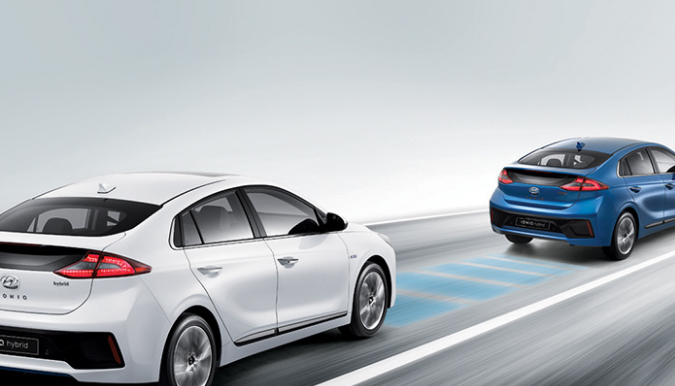
▲The sensor on the front radiator grille of the vehicle plays a bigger role than it appears (Ioniq Hybrid Smart Cruise Control)
As the IoT market expands, smart applications in healthcare, smart homes, and automobiles are also increasing. Ultra-small smart sensors for attachable healthcare devices are being developed, and ultra-small olfactory and motion recognition sensors are being applied to home lighting and security systems. In particular, automobiles, driven by growing demands for reliability, convenience, and safety, are adopting numerous sensors for engines, transmissions, eco-friendliness, steering, indoor environments, and telematics.
Personalized wearable healthcare sensors incorporate novel measurement technologies that are improved over existing biosignal measurement technologies, enabling them to acquire, store, and transmit all data related to an individual's daily activities. Because it requires semiconductor convergence technology that applies UI/UX interfaces that emphasize user convenience and flexible circuit board and display technology, the sensors applied include: △ IoT biosensors for health monitoring using urine or saliva, △ flexible wearable sensors for CDSS based on artificial intelligence, and △ blood sugar monitoring sensors using non-invasive methods.
The body integrated control sensor system recognizes the internal and external situations of the vehicle.
'Body-integrated control sensor system technology for ADAS' is a technology that recognizes the internal and external situations of a vehicle by utilizing various environmental recognition sensors installed in the vehicle or terminals capable of transmitting and receiving with the outside world. Since the design technology for detection technology (detection sensors, signal processing algorithms, systems) that recognize the environment in all directions of the vehicle and the communication technology for exchanging them are key, the following are required: △IR-UWB radar sensor technology △Intersection-responsive wide-angle MRR sensor technology △Pedestrian-detecting MEMS-based uncooled far-infrared sensor technology △Closed Velocity sensor technology for proximity vehicle detection.
Lee Gyu-taek, embedded SW PD (Korea Institute of Industrial Technology Evaluation and Planning), said, “If we compare AI technology to humans, the head corresponds to cloud computing, the spine corresponds to a networking hub like a gateway, and the peripheral nervous system, which corresponds to lightweight OS/middleware and processors in data collection/filtering, is a smart sensor.” He added, “In order to become one of the four major advanced sensor powerhouses, we plan to focus on developing promising fields such as bio, drones, ADAS, factory equipment diagnosis, realistic touch sensors, and robot sensors.”
Comments
Related news
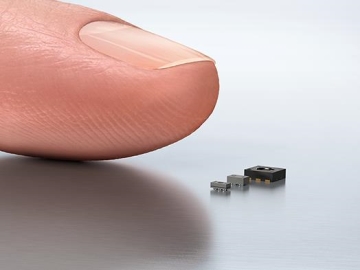
Environmental sensors that meet IoT are expanding in all directions, including “indoor car environments, mobile, and smart homes”
As Internet of Things (IoT) technology spreads, demand for environmental sensors such as temperature/humidity sensors, gas sensors, and pressure sensors is rapidly increasing. This is because demand for sensors that meet requirements such as ultra-miniaturization and low power consumption is surging in order to collect object information across various IoT application fields. In particular, smart environmental sensors are high-functionality, high-precision, high-convenience, and high-value-added sensors that combine sensing elements with intelligent signal processing to perform data processing, automatic calibration, self-diagnosis, and decision-making functions. Environmental sensors include temperature/humidity sensors, gas/pressure sensors, as well as dust sensors, ultraviolet sensors, and water quality sensors, and these sensors support real-time environmental monitoring regarding the effects of environmental pollutants in environmental media such as water and atmosphere, humans, and ecosystems.
2016.03.21by 신윤오 기자
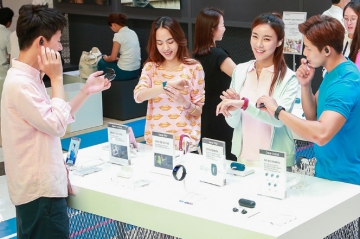
[ICT R&D Overview] ③ Urgent Development of ICT Devices, Complex Sensors, and Intelligent Semiconductors
ICT devices comprehensively refer to intelligentized terminals and components that deliver information and communication technology and services between users and objects in IoT environments, extending beyond conventional terminals such as PCs and smartphones. Based on functions such as sensing, processing, and communication, the scope includes devices and related component technologies used in various fields including healthcare, transportation, safety, education, and convenience. ICT devices handled by the Ministry of Science and ICT include smart devices, wearable devices, unmanned mobile devices, intelligent semiconductors, smart vehicles, and 3D printing. As society enters into a hyper-connected era where all people, objects, and spaces are interconnected centered on ICT, the number of network-connected devices is increasing rapidly and numerous types of application products and services are emerging, generating high expectations for ICT devices.
2016.08.16by 신윤오 기자
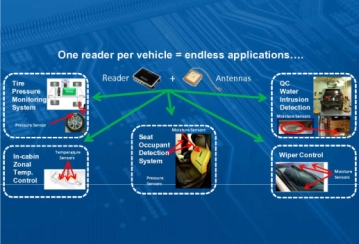
How smart passive sensors are used in tire pressure monitoring solutions
onsemi has become a topic of discussion by demonstrating in a video (http://www.onsemi.com/community/blog/post/auto-tire-pressure-monitoring) how their smart passive sensor products are used in tire pressure monitoring solutions. The demo utilized a standard-sized passenger car tire compatible with onsemi's smart passive sensor tag. The sensor tag consists of an inductive tuned loop utilized as a sensing element, a printable antenna, and a smart sensor IC.
2016.08.18by 홍보라 기자

ESP32 Development Environment Selection and GPS Application Implementation
The ESP32 is a microcontroller that integrates Wi-Fi, Bluetooth, 12-bit ADC, capacitive touch, PWM, DAC, and UART in a single SoC. However, the abundance of features does not by itself solve the designer's problems. The real challenges lie in selecting the appropriate development environment, determining which pins can be used and which must be avoided, and converting raw data from modules into usable information. This document addresses ESP32 peripheral constraints (ADC2 and Wi-Fi coexistence limitation, UART1 occupancy, ADC non-linear regions), the trade-offs between Arduino IDE and ESP-IDF, and the process from connecting NEO-6M/NEO-M8N GPS modules to UART2, parsing NMEA sentences, and visualizing routes in Google Earth, all organized based on documented references.
2026.10.12by 편집부
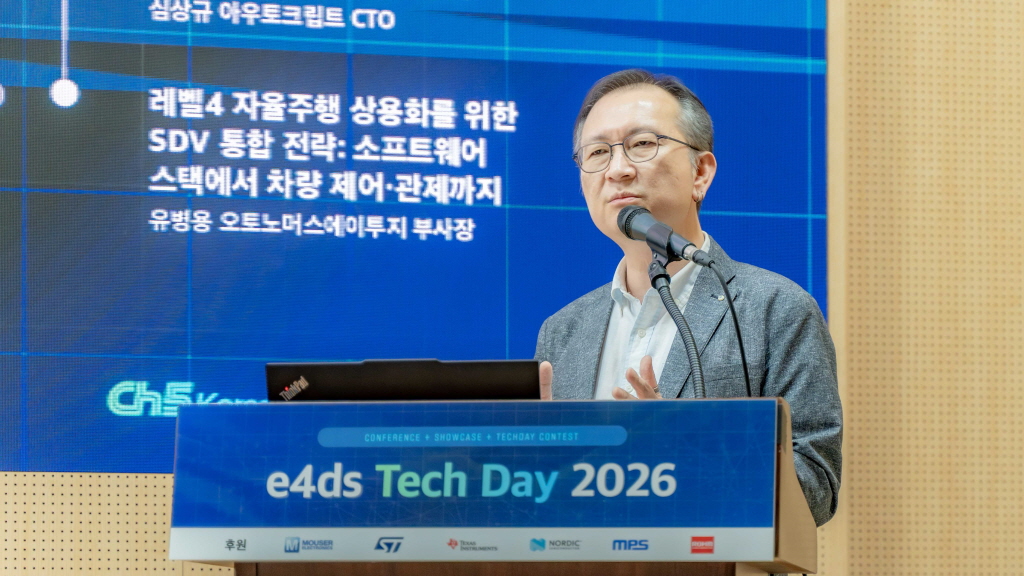
[e4ds Tech Day 2026 ⑨] Sim Sang-gyu, Autocrypt CTO: "In the Physical AI Era, Automotive Security Must Extend Beyond the Vehicle"
At e4ds Tech Day 2026, Sim Sang-gyu, CTO of Autocrypt, explained automotive cybersecurity strategies in the era of Physical AI and SDV (Software-Defined Vehicle). Automobiles are evolving as part of an ecosystem connected to AI, cloud, chargers, IoT, and robots, and he emphasized that the scope of security must expand beyond the vehicle interior to the entire connected environment. In particular, AI model tampering, adversarial attacks, OTA updates, and EV charger hacking were identified as major threats. He explained that response measures require zero trust, AI model integrity protection, intrusion detection, Security by Design and Default, and full lifecycle security management, and that proactive security system establishment beyond regulatory compliance is critical for securing future mobility competitiveness.
2026.10.12by 배종인 기자











