


TI Launches Automotive-Standard Hub IC for Designing ADAS Applications
 Published2016.10.19 10:14
Data collection and replication possible from multiple high-resolution sensors such as automotive cameras and radar
TI announced that it is launching the industry's first dual-port quad deserializer hub that meets the MIPI Camera Serial Interface 2 (CSI-2) standard.
This new automotive standard hub IC can collect and replicate high-resolution data from up to four cameras simultaneously. In addition, autonomous driving and sensor fusion-based ADAS systems, such as surround view systems, rear cameras, driver monitoring cameras, camera monitoring systems, front camera systems, and satellite radar equipment, require high data throughput and precision.
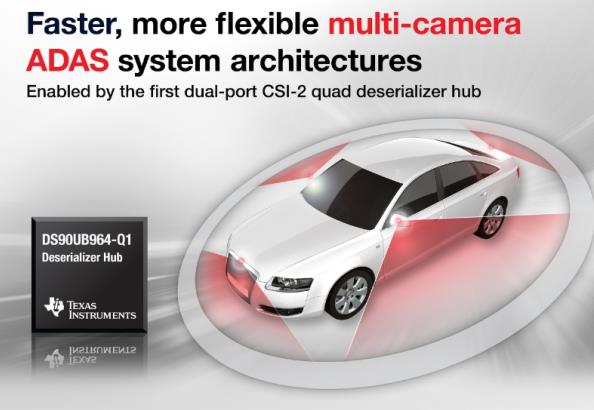
This new product provides higher bandwidth, helping equipment capable of recognizing pedestrians, bicycles, and other obstacles along a vehicle's driving path or in its vicinity to process video data more quickly. The DS90UB964-Q1 FPD-Link III device provides dual CSI-2 outputs, virtual channel ID mapping, and port replication capabilities, enabling fast processing of data from up to four cameras operating at 100 MHz and 12-bit resolution per sensor while saving processor resources.
In addition, TI’s Adaptive Equalization (EQ) feature allows the system to monitor cable conditions and take preventive measures before cable defects occur.
The main features and advantages of this hub IC are that it can transmit video at up to 1.6 Gbps per lane with dual-port CSI-2 outputs, enabling higher bandwidth and faster obstacle detection, and the second CSI-2 port can use simultaneous video replication to perform data logging or separate viewing or machine vision flows.
In addition, unlike competing products, virtual channel ID mapping is possible, allowing the processor to distinguish between cameras and HDR (high-dynamic-range) exposures for more efficient processing. Furthermore, the extremely low latency of the control channel enables image signal processing (ISP) functions to be taken from the camera and integrated into the electronic control unit (ECU), thereby improving image quality and lowering system costs.
Like other products in the TI FPD-Link III Serializer-Deserializer (SerDes) family, it uses the Adaptive Receiver EQ function instead of transmitter pre-emphasis. Adaptive EQ can automatically compensate for the effects of cable aging and bending, thereby achieving optimal signal quality and reducing electromagnetic interference (EMI).
TI FPD-Link III SerDes devices offer interoperability and upstream and downstream compatibility, allowing automotive manufacturers and Tier 1 suppliers to utilize high-end, mid-range, and entry-level performance as needed. Additionally, they can conveniently select SerDes products that optimize system performance and minimize costs.
The DS90UB964-Q1 deserializer hub can be used with various processors on the market, including the TDA3x SoC processor for ADAS. Since both devices support PoC (power-over-coax), the wiring required for the system can be significantly reduced.
TI is currently supplying samples of SerDes devices for 2MP cameras with a speed of 60 frames per second, along with the DS90UB964-Q1 1MP (megapixel) deserializer hub. These 2MP devices feature synchronous clocking and advanced data protection and diagnostic capabilities.
Comments
Related news
Maxim Integrated Launches Advanced Automotive 4-Channel Deserializer
2015.07.29by 명세환 기자
TI Announces Multiport Minidock Reference Offering Flexible and Intelligent Features
TI Korea (CEO Kent Jeon) announced the launch of a reference design for a multiport USB Type-C and Power Delivery (PD) mini dock that supports audio, USB data, power, and video. This reference design, newly added to TI Designs, TI's reference design library, can be powered by conventional power adapters, USB Type-C adapters, or notebook computers, providing flexible and intelligent functionality to end users. Additionally, it offers a tested and validated docking solution in a 2 x 4 inch form factor that is at least 50% smaller than existing docking solutions.
2016.08.16by 홍보라 기자
TI Unveils Reference Design to Add Wi-Fi to EV Charging Stations
TI announced that it is providing a reference design that enables electric vehicle (EV) charging stations to add Wi-Fi connectivity functionality for the first time in the industry. EV drivers can now remotely monitor their vehicles and control charging from anywhere Wi-Fi is available, and this enables various use cases ranging from home automation to searching for nearby charging stations.
2016.09.05by 홍보라 기자

[e4ds Tech Day 2026 ⑨] Sim Sang-gyu, Autocrypt CTO: "In the Physical AI Era, Automotive Security Must Extend Beyond the Vehicle"
At e4ds Tech Day 2026, Sim Sang-gyu, CTO of Autocrypt, explained automotive cybersecurity strategies in the era of Physical AI and SDV (Software-Defined Vehicle). Automobiles are evolving as part of an ecosystem connected to AI, cloud, chargers, IoT, and robots, and he emphasized that the scope of security must expand beyond the vehicle interior to the entire connected environment. In particular, AI model tampering, adversarial attacks, OTA updates, and EV charger hacking were identified as major threats. He explained that response measures require zero trust, AI model integrity protection, intrusion detection, Security by Design and Default, and full lifecycle security management, and that proactive security system establishment beyond regulatory compliance is critical for securing future mobility competitiveness.
2026.10.12by 배종인 기자

Practical HIL Construction Strategy for Automotive and Off-Highway Controller Validation
As vehicle E/E architecture transitions to zonal structures and shifts to software-defined vehicles (SDV), the number of controllers (ECUs) requiring validation and software complexity are surging dramatically. Meanwhile, real vehicle testing cannot provide repeated verification under identical conditions and entails lead time and safety concerns. This white paper explains the principles of HIL (Hardware-in-the-Loop) validation and the structure of the NI platform composed of PXI, SLSC, and VeriStand, and through two actual implementation cases—Camera Record & Replay HIL for In-Cabin Monitoring Controller (ICMU) and Forklift Controller (VCU) HILS—describes how controller-level regression testing becomes possible. Additionally, it explicitly states application boundaries and limitations, such as lack of A2B support.
2026.10.12by 편집부











