


Automotive LiDAR, drone systems... which technologies should be commercialized?
 Published2016.11.14 15:27
Introduction of leading domestic technologies such as wireless charging, automotive LiDAR, and drones
We support the successful technology commercialization of domestic small and medium-sized enterprises.
KETI (Korea Electronics Technology Institute) held a “Technology Innovation Matchmaking” technology transfer briefing session at Kinstower in Bundang on the 10th.
KETI, which has established a corporate cooperation platform for proactive corporate support and is taking the lead in expanding the win-win cooperation ecosystem, identified potential client companies and supported technology transfer and commercialization through this event.
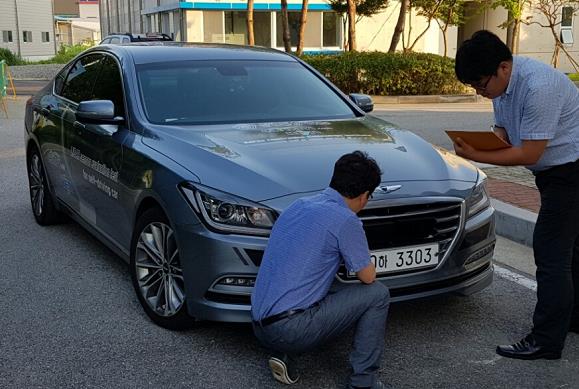
KETI officials are examining a LiDAR for automobiles.
At this briefing, the institute introduced 10 of its latest technologies, focusing on four major fields: materials and components (3D magnetic resonance-based wireless charging technology, high-efficiency induction-start motor technology, electromagnetic shielding integrated sheet technology), medical and bio (3D oral scanner technology, food additive detection technology), automotive and aviation (LiDAR technology for automobiles, WAVM technology, embedded system technology for drones), and software (audio volume measurement and control technology, global taboo/synonym verification analysis technology).
Director Park Cheong-won stated, “Through this event, we will widely promote the research institute’s promising technologies for commercialization and identify the needs of small and medium-sized enterprises to the fullest extent to support customized technology commercialization for each company in the future.”
The following is a summary of the key technologies introduced at this briefing.
Charging works even if the phone is tilted or face down, 3D magnetic resonance-based wireless charging technology
existingWireless charging technology using pad-type 2D (planar) antennas had the disadvantage that charging efficiency decreased or charging did not occur due to changes in the charging position and angle of the receiver relative to the transmitter.
3D magnetic resonance-based wireless charging technology (three-dimensional type) is a wireless charging technology that applies a three-dimensional coil antenna, and it is possible to secure the positional freedom of a receiver placed on a three-dimensional wireless charging transmitter, such as a cup holder or pencil holder.
It is possible to secure a certain level of charging efficiency regardless of the angle or position of the receiver placed arbitrarily inside the cup holder, without the user being aware of it. Since it can be applied to wireless chargers with various three-dimensional structures, it is suitable for multi-purpose wireless chargers with three-dimensional structures, such as car cup holders, pencil holder-type multi-purpose wireless chargers, and chair-type chargers capable of wirelessly charging target devices in pockets or bags.
Researcher Jin-Hyung Kim of the Smart Sensor Research Center said, “It is based on magnetic resonance (6.75 MHz) and has the advantage of being able to fabricate an antenna using a single winding without applying multiple coil antennas to construct a 3D resonant coil antenna.”
The center has also developed magnetic resonance-based lighting technology. This wall-mountable thin-film wireless lighting technology can be installed without exposed wires or installation work, and is controlled via a smartphone. In addition, applying this technology to a smart desk allows for the simultaneous operation of devices placed on the desk, such as lamps, wireless speakers, and fans.
World's best technology at a lower price, automotive LiDAR technology
Lidar sensors have become a hot topic recently as interest in autonomous vehicles grows and the government has decided to actively foster related R&D.
LiDAR (Light Detection and Ranging) is a technology that measures distance using lasers. Automotive LiDAR is a device that measures the distance between vehicles in real time to provide warnings or control the vehicle, enabling a moving vehicle to avoid collisions with the car in front or minimize impact.
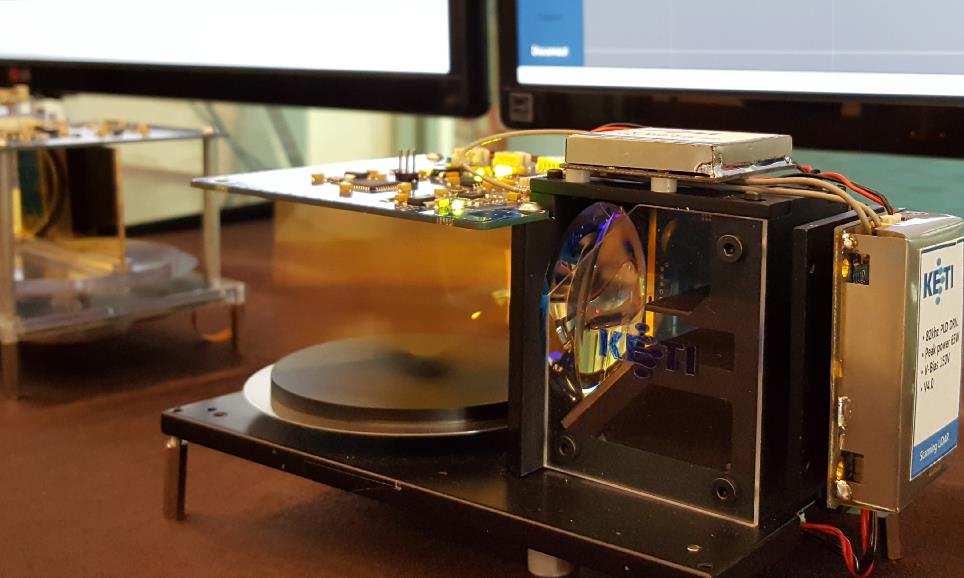
▲ Scanning LiDAR having an optical system structure that shares transmitting and receiving lenses.
Until recently, millimeter-wave RF was partially commercialized for vehicle distance sensors; however, its weak directional properties have limited its practical application, such as detecting vehicles in other lanes. Additionally, while products incorporating RF radar technology were developed to impart directional properties to RF, their excessively high cost has hindered their application in automotive sensors.
LiDAR technology measures the distance to an object by emitting a high-power pulsed laser and measuring the time it takes for the laser to reflect back. Using this method, it simultaneously measures the distance and relative speed to a moving vehicle in real time. As a commercially available technology not yet present in Korea, it possesses a size and technology comparable to that of Germany's CV sensor (Closing). The detection range is within 1 to 10 m @ 150 kph, and the measurement accuracy is distance ±0.1 m (±10%) and speed ±2 kph (±10%).
Dr. Lee Han-young of the Smart Sensor Research Center stated, “The applications of automotive LiDAR are expected to expand as a prototype is released next month,” adding, “In addition, we have completed the development of an invisible laser fence using LiDAR and are developing a LiDAR for next-generation high-end CCTVs, so utilizing this will enable us to provide distance information for long-distance AF of about 100 meters.” In addition, Dr. Lee plans to enable object recognition via LiDAR even at night using multi-channel LiDAR technology by utilizing the MEMS mirror-based project technology currently under development.
WAVM technology enables on-site video rendering via remote control.
To efficiently control robots that perform tasks in place of humans via remote control in environments where it is difficult for humans to work, video representation technology capable of reconstructing the surrounding environment and changing the viewpoint in real time is required.
WAVM (Wrap Around View Monitoring) provides intuitive images of the driving environment by generating arbitrary image views using only 2D images from four cameras in open areas where 3D information is lacking and the sensor range is outside, thereby providing control viewpoints according to the driving environment or situation.
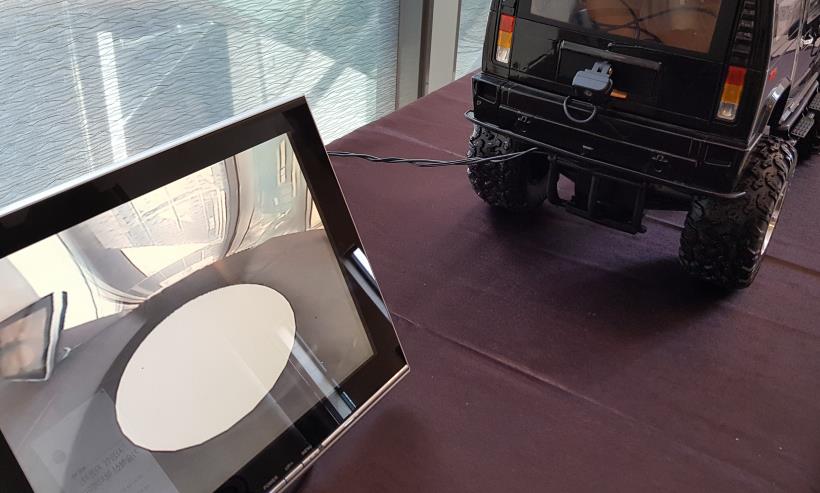
▲ WAVM technology was implemented in a model car.
For model configuration and preprocessing techniques for WAVM image construction, hemispherical model construction and real-time texture wrapping techniques, radial distortion correction techniques through wide-angle camera calibration, homography construction, and image warping techniques were applied. In addition, WAVM images were constructed using four cameras without utilizing depth information.
"Researcher Kim Seung-hoon of the Intelligent Robotics Research Center said, 'WAVM is a technology that uses four cameras to provide a 3D view to the remote operator for robot navigation, and it was developed with a focus on remote control rather than autonomous driving.'" He continued, “We developed this by benchmarking the method developed by Fujitsu, but that company developed it exclusively for automobiles,” and explained, “The technology we developed can be used for remote-controlled robots that provide a third-person view or drone devices that can capture 360-degree video at once.”
This technology can be applied to smart black boxes that require three-dimensional accident scenario reconstruction and analysis capabilities, as it is difficult to accurately analyze accident situations using only simple video information; it can also be applied to intelligent excavation control technology based on work environment recognition. Intelligent excavators utilize technology that visualizes surrounding information at work sites prone to blind spots to present risk factors to the user, and enable realistic control of the work site even from a remote location.
Embedded system technology for drones for autonomous flight
This technology collectively refers to the technology for extracting moving objects through camera footage and tracking specific objects among them, the control processor—a critical component of the flight controller that controls the drone's motors and sensor data—and the embedded software-based platform technology built upon it.
It provides a modular software and hardware development environment and supports highly integrated controller chip technology for implementing low-complexity aircraft controllers. Furthermore, by offering hardware-based motion detection and collision avoidance capabilities through sensor fusion, it provides platform technology for drones that can be utilized even in high-speed systems.
"Hwang Tae-ho, a principal researcher at the SoC Platform Research Center, stated, 'We expect embedded system technology for drones to be utilized in the design and development of drone systems for unmanned transport systems, various disasters, industrial site monitoring, and agricultural and aquaculture monitoring and video recording.'"
Low-noise, low-vibration, and ultra-lightweight 3D oral scanner technology that satisfies all-around requirements
Since the field of dental oral scanners for the custom production of dental prosthetics involves the human body, it is essential to develop confocal 3D scanner technology that enables precise 3D scanning without the need for spray application that causes discomfort, and simultaneously allows for shape acquisition in a confined space.
3D oral scanner technology is an optical module technology for confocal 3D scanners capable of measuring three-dimensional shapes without the need for a separate spray application. To solve the problems of noise, vibration, and weight associated with mechanical drive parts such as motors for focus adjustment, it implements a core optical module for 3D scanners with a low-noise, low-vibration, and lightweight structure capable of electronic focusing without moving parts.
Among 3D scanner technologies, 3D Triangulation-based white light irradiation and structured light irradiation 3D scanners are widely commercialized and used, but they are vulnerable to shiny objects, highly reflective objects, or transparent objects such as glass. Confocal 3D scanners are a method that enables accurate measurement of the three-dimensional shape of an object without the need for a separate spray coating to prevent surface reflection.
This technology miniaturizes a core optical module for a Confocal 3D scanner, which is expected to be used for dental or small object scanning as it enables precise 3D scanning in a narrow space without spray application among various types of 3D scanner technologies.
Hong Hyuk-ki, a principal researcher at the Human Care System Research Center, stated, “The 3D oral scanner technology developed by the center improves upon shortcomings such as focus changes caused by vibration, noise, and shock by providing a driveless optical system using an electronic focusing method. Furthermore, because it does not use mechanical motors, it enables low noise, low vibration, and an ultra-lightweight probe. With the application of USB 3.0 interface technology, high-speed image transmission to a PC at 500fps is possible.”
Comments
Related news
Can domestic LiDAR technology, the eyes of autonomous vehicles, drastically lower prices?
Last May, when a fatal accident involving a Tesla electric vehicle occurred while driving with autonomous driving capability (Autopilot), autonomous vehicles once again became the center of controversy. The U.S. National Highway Traffic Safety Administration (NHTSA) regards this accident as the first fatal accident occurring in autonomous driving mode. This accident has become an opportunity to comprehensively review autonomous vehicle technology, from the sensor role to commercialization. Accordingly, we examined autonomous vehicle forward detection technology through the current domestic technology status of LiDAR (Light Detection and Ranging), which can be considered the "eyes" of autonomous vehicles, and related technologies.
2016.07.04by 신윤오 기자
Autonomous vehicles, drones, healthcare... Ultimately, the key lies in the development of "smart sensors." Where are we now?
As emerging strategic industries such as future automobiles, healthcare, smart factories, robots, and drones have become hot issues, the importance of so-called 'smart sensors' is growing day by day. Smart sensors are sensors that have been given intelligence, referring to intelligent advanced sensors in the IT convergence era. As the types of sensors and their application objects have increased, the role of sensor hubs that can control sensors and collect data at low power consumption has also become increasingly important.
2016.10.10by 신윤오 기자
LG Innotek Begins Mass Production of 15-Watt Wireless Charging Pads for Smartphones
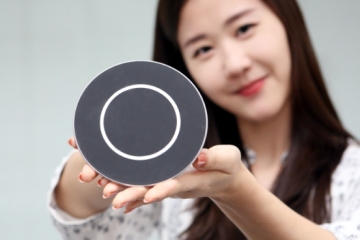
LG Innotek (CEO Park Jong-seok) has commercialized a wireless charging pad that can charge smartphones as quickly as a wired fast charger without the need for cables. The company announced on the 12th that it has begun mass production of a 15-watt (W) wireless charging pad for the first time in the world. This is the first mass production for consumer sales, not a prototype. A wireless charging pad is a device that supplies power to smartphones and is manufactured in a slim shape like a cup coaster. When a wireless charging-enabled smartphone is placed on top of it, the battery charges.
2016.10.13by 김수지 기자

ESP32 Development Environment Selection and GPS Application Implementation
The ESP32 is a microcontroller that integrates Wi-Fi, Bluetooth, 12-bit ADC, capacitive touch, PWM, DAC, and UART in a single SoC. However, the abundance of features does not by itself solve the designer's problems. The real challenges lie in selecting the appropriate development environment, determining which pins can be used and which must be avoided, and converting raw data from modules into usable information. This document addresses ESP32 peripheral constraints (ADC2 and Wi-Fi coexistence limitation, UART1 occupancy, ADC non-linear regions), the trade-offs between Arduino IDE and ESP-IDF, and the process from connecting NEO-6M/NEO-M8N GPS modules to UART2, parsing NMEA sentences, and visualizing routes in Google Earth, all organized based on documented references.
2026.10.12by 편집부

[e4ds Tech Day 2026 ⑨] Sim Sang-gyu, Autocrypt CTO: "In the Physical AI Era, Automotive Security Must Extend Beyond the Vehicle"
At e4ds Tech Day 2026, Sim Sang-gyu, CTO of Autocrypt, explained automotive cybersecurity strategies in the era of Physical AI and SDV (Software-Defined Vehicle). Automobiles are evolving as part of an ecosystem connected to AI, cloud, chargers, IoT, and robots, and he emphasized that the scope of security must expand beyond the vehicle interior to the entire connected environment. In particular, AI model tampering, adversarial attacks, OTA updates, and EV charger hacking were identified as major threats. He explained that response measures require zero trust, AI model integrity protection, intrusion detection, Security by Design and Default, and full lifecycle security management, and that proactive security system establishment beyond regulatory compliance is critical for securing future mobility competitiveness.
2026.10.12by 배종인 기자











