


Maxim Simplifies Medical Wearable Design with Ultra-Low Power, High Performance MCUs
 Published2016.11.16 12:19
Maxim Integrated Korea (CEO Choi Heon-jeong) announced the ARM Cortex-M4F microcontrollers (MCUs) 'MAX32630' and 'MAX32631', which simplify the design of high-performance medical and fitness wearable devices.
As the market for wellness and medical wearable applications grows rapidly, the requirements for internal electronic components in wearable devices have become more complex and novel. Internal electronic components must provide high levels of functionality, processing power, and optimal integration with peripherals while maintaining a small size. In addition to high precision and low noise, they must exhibit extremely low power loss across various operating modes to ensure sufficient battery life on a single charge. The Maxim MAX32630 and MAX32631 MCUs address these challenges.
The sophisticated power management features of the MAX32630 and MAX32631 maximize operating time. It extends battery life with the industry's lowest energy consumption in full active (127uW/MHz), DMA (32uW/MHz), and retain standby (3.5uW) modes. The onboard code (2MB flash), data (512KB SRAM), and cache (8KB) memory facilitate the execution of third-party applications and the recording of sensor data, thereby enhancing the overall user experience.
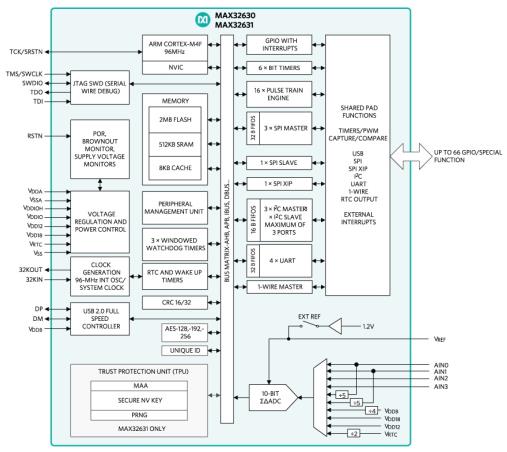
▲ Block diagram of Maxim's ultra-low power, high-performance MCU 'MAX32630/MAX3263' that simplifies the design of medical and fitness wearable devices.
The MAX32630 and MAX32631 are powerful processors equipped with a fast Cortex-M4F 32-bit MCU core including an FPU (Floating-Point Unit) in a small form factor of a 4.37mm × 4.37mm 100-ball WLP package. Interfaces include SPI, SPI XIP, UART, I2C, 1-Wire, and USB ports. Peripherals consist of six 32-bit timers, a clock, 66 general-purpose I/O pins, a pulse train engine, and a 10-bit analog-to-digital converter (7.8 ksps).
In particular, the MAX32631 provides customers with a complete security toolbox that protects IP, algorithms, and user data by reinforcing it with a Trust Protection Unit (TPU) that executes intelligent hardware encryption and authentication functions.
Maxim has expanded its portfolio of wearable MCUs featuring a scalable memory architecture with the MAX32630 and the security-enhanced MAX32631. This portfolio consists of the MAX32620 with 2MB of flash memory and 256KB of SRAM, the security-enhanced MAX32621, the security-enhanced MAX32625 with 512KB of flash memory and 160KB of SRAM, and the security-enhanced MAX32626. An evaluation board for the MAX32630 is also available. All products operate in a range from minus 20 degrees Celsius to plus 85 degrees Celsius.
Prem Nayar, Director of Medical & Wearable Micro at Maxim Integrated, stated, “The MAX32630 and MAX32631, designed from the ground up for medical and fitness wearable products, are powerful solutions in ultra-low power, high performance, and small packages,” adding, “The MAX326 MCU family enhances the user experience through sensor integration, flexible design, and connectivity.”
Comments
Related news

Maxim Unveils Smallest Form Factor for Maximum Power Efficiency in Next-Generation PLC Designs
Maxim Integrated Products Korea (CEO Kim Hyun-sik, www.maximintegrated.co.kr), a leader in analog mixed-signal semiconductor markets, has announced the 'Pocket IO' programmable logic controller (PLC) development platform that maximizes manufacturing productivity for Industry 4.0 applications. With Maxim Pocket IO, customers can achieve maximum power efficiency with a minimal form factor when designing next-generation PLCs.
2016.10.07by 김수지 기자
Maxim Announces Secure DeepCover Authentication Device to Protect IP and Guarantee Device Integrity
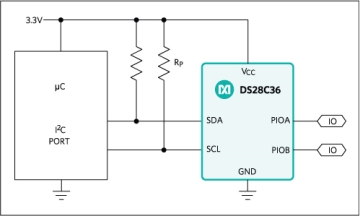
Maxim Integrated Products Korea (CEO Kim Hyun-sik, www.maximintegrated.co.kr) has announced the DS28C36, a secure DeepCover authenticator device that protects and safely controls industrial, medical, and Internet of Things (IoT) systems. Using the DS28C36, enterprises can protect their intellectual property and ensure device integrity. Faced with frequent product counterfeiting, dangerous reuse of medical auxiliary devices, and vulnerabilities in networks connected to sensor nodes, enterprises have recognized the need for robust security features in their products and systems. The DS28C36 is a compact, cost-effective solution that provides both asymmetric and symmetric key cryptography tools. It supports asymmetric public key functionality based on P256-based ECC (Elliptic Curve Cryptography) algorithms and symmetric secret key functionality based on the SHA-256 algorithm.
2016.10.13by 김수지 기자

Maxim Announces Ultra-Small Reference Design for Wearables
Maxim Integrated Korea (CEO Choi Hun-jung) has unveiled an ultra-compact 'hSensor Platform' for wearable applications. Designers of healthcare, wellness, and fitness applications can quickly and easily validate next-generation solutions using Maxim Integrated's ultra-compact hSensor Platform. Developing a board with sensors is complex. Designers must first develop custom hardware and firmware for concept verification, then produce prototypes before starting field testing. During prototype development, significant time is spent evaluating sensors and existing solutions. The Maxim hSensor Platform integrates all hardware components onto a PCB (printed circuit board) and allows immediate verification of hardware performance with the 'ARM mbed' Hardware Development Kit (HDK), accelerating prototype development by 3 to 6 months.
2016.11.07by 명세환 기자
ESP32 Development Environment Selection and GPS Application Implementation
The ESP32 is a microcontroller that integrates Wi-Fi, Bluetooth, 12-bit ADC, capacitive touch, PWM, DAC, and UART in a single SoC. However, the abundance of features does not by itself solve the designer's problems. The real challenges lie in selecting the appropriate development environment, determining which pins can be used and which must be avoided, and converting raw data from modules into usable information. This document addresses ESP32 peripheral constraints (ADC2 and Wi-Fi coexistence limitation, UART1 occupancy, ADC non-linear regions), the trade-offs between Arduino IDE and ESP-IDF, and the process from connecting NEO-6M/NEO-M8N GPS modules to UART2, parsing NMEA sentences, and visualizing routes in Google Earth, all organized based on documented references.
2026.10.12by 편집부
MIPI CSI-2, DSI-2, C-PHY, D-PHY Test Solution Technical White Paper
The MIPI interface adopts a burst mode that transitions between low-power (LP) and high-speed (HS) states for low-power consumption, and in return, strict timing rules are imposed on state transitions. Additionally, the high-speed section operates as a packet-based protocol with headers, ECC, and CRC, so verification engineers must handle waveforms and protocols simultaneously. Traditional configurations combining general-purpose oscilloscopes and AWGs reveal limitations in setup complexity, measurement uncertainty, and lack of reproducibility when faced with these requirements. This white paper, based on webinar materials, organizes the structure of this problem and describes how the SV5C-DPTXCPTX generator for receiver testing and SV5C-DPRXCPRX analyzer for transmitter testing integrate state transition testing, stressed eye testing, and protocol analysis into a single bench, along with their application boundaries.
2026.10.12by 편집부











