



Intel CEO: "Data is the new fuel for future cars and self-driving cars"
 Published2016.11.16 12:52
Intel CEO Brian Krzanich
The world today runs on oil. It heats and cools our homes, and powers almost every type of transportation. If you were to drive a non-oil-based vehicle, you would have a hard time driving long distances. Without oil, your car engine would overheat, pistons and rings would melt against the cylinder walls, and engine blocks would break. . So oil is the core technology that makes the automotive world we know possible today. But now, everything is starting to change.
Especially in the future of cars and autonomous vehicles, data has literally become the new oil. Data has the potential to radically change the way we think about our automotive driving experiences as consumers, as automakers, as technologists, and as citizens.
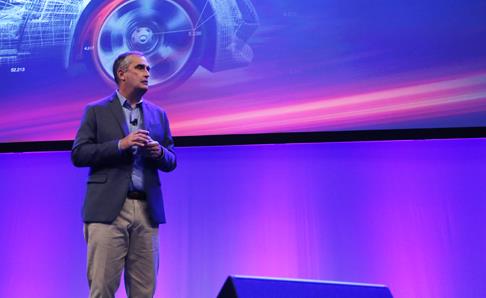
One of the most radical transformational trends I see as a technology professional is that virtually every industry is experiencing a massive data deluge due to the proliferation of smart, connected devices.
If we look more closely, we are currently living in a world overflowing with data. However, compared to the future, the amount of data today is relatively small. In 2016, the average person creates 650MB of data a day across their PCs, mobile phones, and wearable devices.
By 2020, that number is expected to reach 1.5GB per day—a staggering 200% increase in less than four years. And yet, that growth pales in comparison to the changes already underway in autonomous vehicles.
In autonomous vehicles, we need to consider components such as cameras, radar, sonar, GPS, and LIDAR (laser-based object recognition technology). These are key to the new way pistons, rings, and engine blocks are driven. Cameras will operate at 20 to 60 MB of data per second, radar at 10 KB per second, sonar at 10 to 100 KB per second, GPS at 50 KB per second, and LIDAR at 10 to 70 MB per second. Therefore, each autonomous vehicle will generate about 4,000 GB, or 4 terabytes of data per day.
That means that one autonomous vehicle will generate the same amount of data as nearly 3,000 people. Let’s take a closer look at how many cars are on the road and make a deeper estimate. Even if we assume that there are just 1 million autonomous vehicles on the road worldwide, that means that autonomous vehicles will generate the same amount of data as 3 billion people.
Just as oil transformed the world over the past century, data is poised to transform the world for centuries to come, and beyond. And the automotive ecosystem has the opportunity to leverage data to drive insights, create new business opportunities, and create a safer, less contentious world. Let’s look at three types of valuable data that autonomous driving will create.
First and most obvious is the technical data, or “inside-out” data. This comes from sensors in the car that can tell the difference between a child and an animal, a fallen branch and a traffic cone, and it also drives decisions about the car’s movements and external events. This data requires a huge amount of computing power, and having the best data will allow anyone to develop the best AI tools, such as machine learning, deep learning algorithms, and data analytics.
The second is social data, or 'outside-in' data, obtained from various sources. Vehicle-related data such as traffic information influences the car's movement from point A to point B, or its course change to point C. The Waze app (traffic congestion information app) is a good example of outside-in data today. Having this data will enable the development of the best applications.
Finally, personal data. This can be used to determine how many people are in the car, what music each passenger prefers, or even analyze the brands or stores that passengers prefer, and provide relevant information when the car is approaching. Wearables and other sensors in the car can also monitor the behavior, interests, emotions, and body cycles of passengers, further enhancing safety and security. Utilizing this personal data will enable the development and delivery of the best user experience.
Data is clearly the new normal in the automotive world, but simply acquiring data isn’t enough. We need to maximize the value of data by turning it into actionable sets of insights. And that requires end-to-end computing solutions that span the car, network, cloud, and powerful connectivity.
Intel will accelerate the implementation of autonomous driving and end-to-end solutions by strengthening collaboration with partners across the industry and globally for future driving, and lead the transformation of next-generation computing. Thanks to the broad and unique technology portfolio developed through acquisition and innovation, only Intel in the industry can realize the synergy of next-generation computing through such collaboration.
The automotive ecosystem currently faces three challenges related to data: massive data sets, intelligence development cycles for data processing, and security. To overcome these challenges, automakers and suppliers must achieve scalability, which means they must collaborate, share, and learn from each other without compromising their respective territories.
Intel Capital announced an additional new investment of more than $250 million over the next two years to enable fully autonomous driving. Going forward, Intel will focus on providing end-to-end solutions that can extract insights and create value from data. Through this, Intel will become a trusted partner to realize fully autonomous driving and take the lead in using data to improve safety, mobility, and efficiency.
Comments
Related news
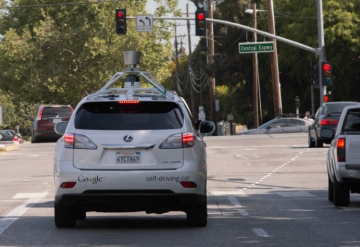
Why did Google's self-driving car spend 3.85 million kilometers on road tests?
Dr. Cha Won-yong, a representative futurologist in Korea and CEO/Director of ASPEC Future Technology Management Research Institute, revealed this through his recently published book titled "Intensive Patent Analysis of Google's AI-based Autonomous Vehicles," stating that "most of Google's patents are aligned with Levels (L) 3 and 4 as defined by the American SAE," and "patents related to software design capabilities for artificial intelligence (AI)-machine learning (ML)-deep learning (DL), which is the core of autonomous vehicles, and patents regarding situations, responses, and learning that occur during actual road testing based on this foundation." Dr. Cha identified 250 Google patents from 2009 through December 31, 2015, related to Google's Self-Driving Car (SDC) project, specifically semi-autonomous cars (Self-Autonomous Car) and autonomous cars (Autonomous Car), and analyzed 110 important patents among them. Most of these patents are sensor systems (Sensor System), autonomous driving computer systems (Autonomous Driving Computer System), which are core to autonomous vehicles, and authentication systems between users and autonomous vehicles when commercialized.
2016.05.02by 신윤오 기자

[Discussion] Autonomous Vehicles: "Overconfidence is dangerous, but there is no need to fear either"
Interest in autonomous vehicles shows no signs of cooling. Autonomous vehicles require extensive technological advancement starting from existing automotive technology itself, encompassing advanced component-related technologies, and extending to surrounding infrastructure technologies including roads. 'Automotive Innovation Day 2016,' hosted by Automotive Electronics, a representative automotive technology exhibition in Korea, was held on the 14th with the participation of approximately 700 people. The event addressed key issues for future automotive development including ADAS and autonomous vehicles, connected cars and IoC (Internet of Car), automotive security, and testing—hot topics in the automotive industry—and received enthusiastic response from participants. In the panel discussion concluding the conference, government and industry experts related to autonomous vehicles participated, providing insights into the latest industry trends. E4ds News presents a live coverage of the panel discussion on 'Core Technologies and Implementation Directions for Autonomous Vehicle Commercialization.' The panel discussion, moderated by Beom-jin Yoon (Automotive Electronics), included ▲Ui-kyung Jung, Section Chief (Ministry of Land, Infrastructure and Transport) ▲Jae-gon Shin, Team Leader (Korea Transportation Safety Authority Automotive Safety Research Institute) ▲Jae-gwan Lee, Director (Korea Automotive Technology Institute) ▲Lars Reger, CTO (NXP Semiconductors), and others.
2016.07.25by 신윤오 기자
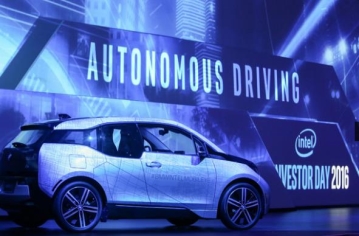
SK Telecom to Develop 5G AI-Based Autonomous Vehicles with Intel
SK Telecom has partnered with Intel, a global semiconductor chip manufacturer, to jointly develop autonomous driving technology based on 5G and deep learning. SK Telecom (CEO Park Jae-young, www.sktelecom.com) announced that it has signed a memorandum of understanding (MOU) with Intel (CEO Brian Krzanich), a global semiconductor chip manufacturer, for joint research and development of autonomous driving technology and services.
2016.10.31by 신윤오 기자
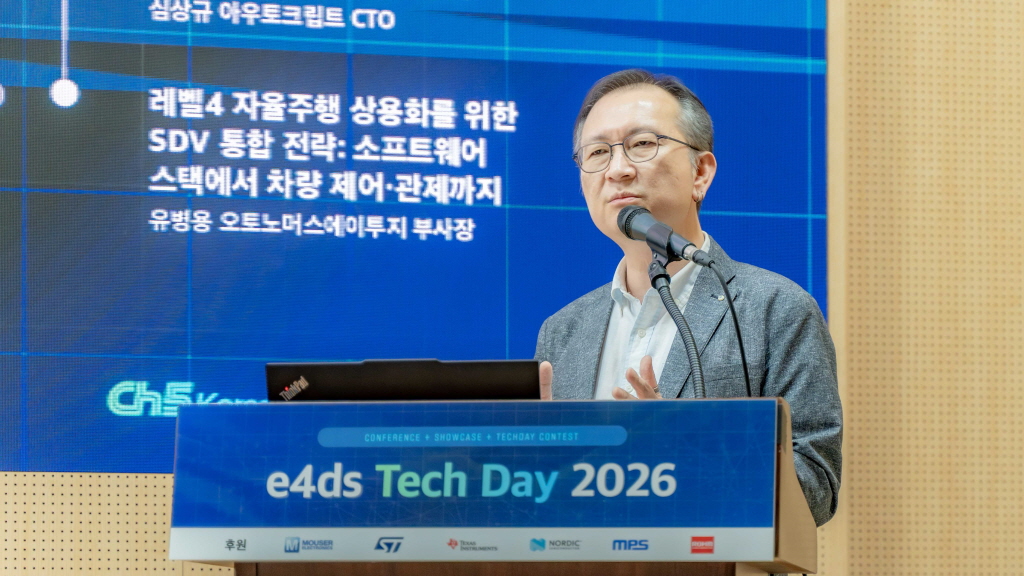
[e4ds Tech Day 2026 ⑨] Sim Sang-gyu, Autocrypt CTO: "In the Physical AI Era, Automotive Security Must Extend Beyond the Vehicle"
At e4ds Tech Day 2026, Sim Sang-gyu, CTO of Autocrypt, explained automotive cybersecurity strategies in the era of Physical AI and SDV (Software-Defined Vehicle). Automobiles are evolving as part of an ecosystem connected to AI, cloud, chargers, IoT, and robots, and he emphasized that the scope of security must expand beyond the vehicle interior to the entire connected environment. In particular, AI model tampering, adversarial attacks, OTA updates, and EV charger hacking were identified as major threats. He explained that response measures require zero trust, AI model integrity protection, intrusion detection, Security by Design and Default, and full lifecycle security management, and that proactive security system establishment beyond regulatory compliance is critical for securing future mobility competitiveness.
2026.10.12by 배종인 기자

Practical HIL Construction Strategy for Automotive and Off-Highway Controller Validation
As vehicle E/E architecture transitions to zonal structures and shifts to software-defined vehicles (SDV), the number of controllers (ECUs) requiring validation and software complexity are surging dramatically. Meanwhile, real vehicle testing cannot provide repeated verification under identical conditions and entails lead time and safety concerns. This white paper explains the principles of HIL (Hardware-in-the-Loop) validation and the structure of the NI platform composed of PXI, SLSC, and VeriStand, and through two actual implementation cases—Camera Record & Replay HIL for In-Cabin Monitoring Controller (ICMU) and Forklift Controller (VCU) HILS—describes how controller-level regression testing becomes possible. Additionally, it explicitly states application boundaries and limitations, such as lack of A2B support.
2026.10.12by 편집부











