


Industrial IoT Platform, Please Build a 'Smart Factory' for Our Plant
 Published2016.12.05 11:16
Smart factories projected to grow 6.8% annually; Korea to establish 10,000 smart factories by 2020
As the global market size for IoT-based smart factories is expected to grow by 6.8% annually, the importance of industrial IoT platforms is also increasing.
Technologies for 'data integration, analysis, and interoperability with higher-level systems' based on industrial IoT platforms have emerged as a core element of manufacturing processes. This is due to the rise of smart factories, incorporating various IoT-based convergence technologies, as the paradigm of future manufacturing, as cost reduction and productivity improvement have become major issues in the manufacturing industry.
It is pointed out that for the practical implementation of a smart factory that integrates the entire process of product planning, design, manufacturing, distribution, and sales into IT, it is essential to apply the OPC UA standard for data integration and to perform analysis work through big data and machine learning.
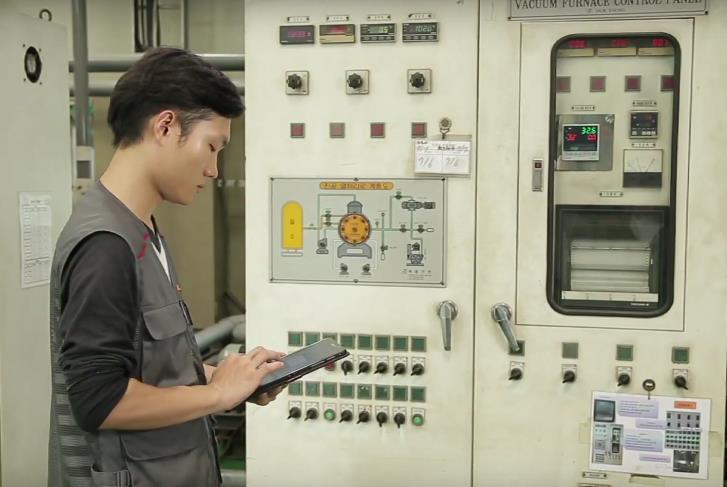
Korea aims to establish 10,000 smart factories by 2020 through the public-private collaborative smart factory promotion team.
(Photo captured from a promotional video for a public-private collaborative smart factory)
The smart factory industry is already gaining momentum. Countries around the world are seeking ways to propel the manufacturing sector forward as a new national growth engine. The size of Korea's smart factory market is projected to reach $4.4 billion in 2018 from $2.4 billion in 2012, while the global market is expected to grow from $155.2 billion in 2012 to $246 billion in 2018. Korea, which is promoting Manufacturing Innovation 3.0 and the development of smart manufacturing technologies, aims to build 10,000 smart factories by 2020 through the public-private collaborative Smart Factory Promotion Team.
Germany has championed 'Platform Industry 4.0' and presented usable results regarding references, standards, research, security, and workforce development, while the United States is strengthening its manufacturing competitiveness by promoting manufacturing component policies and launching smart manufacturing research projects under the slogan 'Remaking America'.
Japan is supporting facility investment to strengthen manufacturing competitiveness and strengthening R&D investment, while China has established a top-down strategic response across the entire manufacturing sector, as well as ten major development strategies including next-generation IT technology, advanced CNS machine tools, and robots.
Software and IoT platforms designed and developed to share generated data and information
As such, Industrial IoT has become necessary to achieve increased productivity, energy savings, and customized manufacturing through the integrated linkage of equipment, process information, external systems, and simulations, as well as real-time sensing and control. IoT platforms, which are software designed and developed to network objects with objects and people with objects to share generated data and information in real time, form the foundation of Industrial IoT.
This means that the process of data integration, transmission, storage, distribution, analysis, and visualization is carried out through an industrial IoT platform. First, data from field equipment is integrated into OPC UA, a global standard for industrial IoT and a core communication technology for realizing smart factories, and then transmitted to the platform. The platform stores the data in its own database or various external databases, while simultaneously transmitting the data directly to external systems that require it. Service applications (SCADA/HMI, Dashboard, etc.) display web socket data in real time, and the analysis platform analyzes the streamed data and integrates the results into the service application UI.
Data must be integrated, and field experience must be overcome with IT technology.
In particular, OPC UA is attracting attention as a communication standard for data integration. It was created in response to the need for a single protocol for interoperability and to address issues related to data integration and operation in environments using various industrial protocols. As an interoperability standard for reliable data exchange and security in industrial fields across diverse sectors, OPC UA serves as a platform for seamless communication between devices manufactured by various companies.
Hyun Jae-young, Managing Director of MDS Technology, who spoke at the Embedded SW & Industrial Convergence Conference, said, “The construction of a smart factory must proceed through a process that starts with data collection by an equipment monitoring system in the first stage, analysis and visualization by an equipment diagnostic monitoring system in the second stage, and process data integration and learning by an equipment predictive diagnostic monitoring system in the third stage.”
Furthermore, Executive Director Hyun emphasized that when building a smart factory, one must consider "defining the current level of the factory and setting goals, and starting with small steps," adding that "data must first be integrated, and on-site experience must be overcome through IT technology."
Comments
Related news
[CASE STUDY] Robots are the central axis of the 'Smart Factory,' innovation in the manufacturing field.
A 'smart factory' is a manufacturing system that integrates the entire manufacturing process—from product planning and design through production, distribution, and sales—using ICT (Information and Communications Technologies). Through systems equipped within the factory and sensors installed on machinery, a 'smart factory' autonomously controls production and processes while managing workplace safety. It is truly a 'smart factory' in the literal sense of the word.
2016.01.28by 명세환 기자
What are the power requirements for implementing a smart factory automation system?
In our country, as manufacturers introduce sensors and new control structures, production site systems are becoming increasingly smart. In this process, industrial form factors are shrinking to incorporate more functions, and there is a growing trend of configuring boards with fewer components in that constrained space.
2016.03.28by 명세환 기자
[Reporter's Notebook] How Telecom Companies Approach the Industrial IoT Market
In fact, it is easy to overlook that the industrial market in the Internet of Things (IoT) sector is several times larger than the consumer home market with which we are more familiar. This is likely why market research firms are forecasting that the industrial IoT market will open up faster and on a larger scale. Industrial IoT holds an important position in the concepts of Industry 4.0 and smart factories that are currently sweeping through the industrial sector.
2016.11.28by 신윤오 기자
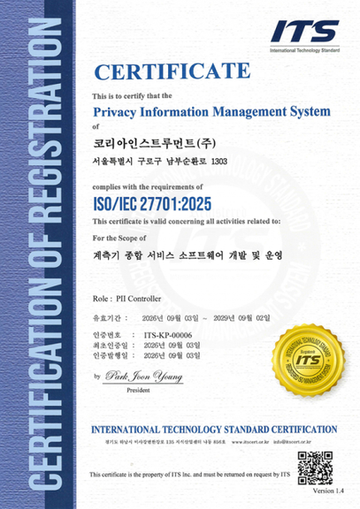
Korea Instrument, KOLAS Accredited Calibration Agency First to Simultaneously Acquire ISO/IEC 27,001·27,701
Korea Instrument has become the first among KOLAS accredited calibration agencies to simultaneously acquire ISO/IEC 27,001 and ISO/IEC 27,701 certifications. Through its proprietary platforms CWIZ Enterprise and CWIZ Partners, the company has embedded information security and personal data protection requirements across all business processes including customer information, equipment data, and calibration reports, with plans to continuously advance its management system through regular audits and security inspections.
2026.10.12by 배종인 기자

TeamViewer One, IT Incident Automation Workflow and Resolution Center Enhanced
TeamViewer has added IT incident automation capabilities and an advanced Resolution Center to its integrated digital workplace management platform 'TeamViewer ONE'. Recurrent service disruptions, configuration errors, and capacity shortages are automatically handled according to preset policies, and device status verification through script deployment can be managed in a unified interface, significantly reducing repetitive tasks for IT teams.
2026.10.12by 배종인 기자











