



[2017 Outlook] Artificial Intelligence Begins Realizing the 'AI First' Era with Voice Assistant Services at the Forefront
 Published2016.12.05 14:10
Market expansion in AI, 5G, MR, autonomous vehicles, biometric authentication, etc.
The KT Economic and Management Research Institute announced the top 10 ICT issues to watch in 2017.
The research institute noted that many people are paying attention to the emergence of new ICT technologies to succeed smartphones, and predicted that in the future, various rather than a single ICT technology will converge to create services and devices and generate new markets. From this perspective, it was stated that 2017 appears to be a year preparing for the emergence of a new paradigm, with the coexistence of 'Revolution,' which provides unprecedented value, and 'Evolution,' which makes existing things more convenient.
In forecasting the top 10 ICT issues to watch in 2017, it was predicted that “artificial intelligence is expected to be applied to our lives and industries with advanced algorithms to realize the ‘AI First’ era, and 5G, which is attracting attention as a next-generation network, will appear before us as concrete services along with the establishment of standards.”
It was also reported that MR (Mixed Reality) offers a completely different experience and fun compared to VR and AR, autonomous vehicles are expected to fundamentally overturn the 130-year paradigm of the automotive industry, and biometric authentication will become a new alternative to the growing threats to personal information.
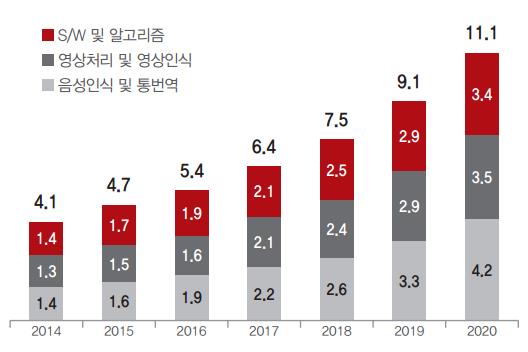
▲ Domestic AI Market Size (Reconstructed by KT Economic & Management Research Institute, Unit: Trillion Won)
Fintech, which sparked innovation through the convergence of ICT and finance, is evolving into Fintech 2.0 by meeting with innovative ICT technologies such as artificial intelligence and IoT. O2O and commerce will evolve to the next level through big data into personalized O2O and data commerce optimized for individuals, and the market size is expected to expand further. IoT will expand into the Industrial Internet of Things (IIoT) and the Internet of Small Things (IoST), laying the foundation for the popularization of IoT. Finally, platforms, the core of the ICT ecosystem, are expected to become the driving force of the Fourth Industrial Revolution, leading new growth across various industrial sectors through business transformation.
1. Artificial Intelligence; Realizing AI First through ecosystem building and service innovation via voice assistants
In 2017, artificial intelligence is expected to achieve an "AI First" trend, spearheaded by voice assistant services, where AI plays a key role in the use of products, messengers, commerce, and content. Competition among operators to build ecosystems centered on voice assistants, extending to home IoT and connected cars, is set to intensify, and new service paradigms such as "personalization," "prediction," and "self" are expected to gain attention.

▲ Amazon Echo (Homepage)
Furthermore, with growth expected centered on new convergence industries such as smart health and B2B for business efficiency, the development and launch of various convergence services, including smart health and autonomous vehicles, are projected to continue.
Key points to watch
1. Competition to build a voice assistant-centric ecosystem begins
2. Driving the Shift in Service Paradigms: Hyper-personalization, Predictiveness, and Self-service
3. Growth expected centered on B2B business
2. Next-Generation Network 5G; An Intelligent Network That Makes Everything Imaginable Possible
5G is a next-generation mobile communication technology that is approximately 270 times faster in transmission and more than 30 times faster in latency compared to LTE. 2017 is the year when the foundation for international standards for 5G, which will become a core infrastructure of the future, is laid. As such, operators around the world are expected to engage in fierce competition to form alliances and secure allies to gain the upper hand in 5G. In addition, the development of 5G services and devices to be showcased at PyeongChang in 2018 is also expected to proceed in earnest. The biggest issues surrounding 5G in 2017 will be the competition for leadership in 5G standards among Korea, the United States, Japan, and China, as well as the development of devices and services that will maximize the attributes of 5G.
Key points to watch
1. 5G, Who Will Lead the Market?
2. 5G services currently under full-scale development for commercialization
3. MR (Mixed Reality); The inaugural year of mass adoption to be completed through the collaboration of devices, platforms, and content
2017 is expected to see the emergence of various products and services heralding the popularization of the MR market. Currently, the MR market is bustling with competition among operators to secure an early market lead. In the future, the MR market is expected to be dominated by goggle-type HMDs capable of self-computing. Furthermore, the market will face a new turning point as Windows emerges as a mainstream platform alongside holographic-based UIs, while dominance in the enterprise sector expands into the general consumer market. Meanwhile, significant investment continues in discovering "killer content" to overcome the "Chasm," bringing the popularization of MR even closer.
Key points to watch
1. Popularization of self-computing goggle-type MR HMDs
2. MS Windows emerges as a mainstream platform with holographic-based UI
3. The foundation laid by enterprise content expands into the general consumer market
4. Autonomous Car; The autonomous car market is blossoming, centered on the B2B market
In 2017, autonomous vehicles are expected to see their technological capabilities further strengthened and concrete development movements accelerated due to the efforts of related companies to expedite commercialization. Autonomous vehicle developers, including automakers, ICT firms, and parts and equipment manufacturers, are pursuing close collaboration and investment to secure differentiated technological capabilities. As ensuring the safety and security of autonomous vehicles becomes a hot topic, the market is expected to blossom first, primarily driven by the B2B sector.
Key points to watch
1. The autonomous vehicle market will open first, targeting the B2B market.
2. The hot keyword for autonomous vehicles is securing security.
5. Bio Authentication; My Body Authenticates Me, The Popularization of the Bio Authentication Era
Biometric authentication technology is a technology that identifies or authenticates individuals by extracting their physical and behavioral characteristics using automated devices such as cameras, touchpads, and speakers. With the recent increase in interest regarding personal information protection,
Accordingly, its utility is increasing. In the future, various biometric authentication methods are expected to compete for dominance based on their high security performance. In 2017, various biometric authentication methods are expected to compete for market leadership. While fingerprint authentication is currently the leading biometric authentication technology on the surface, it is projected that biometric authentication technology will become deeply embedded in daily life as the utilization of new technologies, such as iris and voice authentication, increases in the future.
Key points to watch
1. Fingerprint authentication replacing accredited certificates in payments and finance.
2. The rapid rise of new biometric authentication methods with enhanced security and convenience
6. FinTech 2.0; Redesigning Finance Through Collaboration
While Fintech 1.0 focused on the deconstruction and reinterpretation of existing financial services through disruptive innovation in areas such as remittance, payment, funds, and asset management via the combination of ICT and finance, Fintech 2.0 aims to create new consumer-centric value in a mobile environment through diverse collaborations between existing financial institutions and fintech companies using innovative technologies, and
The goal is to provide financial services. First, consumers can easily access the innovative financial services they need by utilizing new ICT technologies (SNS, cloud, IoT, smartphones, etc.). Second, primary customers of existing financial institutions are also showing an increasing preference for and use of mobile financial transactions. Third, following the 2008 financial crisis, consumer concerns regarding the credibility and profitability of traditional financial institutions have risen, leading to increased interest and demand for alternative financial services that can address these issues. Finally, governments around the world have begun providing policy support for the nurturing of fintech and startups as a tool for job creation, while simultaneously securing new engines for industrial growth.
Key points to watch
1. Increase in full-scale collaboration between financial institutions and fintech companies
2. Fintech, the emerging core technology is.
7. O2O (Online to Offline); Optimal consumption for 'me' that takes place anywhere, online or offline
O2O refers to the phenomenon of combining online and offline experiences. As the number of consumers seeking to enjoy shopping under optimal conditions by seamlessly transitioning between online and offline channels is rapidly increasing, O2O is emerging as a key competitive factor in the commerce sector. O2O is evolving into a platform through service alliances, and 'personalized O2O' and omnichannel integration of online and offline experiences are expected to become the mainstream trend. In line with new trend changes, such as the increase in single-person households, 'personalized O2O' services are emerging as the dominant trend. New technologies, such as virtual reality, are expected to accelerate the 'omnichannelization' of O2O.
Key points to watch
1. Evolving into a platform business through service alliances
2. Evolution into 'Personalized O2O' Services
3. Omni-channel offering an integrated online-offline experience is the trend
8. Data Commerce (D-Commmerce); The Convergence of Big Data and Commerce, the Advent of the Curation Commerce Era
Data commerce, which induces purchases and provides customized products through big data analysis, is a new trend in the commerce market. Recently, it has evolved from simple product recommendations into brokerage platforms that recommend products tailored to individual lifestyles based on devices, time of day, and content, and connect users with companies. Furthermore, as 'smart rental' rapidly emerges as a new consumption trend, customized rentals utilizing big data are also appearing.
It is evolving from a past model of recommending products based on expert knowledge and intuition to a more accurate and smart commerce through big data analysis.
Overpriced points
1. The Evolution of Curation Commerce
2. Location-based services utilizing big data
3. A New Trend in the Commerce Market: Utilization of Big Data in Smart Rental
9. Industrial Internet of Things (IIoT), Internet of Small Things (IoST); Competition to Dominate the Industrial Internet and IoT Markets Intensifies
2017 will be a year in which the Internet of Things (IoT) sees diverse competition centered on the Industrial Internet of Things (IIoT) and the Internet of Small Things (IoST). In the IoT sector, competition between LoRa and NB-IoT is expected to come to the forefront. Subsequently, competition related to the provision of Industrial Internet platforms and services will become increasingly important, and key issues will emerge regarding an understanding of industrial domains, the possession of security and analytics solutions, and the securing of successful case studies. Building on the active competition to establish nationwide IoT networks, such as LTE-M and LoRa, throughout 2016, it is projected that 2017 will see even fiercer competition as new networks, such as NB-IoT, join the fray.
Key points to watch
1. NB-IoT vs. LoRa, Who Will Be the Winner of the Internet of Things?
2. The Core of Industrial Internet Platforms: Security and Analytics
10. Platform Economy; The Core of the Fourth Industrial Revolution, Platform Services
As the trading of goods and services based on digital technology takes place through networks, the need for various technological expansions and ensuring interoperability has increased across society, politics, and the economy. Platforms that connect businesses and consumers through networks and manage the supply and demand of products and services are leading the economy. The platform economy is acting as the driving force of the Fourth Industrial Revolution, creating new value and markets and driving corporate growth through 'business transformation.'
Key points to watch
1. Global companies seeking to transition into platform operators
2. Leap to a Global Platform and Challenges
Comments
Related news
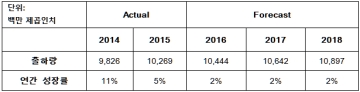
Wafer shipments projected to record moderate annual growth through 2018
The Semiconductor Equipment and Materials International (SEMI) recently announced its annual silicon wafer shipment forecast for the semiconductor industry. The report contains forecasts for silicon demand between 2016 and 2018. According to SEMI's projections, the total area shipments of polished and epitaxial silicon wafers are forecast at 10.444 billion square inches in 2016, 10.642 billion square inches in 2017, and 10.897 billion square inches in 2018 (see table). Total wafer shipments this year are expected to exceed the record levels achieved in 2015, and this elevated level of shipments is projected to continue in 2017 and 2018 as well.
2016.10.14by 신윤오 기자

What are the top 10 predictions to watch out for since 2017?
Gartner Inc., a leading global IT advisory firm, has announced its top 10 strategic predictions to watch beyond 2017. Gartner's key predictions for 2017 evaluate the fundamental impact of secondary effects resulting from three ongoing digital revolutions: ▲experience and engagement ▲business innovation ▲and digital capability enhancement. Daryl Plummer, Executive Vice President and Gartner Fellow and Chief Research Officer, stated, "Gartner's strategic technology predictions continue to provide provocative insights into emerging possibilities in the most critical areas of technology evolution. The concept of digital disruption, which has transformed into a wave of constant change that redefines markets and entire industries, is key to future performance." He added, "Last year, Gartner forecasted that digital change would arrive rapidly. This year, acceleration will continue, and secondary effects that broadly impact people and technology may occur."
2016.10.20by 김수지 기자
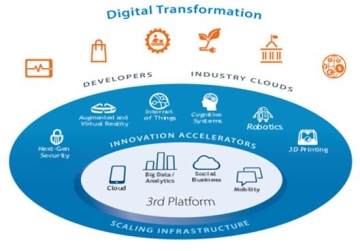
[2017 Outlook] Leading the Way as a Smart Company by Leading IoT and Artificial Intelligence
Korea IDC (CEO Hong Yoo-suk) introduced "Korea IDC's Top 10 Predictions for 2017," highlighting major issues and trends expected in the domestic IT market for 2017. Jang Soon-yul, Senior Managing Director overseeing the research group at Korea IDC, stated, "While the low-growth trend in the IT market continues, the traditional IT market faces difficulties in growth. However, the third-platform-based technology market driving digital transformation—including cloud, mobility, big data analytics, and social—is leading IT investments." He added that digital transformation (DX) is exerting significant impact on the macroeconomy through the digital economy (DX Economy).
2016.12.05by 김수지 기자

[e4ds Tech Day 2026 ⑨] Sim Sang-gyu, Autocrypt CTO: "In the Physical AI Era, Automotive Security Must Extend Beyond the Vehicle"
At e4ds Tech Day 2026, Sim Sang-gyu, CTO of Autocrypt, explained automotive cybersecurity strategies in the era of Physical AI and SDV (Software-Defined Vehicle). Automobiles are evolving as part of an ecosystem connected to AI, cloud, chargers, IoT, and robots, and he emphasized that the scope of security must expand beyond the vehicle interior to the entire connected environment. In particular, AI model tampering, adversarial attacks, OTA updates, and EV charger hacking were identified as major threats. He explained that response measures require zero trust, AI model integrity protection, intrusion detection, Security by Design and Default, and full lifecycle security management, and that proactive security system establishment beyond regulatory compliance is critical for securing future mobility competitiveness.
2026.10.12by 배종인 기자
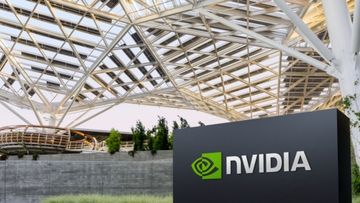
NVIDIA to Invest $1 Billion in U.S. Science Over Next Five Years
NVIDIA has announced plans to invest $1 billion over the next five years to strengthen U.S. scientific and technological competitiveness. The company will enhance cutting-edge artificial intelligence research and development capabilities in key areas including quantum computing, healthcare, and energy security, while expanding support for higher education research institutions and cloud service providers. NVIDIA is participating as a major industry partner in the White House Office of Science and Technology Policy's Genesis Mission, and is promoting supercomputer construction in collaboration with national laboratories including Argonne and Los Alamos.
2026.10.12by 배종인 기자











