


NVIDIA and Tesla GPU-equipped Titan supercomputers utilized for next-generation biofuel research
 Published2016.12.12 06:39
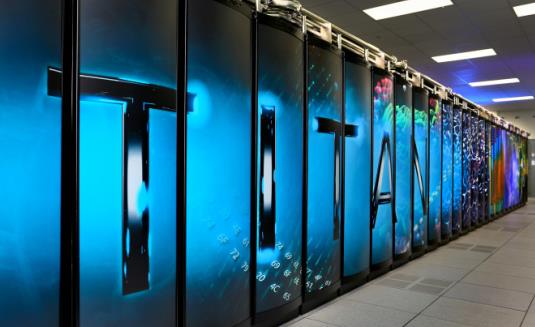
NVIDIA (CEO Jensen Huang) announced that the Titan supercomputer, accelerated by Tesla GPUs, plays a key role in the next-generation biofuel development research being conducted by Dr. Jeremy Smith of Oak Ridge National Laboratory.
Ethanol, which Henry Ford, the founder of the American automobile company Ford, once called the "next-generation fuel," is a biofuel extracted from corn that can be utilized in a wide range of fields as a renewable transportation fuel. However, the biomolecular structural characteristics of ethanol act as an obstacle to mass-producing it at a level where it can generate economic value. Dr. Jeremy Smith, a scientist at Oak Ridge National Laboratory under the U.S. Department of Energy (DOE), conducted research to overcome this problem using the supercomputer Titan.
Dr. Jeremy Smith and a research team at the BioEnergy Science Center (BESC) under the U.S. Department of Energy utilized the supercomputer Titan to conduct the largest and most complex biomolecular simulations in history at a very detailed level.
The focus of this research is lignin, a major component of plant cell walls. A critical part of the process in which plant raw materials are converted from monosaccharides into the biofuel ethanol is the breakdown of cellulose. However, the plant cell walls composed of lignin play a role in blocking cellulose-degrading enzymes. Therefore, extracting lignin is key to cost-effective ethanol production.
Dr. Jeremy Smith's research team was able to conduct large-scale observations on the binding properties of lignin by simulating a biomass system composed of 23.7 million atoms using the Titan supercomputer. The team combined the insights gained from this simulation with other experimental results to develop new chemical pretreatments and improve biofuel yields.
The study results showed that in an experimental mixture of tetrahydrofuran (THF) and water and a 250,000-atom model composed of lignin, the mixture acted as a barrier between the water and the lignin. In other words, if a solvent such as THF is used as a buffer, lignin can be easily removed during the biofuel processing.
This model also revealed that lignin exhibits selective binding preferences and shows a high preference for crystalline cellulose fibers. This detailed information would have been impossible to ascertain without large-scale computer simulations conducted on Titan, a supercomputer equipped with NVIDIA Tesla GPUs.
Dr. Jeremy Smith's research team also observed the mechanism of lignin's action using a relatively small-scale simulation model of 200,000 atoms. By comparing lignin with hemicellulose, another major component of plant cell walls, in natural and genetically modified biomass systems, the team derived insights into how the hydrophobicity or water repellency of modified lignin can increase biofuel yields. These insights are expected to be useful for subsequent research aimed at making plants easier to decompose during the biofuel production process.
Comments
Related news
NVIDIA and Microsoft Partner to Accelerate AI Development
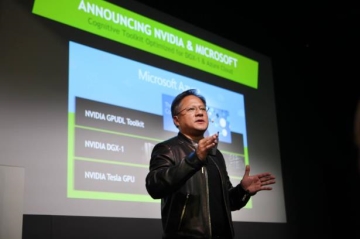
Nvidia announced a partnership with Microsoft to accelerate AI advancement in the enterprise sector. The company stated that this enables more enterprises to participate in the AI revolution. Through this collaboration, enterprises can now leverage optimized enterprise AI frameworks designed to run on Nvidia Tesla GPUs on Microsoft Azure or On-Premises environments, allowing them to maintain an AI platform spanning from their own data centers to the Microsoft cloud.
2016.11.17by 신윤오 기자
Nvidia Collaborates with IBM to Develop New Deep Learning Tool
Nvidia (CEO Jensen Huang) announced that it is collaborating with IBM to develop new deep learning tools optimized for the latest technologies from both IBM and Nvidia. This collaboration aims to rapidly train computers to think and learn in a manner more similar to humans. Deep learning is a rapidly growing machine learning approach that extracts information by segmenting data into millions of pieces and detecting the most critical aspects of the data to rank them according to importance. Supported by public endorsements from leading consumer web and mobile application companies, deep learning is rapidly being adopted in traditional enterprises as well.
2016.11.22by 김수지 기자
NVIDIA Tesla GPUs to Run on Google Cloud Platform Early Next Year
Nvidia (CEO Jensen Huang) announced that Nvidia Tesla P100 GPU and Tesla K80 GPU will be operational on Google Cloud Platform starting in the first half of next year. With the ability to leverage the powerful performance of Nvidia's Pascal GPU architecture in the cloud, enterprises now have another excellent option to utilize data for business purposes and use AI services for development.
2016.11.22by 신윤오 기자
.jpg)
SalePoint Signs Multi-Year Partnership Agreement with AWS… Promoting Identity Security that Integrates Even AI Agents
Sailpoint has entered into a multi-year strategic partnership agreement with AWS and is moving forward with establishing an integrated governance system that manages both human and non-human identities together. The plan is to consistently manage access permissions in an environment where AI agents are increasing as work execution entities, while applying the principle of least privilege and automated policy enforcement. The two companies plan to jointly expand capabilities to manage the identities of various entities, including AI agents, within a single layer in the AWS environment. This collaboration is interpreted as a move to design security and governance together in corporate environments where AI adoption is expanding.
2026.03.26by 배종인 기자
.png)
Databricks Unveils Open AI Security Monitoring 'Lakewatch'
Databricks entered the security market on March 24 by unveiling LakeWatch, an open-source agentic SIEM. The core functionality of this product is to integrate and analyze security, IT, and business data in a single environment to support AI-based threat detection and investigation. The company explained that it reduces the limitations of existing security operations centers, which have had to forgo some data due to high cost structures, and enables large-scale data analysis and automation based on open formats and ecosystems. LakeWatch is currently offered as a private preview, with Adobe and Dropbox mentioned as early customers. Databricks also announced an expanded partnership with Anthropic as well as the acquisition of Antimatter and SiftD.ai.
2026.03.26by 배종인 기자











