



Global cloud traffic increased approximately fourfold in 2020, accounting for 92% of data center traffic.
 Published2016.12.20 17:52
Enterprise Workloads Increase 2.4-fold - IoT Analytics Databases Account for a Large Share
Cisco has released the 'Cisco Global Cloud Index 2015-2020,' which analyzes the growth and trends of global data center and cloud traffic.
In this report, Cisco projected that global cloud traffic will increase 3.7-fold by 2020, rising from 3.9 zettabytes (ZB) per year in 2015 to 14.1 ZB per year in 2020. The company analyzed that migration to cloud architectures has increased because the cloud can support more workloads and scale rapidly compared to traditional data centers.
In addition, as operational efficiency increases due to the expansion of data center virtualization, cloud operators are expected to be able to flexibly provide various services to corporate and individual users with optimal performance.
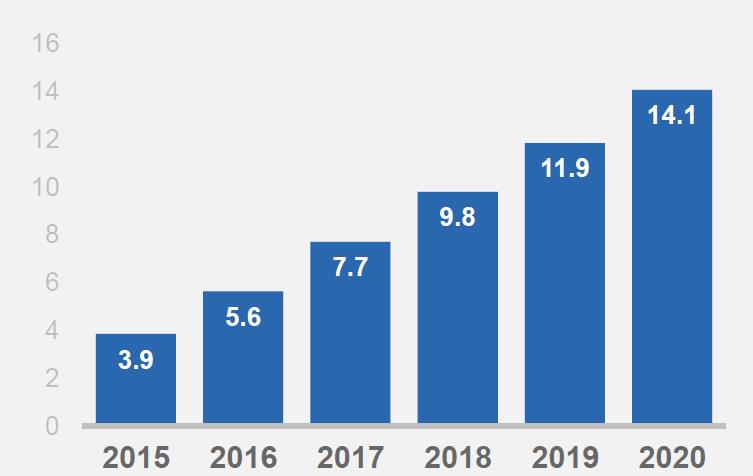
▲ Global Cloud Traffic Growth: In 2020, cloud traffic grew 3.7-fold compared to 2015, accounting for 92% of total data center traffic.
(Annual compound growth rate 30% 2015–2020, Unit: zettabytes)
According to the report, corporate workloads are expected to increase 2.4-fold from 2015 into 2020. Of the enterprise workloads and consumer user workloads that make up the total data center workload, the share of enterprise workloads is expected to decrease slightly from 79% in 2015 to 72% in 2020, but enterprise workloads are still expected to account for a significant portion of the data center workload.
In enterprise workloads, IoT, analytics, and database workloads are projected to increase from 20% in 2015 to 22% in 2020, with collaboration and computing workloads accounting for a large share.
IoT, analytics, and database workloads among enterprise workloads have increased significantly.
Video and social media workloads account for a significant portion of personal user workloads.
Although individual user workloads are smaller in scale compared to enterprise workloads, their share of total data center workloads is expected to increase significantly from 21% (38.6 million) in 2015 to 28% (134.3 million) in 2020. In particular, video streaming workloads are projected to grow from 29% in 2015 to 34% in 2020, and social media workloads are expected to grow from 20% in 2015 to 24% in 2020, with these two sectors driving the growth of individual user workloads. Conversely, the share of search workloads is forecast to decrease from 17% in 2015 to 15% in 2020.
Cisco quantified the impact of hyperscale data centers for the first time this year [1] and released the analysis results. Global hyperscale data centers are expected to increase from 259 in 2015 to 485 in 2020, and traffic is expected to increase about fivefold over the next five years. Hyperscale infrastructure is expected to account for 47% of all data center servers and support 53% of data center traffic by 2020.
In addition, Cisco focused on infrastructure trends that will drive changes in data centers, including hyperscale. Software-Defined Networking (SDN) and Network Functions Virtualization (NFV) are expected to transform data center architectures and streamline traffic flow, with approximately 60% of hyperscale data centers worldwide projected to deploy SDN and NFV solutions by 2020. Furthermore, as data center operators continue to seek increased operational efficiency, traffic supported by SDN and NFV platforms within data centers is expected to rise from 23% in 2015 to 44% over the next five years.
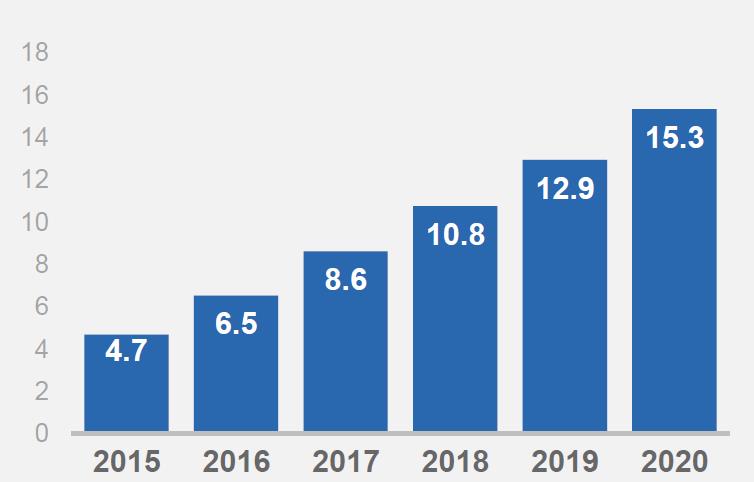
▲ Global Data Center Traffic Growth 2015-2020, Data Center Traffic Grew More Than Threefold
(Annual compound growth rate 27% 2015–2020, Unit: zettabytes)
Cisco announced the rankings of the top 10 countries for fixed and mobile networks worldwide based on average download, upload, and latency speeds. For the top 10 countries, the average download speed for fixed networks is 66 Mbps, the average upload speed is 56 Mbps, and the average latency is 21 ms; for mobile networks, the average download speed is 29 Mbps, the average upload speed is 14 Mbps, and the average latency is 47 ms.
Significant increase in hyperscale data centers and traffic by 2020
Korea Leads in Fixed/Mobile Network Technology... Ready for Cloud
Korea ranked in the top 10 in both fixed and mobile network sectors. Korea's fixed network recorded an average download speed of 60 Mbps, an average upload speed of 53 Mbps, and an average latency of 21 ms. Additionally, mobile networks recorded an average download speed of 31 Mbps, an average upload speed of 14 Mbps, and an average latency of 68 ms.
"When Cisco began this survey six years ago, cloud computing was merely an nascent technology. However, it has now evolved into a core architectural element that provides scalability and flexibility to all telecommunications operators worldwide," said Jae-Beom Park, Vice President of the Telecommunications Business Unit at Cisco Korea. "Going forward, as telecommunications operators improve their infrastructure to provide proper IP-based services to enterprise and individual users, large-scale cloud migration and an increase in network traffic are expected to accelerate due to factors such as video, IoT, SDN, and NFV."
Comments
Related news
Growth in global cloud IT infrastructure spending, with a large share of public cloud data centers
According to IDC's (www.idc.com) recent forecast report, global IT infrastructure product spending (servers, storage, Ethernet switches) for building cloud environments is expected to increase 16.2% in 2016 and reach $37.4 billion in scale. The public cloud data center segment is projected to grow 18.6% and account for 62.6% of total spending, while IT infrastructure spending for building off-premises cloud environments (public and private) is forecasted to reach $28.4 billion in 2016, the report ('Worldwide Quarterly Cloud IT Infrastructure Forecast') revealed.
2016.10.20by 김수지 기자

NVIDIA Tesla GPUs to Run on Google Cloud Platform Early Next Year
Nvidia (CEO Jensen Huang) announced that Nvidia Tesla P100 GPU and Tesla K80 GPU will be operational on Google Cloud Platform starting in the first half of next year. With the ability to leverage the powerful performance of Nvidia's Pascal GPU architecture in the cloud, enterprises now have another excellent option to utilize data for business purposes and use AI services for development.
2016.11.22by 신윤오 기자

Oracle Launches New Cloud Platform to Accelerate Cloud Transition
Oracle (www.oracle.com/kr) announced major innovations across the Oracle Cloud Platform at Oracle Open World, and through these new features will support enterprises in operating mission-critical applications in the cloud. The core of Oracle's PaaS (Platform-as-a-Service) solution is the new DBaaS (Database-as-a-Service) using Oracle Database 12c Release 2. Oracle's new database is available for the first time in the cloud, enabling enterprises of all sizes to leverage database technology with superior performance, scalability, and reliability in a cost-effective and flexible cloud environment.
2016.11.23by 홍보라 기자
.jpg)
SalePoint Signs Multi-Year Partnership Agreement with AWS… Promoting Identity Security that Integrates Even AI Agents
Sailpoint has entered into a multi-year strategic partnership agreement with AWS and is moving forward with establishing an integrated governance system that manages both human and non-human identities together. The plan is to consistently manage access permissions in an environment where AI agents are increasing as work execution entities, while applying the principle of least privilege and automated policy enforcement. The two companies plan to jointly expand capabilities to manage the identities of various entities, including AI agents, within a single layer in the AWS environment. This collaboration is interpreted as a move to design security and governance together in corporate environments where AI adoption is expanding.
2026.03.26by 배종인 기자
.png)
Databricks Unveils Open AI Security Monitoring 'Lakewatch'
Databricks entered the security market on March 24 by unveiling LakeWatch, an open-source agentic SIEM. The core functionality of this product is to integrate and analyze security, IT, and business data in a single environment to support AI-based threat detection and investigation. The company explained that it reduces the limitations of existing security operations centers, which have had to forgo some data due to high cost structures, and enables large-scale data analysis and automation based on open formats and ecosystems. LakeWatch is currently offered as a private preview, with Adobe and Dropbox mentioned as early customers. Databricks also announced an expanded partnership with Anthropic as well as the acquisition of Antimatter and SiftD.ai.
2026.03.26by 배종인 기자











