


Wind River Achieves Leading Market Share in RTOS and Embedded Linux
 Published2017.01.11 09:56
IoT and embedded operating systems provide the software foundation for billions of new devices, including Internet of Things devices, that emerge every year.
According to VDC Research, a global market research firm, the global embedded OS market size is expected to grow from $13.3 billion in 2016 to $19.3 billion in 2020.
Wind River, an Intel subsidiary and leading provider of specialized software for the Internet of Things (IoT), announced that it recorded the highest market share worldwide in terms of revenue in two segments: embedded real-time operating systems (RTOS) and commercial embedded Linux, citing analysis from VDC Research's recent report, "Global IoT and Embedded OS Market Report."

▲Capture of Wind River homepage
According to VDC, Wind River has been leading the market in the existing RTOS sector for several years based on global sales of VxWorks, the market-leading RTOS, and related services.
In addition, the Wind River Linux platform has maintained a market share of over 50% in the embedded global Linux market for eight consecutive years. In particular, the report details Wind River's contributions to the Linux Foundation, including the recently released free version of Wind River Pulsar Linux.
The report also notes the growth of the automotive and automotive markets. The report explains that Wind River is aggressively expanding its presence in the connected car space in 2016 by releasing the Wind River Helix Chassis framework, which provides comprehensive capabilities for connected cars.
Wind River CEO Park Joo-dong, the most important driving force leading the 'software-defined era'
Wind River has long maintained a unique competitive edge in the embedded industry by providing a comprehensive product portfolio that encompasses edge-to-cloud-software. At the heart of this portfolio is the VxWorks family of products, which provide the scalability, reliability, security for devices, and virtualization capabilities essential to address the many challenges faced when building intelligent, connected systems today.
Also, the Linux product line, consisting of runtime functions and software tools based on expertise accumulated for more than 30 years, is centered on key technologies required and optimized for each different specific industry group, and plays a key role in the stringent carrier-grade solutions required by telecommunications companies, open virtualization, security, and automotive markets.
Park Joo-dong, President and CEO of Wind River, said, “Wind River’s leadership in the global embedded software market is proof that Wind River is successfully responding to the needs and demands of the rapidly evolving IoT market. Wind River’s inherent DNA, which focuses on safety and security, along with a portfolio that comprehensively integrates the expertise accumulated over the past 30 years, is the basis for this competitiveness and is now the most important driving force that will lead the upcoming ‘software-defined era.’”
Comments
Related news
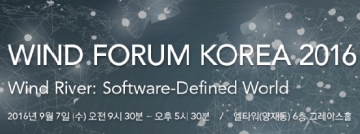
Welcome to the 'Software Defined' World of Wind River, Accelerating IoT and NFV Innovation
Wind River announced that it will hold 'Wind Forum 2016' on September 7th at El Tower in Yangjae-dong, where it will introduce the latest NFV (Network Function Virtualization) and IoT technologies. The event, held under the theme of 'Software-Defined World,' will showcase the latest global technologies and innovative cases for industrial and network markets. Michael Krutz, chief product officer of Wind River, will visit Korea and present specific use cases on how Wind River's portfolio, spanning from Edge to Cloud, leads and is applied in this market.
2016.08.25by 신윤오 기자

Wind River Launches VxWorks Client for IBM Watson IoT Platform
Wind River, a leading software company specializing in the Internet of Things (IoT), announced today the launch of a VxWorks client for the IBM Watson IoT platform, a real-time operating system (RTOS).
2016.10.05by 신윤오 기자

Wind River's High-Reliability Embedded Software Recognized for High Reliability
Wind River, an Intel subsidiary, announced that its highly reliable embedded software platform 'VxWorks 653' has received a Platinum Award at the '2016 Defense and Aerospace Electronics Technology and Intelligent Aviation Technology Innovation Awards'.
2016.12.22by 신윤오 기자

Intel Unveils Next-Generation 'Core Ultra Series 3' and vPro Platform for Enterprise PCs
Intel has officially unveiled the "Intel Core Ultra Series 3" for next-generation enterprise PCs and the latest vPro platform, addressing a wide range of demands from enterprise notebooks to high-performance workstations.
2026.03.26by 배종인 기자

ROHM Launches ESD Protection Diode Compatible with High-Speed Interfaces of 10Gbps or Higher
Semiconductor specialist ROHM has developed the 'RESDxVx series' of ESD (electrostatic discharge) protection diodes capable of responding to next-generation high-speed data communication environments exceeding 10Gbps, simultaneously enhancing both signal quality maintenance required in high-speed interfaces and IC protection performance.
2026.03.26by 배종인 기자











