


Implementing future optical computers using light-absorbing graphene properties
 Published2017.01.12 17:05
Professor Park Hong-gyu's research team controls singularity of nano laser
The Ministry of Science, ICT and Future Planning (Minister Choi Yang-hee) announced that “a technology that can freely change the color of nanolasers, which are small lasers the size of nanometers, has been developed by domestic researchers by utilizing the light-absorbing properties of graphene.”
Graphene is a material with a honeycomb-shaped structure made of carbon atoms of atomic size. It has excellent thermal conductivity, transparency, and elasticity, so it has a wide range of applications. However, it is known to be difficult to use in optical devices that utilize light because of its light-absorbing properties. A nanolaser is a laser that uses a device that traps light of tens to hundreds of nanometers in size.
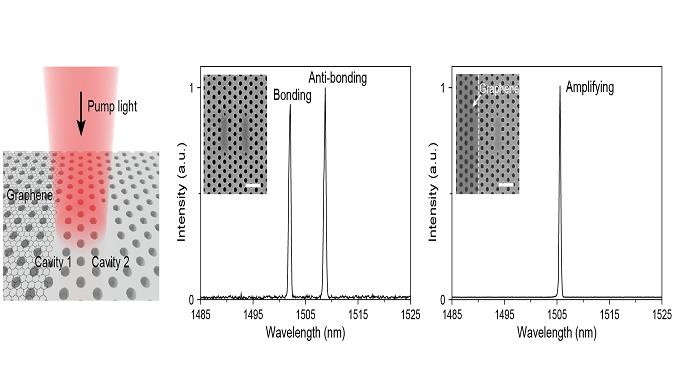
▲ Measurement of singularity of photonic crystal nanolaser using graphene
Researchers are working hard to develop optical computers, which are future computers that operate at the speed of light. In order to process information, images, etc. with light, lasers that are small enough to be integrated into current electronic chips are needed, and research is constantly being conducted to utilize them. In the midst of this, research has revealed that graphene can freely change the color of small lasers that are nanometer-sized.
The research team positioned two nanolasers close together and covered only one laser with graphene to separate the part where light is lost from the part where light is generated. This was the first experimental observation of the physical phenomenon in which two colors of light change into one color of light.
Professor Hong-Gyu Park's research team (Korea University) conducted the research with the support of the Basic Research Project (Individual Research) of the Ministry of Science and ICT, and the research was published in the December 21 issue of the world-renowned academic journal Nature Communications.
Professor Park Hong-gyu stated the significance of the research, saying, “This study is the first to discover that the singularity of a nano laser can be controlled using graphene. It is a new discovery of a physical phenomenon. It is expected to be applied to the development of future optical computers, etc., as it can effectively change the characteristics of laser light.”
Comments
Related news
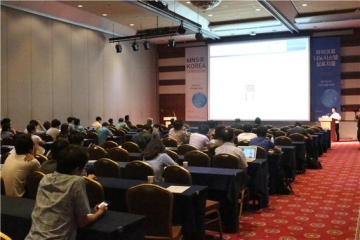
Korea's Largest Specialized Micro-Nano System Exhibition to be Held
The "2016 International Micro Nano System Exhibition and Symposium," a specialized exhibition for advanced technology micro nano system business, will be held for three days from July 13th (Wednesday) to 15th (Friday) at KINTEX in Goyang City. MNS KOREA has been held annually since 2008 under the joint sponsorship of the Ministry of Trade, Industry and Energy and the Ministry of Science, ICT and Future Planning. This year, it is being held under the joint organization of the Micro Nano System Society and the Nano Convergence Industry Research Cooperative.
2016.07.05by 명세환 기자
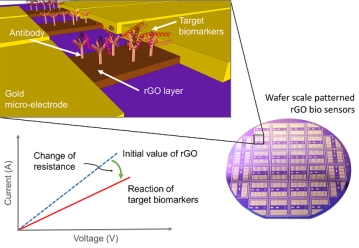
Diagnosing diseases with a single drop of blood: Development of high-sensitivity graphene biosensors takes a step closer
Recently, domestic researchers successfully implemented graphene, known as the 'dream material,' on a large-area panel (4-inch wafer) and developed a high-sensitivity biosensor fabrication technology capable of diagnosing various diseases and conditions. Dr. Hwang Gyo-seon's team at the Biomicrosystems Research Division of the Korea Institute of Science and Technology (KIST, President Lee Byung-kwon) fabricated a graphene biosensor with precisely implemented patterns of tens of micrometers (one hundred-thousandths to one millionth of a meter) by applying semiconductor processing technology.
2016.08.16by 신윤오 기자
20.2 billion won will be provided to the Nano Convergence 2020 project this year.
The Ministry of Trade, Industry and Energy and the Ministry of Science, ICT and Future Planning jointly held a 2017 business briefing session and industry-academia-research technology exchange meeting for the 'Nano Convergence 2020 Project' on the 11th (Wednesday) at POSCO P&S Tower (located in Gangnam, Seoul). The Nano Convergence 2020 Project is a business that supports commercialization by connecting nano technology patents held by research institutes and universities with companies' new product ideas.
2017.01.12by 신윤오 기자

Intel Unveils Next-Generation 'Core Ultra Series 3' and vPro Platform for Enterprise PCs
Intel has officially unveiled the "Intel Core Ultra Series 3" for next-generation enterprise PCs and the latest vPro platform, addressing a wide range of demands from enterprise notebooks to high-performance workstations.
2026.03.26by 배종인 기자
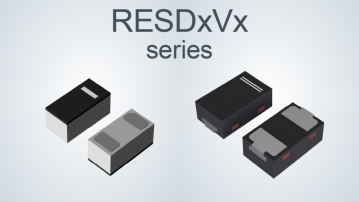
ROHM Launches ESD Protection Diode Compatible with High-Speed Interfaces of 10Gbps or Higher
Semiconductor specialist ROHM has developed the 'RESDxVx series' of ESD (electrostatic discharge) protection diodes capable of responding to next-generation high-speed data communication environments exceeding 10Gbps, simultaneously enhancing both signal quality maintenance required in high-speed interfaces and IC protection performance.
2026.03.26by 배종인 기자











