



[Critical IT Scene] The Note 7's final conclusion: battery defects.
 Published2017.01.23 18:20
The damage phenomenon was reproduced through a charge-discharge test using 200,000 products and 30,000 batteries.
On the 23rd, Samsung Electronics transparently disclosed the cause of the Galaxy Note 7 fire and announced measures to prevent a recurrence in the future, with approximately 300 domestic and international media outlets in attendance at its Seocho office building.
To enhance the objectivity of the investigation into the cause of this damage, independent investigations were conducted by overseas expert organizations such as UL, Exponent, and TÜV Rheinland. Sajeev Jesudas, President of UL's Consumer Business Unit, Dr. Kevin White, Chief Researcher at Exponent, and Holger Kunz, Vice President of TÜV Rheinland, each presented their findings.
In addition to improving the cause of this fire, Samsung Electronics has introduced an '8-point battery safety inspection' process, including introducing special equipment to identify internal battery problems, strengthening mass charge-discharge testing of batteries and finished products, and accelerated testing that takes into account actual user environments.
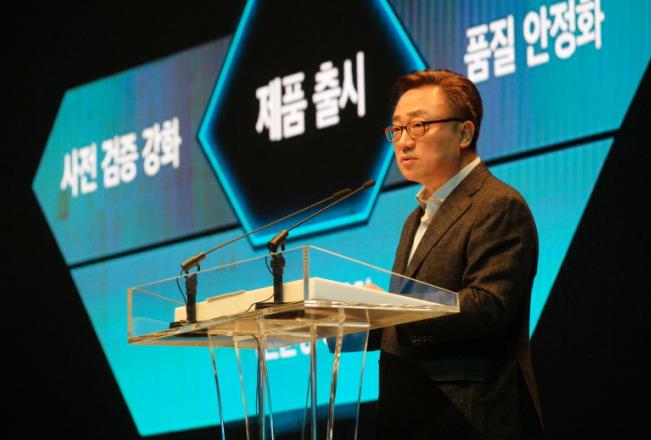
▲ President Koh Dong-jin announces the final conclusion on the cause of the Galaxy Note 7 damage.
'8-point battery safety inspection includes: △'Safety inspection': This is an inspection to check the safety and durability of the battery, and the cycle and number of times have been greatly expanded. △'Battery appearance inspection': Comparative evaluation of the battery appearance with a standard sample to determine if there are any abnormalities. △'X-ray inspection': An inspection to detect pressing of the electrode plates inside the battery in advance. △'Battery disassembly inspection': An inspection to check the tab fusion status, insulation status, and process quality status inside the battery. △'TVOC inspection': An inspection to detect battery leakage (TVOC: Total Volatile Organic Compound). △'ΔOCV (Delta Open Circuit Voltage) measurement inspection': Checks if there is a change in the battery voltage at room temperature to determine the battery life.Inspection to recheck for defects △ 'Charge and discharge test': Repeated charging and discharging tests on finished products under consumer conditions △ 'Accelerated user condition test': Intensive inspection tailored to consumer usage environment, conducted before product shipment to verify safety once again.
A dedicated "parts specialist team" has been established to handle core components, and the recruitment of external experts has been expanded.
Samsung Electronics has further strengthened its expertise in component development by establishing a "Component Specialist Team" dedicated to the design, verification, and process management of core components and expanding the recruitment of external experts. From the product planning stage, safety is the top priority, and "multiple safety devices" are implemented.
By securing additional battery mounting space, we have added a device that minimizes physical shock to the battery in case the consumer drops the product while using it, and have also strengthened safety design standards for batteries.
Additionally, we have strengthened our software protection algorithms, including applying safer algorithms for charging temperature, current, and charging speed. Samsung Electronics has also established an advisory group comprised of experts from academia and research institutes to objectively evaluate the safety of its products.
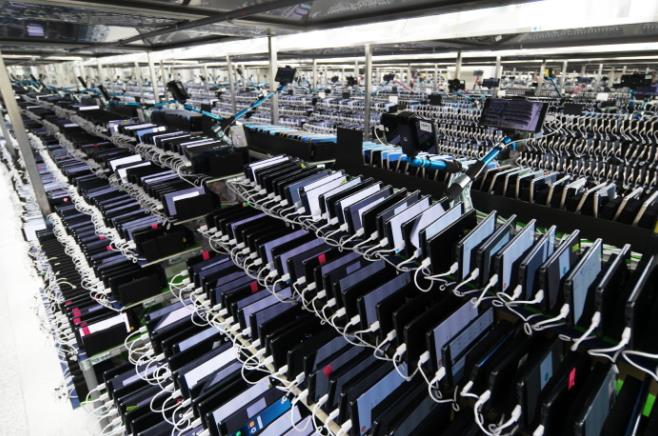
▲Large-scale charge-discharge experiment
Samsung Electronics has also decided to consider disclosing its multi-layered safety design and verification processes to relevant organizations, so that this lesson can serve as an opportunity for the entire industry to ensure the safety of lithium-ion batteries. Meanwhile, the cause of the Samsung Galaxy Note7 fires was ultimately determined to be a defect in the battery itself.
Samsung Electronics reproduced the burnout phenomenon in large-scale charge-discharge tests conducted on 200,000 products and 30,000 batteries, and confirmed that the burnout occurred for different reasons in batteries A and B used in the Note 7. The results of analyses by overseas expert agencies participating in the analysis of the cause of the Galaxy Note 7 burnout also converged on the battery defect.
External expert organizations such as UL and Exponent also analyzed the battery defect.
UL, a global scientific company and leading safety certification company, conducted a detailed technical analysis to determine the cause of the Galaxy Note 7 fire. UL was unable to find any issues related to the Note 7 damage at the product level, and analyzed that Battery A caused the damage due to a compression phenomenon at the upper corner of the battery and a thin separator that caused an internal short circuit, and for Battery B, analyzed that the combination of an abnormal fusion protrusion, no insulation tape attached, and a thin separator caused a short circuit inside the battery.
Exponent, a U.S.-based science and technology analysis firm, also conducted a detailed analysis of the entire product and announced that no factors related to the damage were found in the hardware and software analysis. For Battery A, the main cause of the damage was identified as the compression phenomenon at the jelly roll corner of the negative tab area, and for Battery B, the main cause of the internal short circuit was identified as the abnormally high fusion protrusion and the resulting damage to the insulating tape and separator.
TÜV Rheinland, a global certification body headquartered in Germany, conducted an intensive investigation into battery safety in battery logistics systems and phone assembly processes. TÜV Rheinland stated that no factors that could compromise battery safety were found in the phone manufacturing processes and battery logistics systems it audited.
CEO Koh Dong-jin said, "In order to create an innovative Note 7, we set goals for battery specifications, and I feel responsible for not being able to confirm and properly verify problems in the battery design and manufacturing process before product launch." He added, "We will continue to innovate in product safety by strengthening our quality-first management system across all management."
Comments
Related news
Samsung Electronics Unveils Galaxy Note 7 Equipped with Iris Recognition and Waterproof Features
Samsung Electronics held the 'Samsung Galaxy Unpacked' event in New York on the 2nd (local time) with approximately 1,000 attendees including global media and partners, unveiling the 'Galaxy Note7'. The 'Galaxy Note7', the sixth product in the 'Note' series that created a new mobile category in 2011 by featuring a large 5-inch-class display and S Pen, garnered intense attention from global media and consumers even before its official announcement. Although the 'Galaxy Note7' is the sixth in the series, the product name was designated as '7', skipping the number '6'. This decision was made to align the numbering with the 'Galaxy S7' released in the first half of the year, enabling simpler and more consistent communication with customers.
2016.08.04by 신윤오 기자

Samsung Electronics Launches 128GB Black Pearl Galaxy S7 Edge
Samsung Electronics will launch the Galaxy S7 Edge Black Pearl through three telecommunications carriers on the 9th, perfecting the allure of a modern and sophisticated black color with an elegant gloss finish. The Black Pearl model, the eighth color variant of the Galaxy S7 Edge, features smooth glossy black glass on both the front and rear of the smartphone. In particular, by finishing the side bezels in black as well, it achieves an even more premium design.
2016.12.08by 김수지 기자
Samsung Electronics Launches 2017 Smartphone Targeting Young Consumers
Samsung Electronics is launching the 2017 Galaxy A5, its first smartphone of the year targeting younger generations, on the 19th. The 2017 Galaxy A5 is equipped with differentiated camera features and design, as well as excellent water and dust resistance. It features a 16-megapixel camera with an F1.9 aperture on both the front and rear, enabling clear photos even in low-light conditions. In particular, it supports selfie photography with a selfie flash feature that produces a lighting effect using the display as a light source.
2017.01.19by 김지혜 기자
ESP32 Development Environment Selection and GPS Application Implementation
The ESP32 is a microcontroller that integrates Wi-Fi, Bluetooth, 12-bit ADC, capacitive touch, PWM, DAC, and UART in a single SoC. However, the abundance of features does not by itself solve the designer's problems. The real challenges lie in selecting the appropriate development environment, determining which pins can be used and which must be avoided, and converting raw data from modules into usable information. This document addresses ESP32 peripheral constraints (ADC2 and Wi-Fi coexistence limitation, UART1 occupancy, ADC non-linear regions), the trade-offs between Arduino IDE and ESP-IDF, and the process from connecting NEO-6M/NEO-M8N GPS modules to UART2, parsing NMEA sentences, and visualizing routes in Google Earth, all organized based on documented references.
2026.10.12by 편집부
MIPI CSI-2, DSI-2, C-PHY, D-PHY Test Solution Technical White Paper
The MIPI interface adopts a burst mode that transitions between low-power (LP) and high-speed (HS) states for low-power consumption, and in return, strict timing rules are imposed on state transitions. Additionally, the high-speed section operates as a packet-based protocol with headers, ECC, and CRC, so verification engineers must handle waveforms and protocols simultaneously. Traditional configurations combining general-purpose oscilloscopes and AWGs reveal limitations in setup complexity, measurement uncertainty, and lack of reproducibility when faced with these requirements. This white paper, based on webinar materials, organizes the structure of this problem and describes how the SV5C-DPTXCPTX generator for receiver testing and SV5C-DPRXCPRX analyzer for transmitter testing integrate state transition testing, stressed eye testing, and protocol analysis into a single bench, along with their application boundaries.
2026.10.12by 편집부











