



Amazon, a company that will demonstrate the true Fourth Industrial Revolution within the next 2 to 5 years
 Published2017.02.20 18:28
KT Economic and Management Research Institute (Digieco) released a report on the 13th titled "Analysis of Amazon's Direction of Development in the Fourth Industrial Revolution" (Cha Won-yong, Representative of ASPAC Future Technology Management Research Institute). According to the report, Amazon appears to be focusing on developing Hyperloop logistics delivery services using autonomous trucks, robots, and drones.
The 'convergence business model of smart data, AI, autonomous vehicles, robots, and drones' led by Amazon ultimately aims to form a Hyperloop dedicated to logistics transport.
When analyzing Google’s autonomous vehicle test road data, safety cannot yet be guaranteed and the level of autonomous driving is still only 61% to 80%, making immediate realization difficult. However, we believe that dedicated roads for logistics transport are more likely to be realized sooner.
Amazon's 'Convergence Business Model of Smart Data, AI, Autonomous Vehicles, Robots, and Drones'
The advantage of autonomous trucks using dedicated autonomous truck lanes is that time and space constraints are reduced, enabling rapid logistics delivery.
Amazon has already laid the groundwork for autonomous trucks. Amazon released a video on YouTube showcasing "autonomous vehicle technologies applied to its unmanned store, Amazon Go." In addition, we are currently developing mapping technology, machine learning and deep learning software, sensor technologies, and sensor fusion algorithms.
Amazon registered a patent titled "Lane Assignment for Autonomous Vehicles" on January 17. This patent describes a method for autonomous trucks to coordinate lanes with one another on the road. A road management system configures lanes and determines directions to help autonomous trucks enter specific lanes. Autonomous trucks can facilitate traffic flow by forming efficient traffic or transport networks, thereby enabling faster delivery.
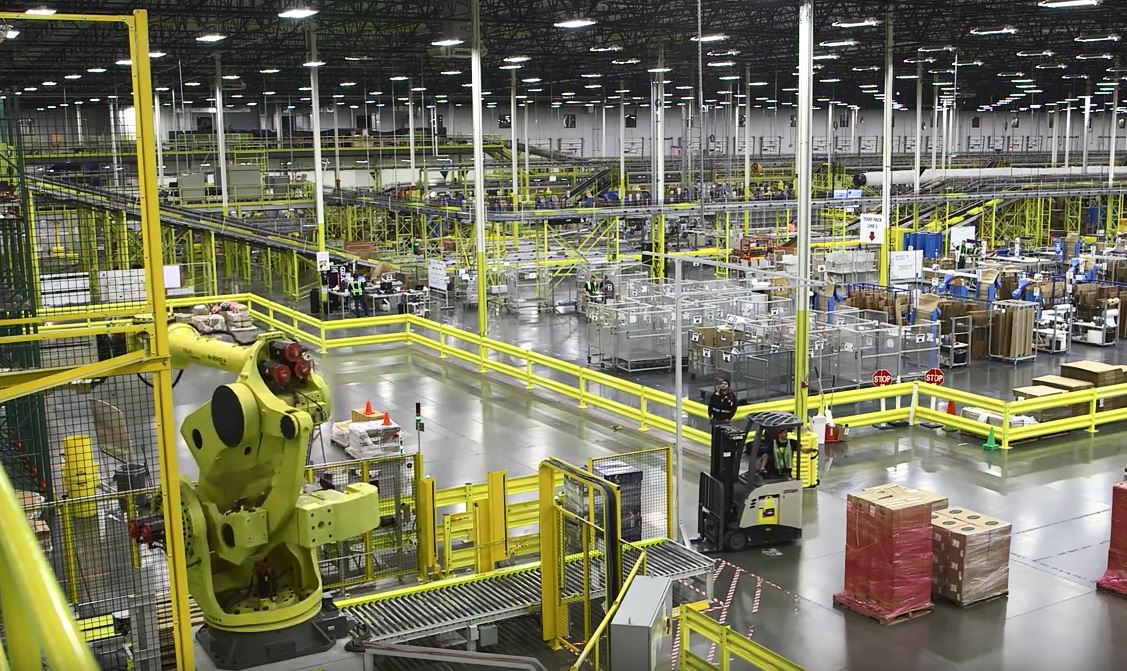
▲ Inside an Amazon warehouse where drones are actually being used
Amazon registered a patent in December 2015 titled "Inventory Management Efficiency Using Ground and Aerial Drones." Amazon is specializing its ground and aerial drones in parcel delivery and inbound/outbound inventory management. In particular, Kiva is a co-bot capable of collaborating with humans.
Unmanned aerial vehicles (UAVs) are currently being deployed for inventory management. One type is a ground-based AGV (Automated Guided Vehicle) responsible for receiving goods into the internal workshop; this vehicle is equipped with a driving mechanism that allows it to move along designated paths. Another type is an aerial-assisted vehicle (AAV) responsible for shipping goods out. Both ground and aerial UAVs are controlled remotely. Equipped with sensors such as cameras, these UAVs monitor the workshop floor to locate products or containers and activate appropriate mechanisms to ensure safety during receiving and shipping.
According to a Business Insider report dated June 15, 2016, Amazon's Kiva robots are actually showing a reduction of about 20% in operating costs. This translates to cost savings of approximately $22 million per logistics center. Currently, Kiva robots are being used in only 13 logistics centers, but it is estimated that an additional $800 million in cost savings could be achieved if the robots are also utilized in the remaining 107 logistics centers.
Amazon's Kiva robots actually reduce operating costs by about 20%... 30,000 robots deployed in the field
Subsequently, according to the Seattle Times on October 29, 2016, Amazon announced that 45,000 Kiva robots had been deployed in 20 of its approximately 120 logistics centers worldwide, with 30,000 robots in the field. Given this trend, it appears that Kiva will continue to be widely used in the future.
On April 5, 2016, Amazon registered a patent with the U.S. Patent Office for a sky logistics center and drone utilization, a delivery and transportation service for a sky station, shuttle, and drone modeled after the International Space Station.
This is a patent that exactly imitates the space shuttle, which carries new items or replacement astronauts up to the International Space Station and carries broken items or returning astronauts down.
Currently, drones are unsuitable for long-distance deliveries exceeding 30 minutes due to limitations in battery life. The round-trip distance for the recently launched drone delivery service is limited to 10 miles. Amazon’s new idea is to overcome these limitations by floating a logistics center in the air, similar to the International Space Station. The concept involves deploying an airship loaded with goods expected to experience a surge in demand over a specific area, connecting it to a ground control system to maintain a constant delivery standby system, and then delivering the goods to their destination via drone once an order is received. Because drones descend from high-altitude airships, they require much less power than when taking off from the ground, and may not require any power at all.
In the report, CEO Cha Won-yong predicts, "Amazon has been building data points regarding distribution networks, customer behavior, and experience for 20 years. With more than 12 data centers, it is in a favorable position to expand systems and apps, and with 120 warehouses worldwide as a decentralized distribution network system, it is an ideal system capable of rapidly connecting the central logistics system with regional logistics centers." He adds, "Therefore, it has established a last-mile service system by deploying autonomous trucks, robots, and drones. Within the next 2 to 5 years, Amazon will demonstrate the true Fourth Industrial Revolution."
Comments
Related news

Provides cloud support including Riverbed and Amazon Web Services.
Riverbed Technology announced that it is expanding its industry-leading hyperconverged solution 'Riverbed SteelFusion' to cloud environments, and will begin supporting Microsoft Azure through StorSimple and Amazon Web Services through AWS Storage Gateway. Through this initiative, Riverbed can now provide customers with greater flexibility and broader options for remote cloud-based storage, and enterprises can now leverage cloud infrastructure for capacity expansion, secondary storage tiers for backup, and tiering that connects private datacenter storage assets.
2016.03.16by 명세환 기자
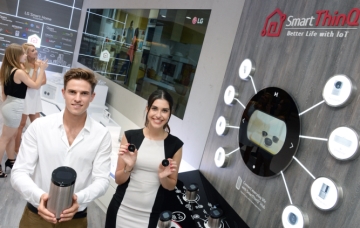
LG Electronics to integrate Amazon voice recognition service into SmartThinQ Hub
LG Electronics has partnered with Amazon, the world's largest e-commerce company, in the smart home sector. LG Electronics has decided to integrate Amazon's Internet of Things service with the SmartThinQ™ Sensor and SmartThinQ™ Hub that it launched domestically. LG Electronics will link Amazon's voice recognition service, 'Alexa,' to the SmartThinQ™ Hub. Users can control LG Electronics appliances through the 'SmartThinQ™ Hub' using voice commands alone. Users can check weather and schedules through the screen and voice of the 'SmartThinQ™ Hub,' and by connecting via Bluetooth, they can listen to music from their smartphone.
2016.09.02by 신윤오 기자

Samsung SDS expands global market with its logistics solution, Cello, a SaaS platform.
Samsung SDS has unveiled its integrated logistics solution Cello as a cloud-based SaaS (Software as a Service) platform and is moving forward with global market expansion. Samsung SDS (CEO Jung Yoo-sung) publicly introduced logistics and SCM (Supply Chain Management) services provided in SaaS format within a cloud environment for the first time through the 'Cello Tech Fair 2016' event held at Samsung SDS West Campus on the 6th. SaaS is software-as-a-service that has been attracting attention in the IT industry, as customers do not own software through direct purchase but instead lease it as a service, thereby avoiding infrastructure investment and management burden, among other advantages.
2016.10.11by 신윤오 기자

[e4ds Tech Day 2026 ⑨] Sim Sang-gyu, Autocrypt CTO: "In the Physical AI Era, Automotive Security Must Extend Beyond the Vehicle"
At e4ds Tech Day 2026, Sim Sang-gyu, CTO of Autocrypt, explained automotive cybersecurity strategies in the era of Physical AI and SDV (Software-Defined Vehicle). Automobiles are evolving as part of an ecosystem connected to AI, cloud, chargers, IoT, and robots, and he emphasized that the scope of security must expand beyond the vehicle interior to the entire connected environment. In particular, AI model tampering, adversarial attacks, OTA updates, and EV charger hacking were identified as major threats. He explained that response measures require zero trust, AI model integrity protection, intrusion detection, Security by Design and Default, and full lifecycle security management, and that proactive security system establishment beyond regulatory compliance is critical for securing future mobility competitiveness.
2026.10.12by 배종인 기자

Practical HIL Construction Strategy for Automotive and Off-Highway Controller Validation
As vehicle E/E architecture transitions to zonal structures and shifts to software-defined vehicles (SDV), the number of controllers (ECUs) requiring validation and software complexity are surging dramatically. Meanwhile, real vehicle testing cannot provide repeated verification under identical conditions and entails lead time and safety concerns. This white paper explains the principles of HIL (Hardware-in-the-Loop) validation and the structure of the NI platform composed of PXI, SLSC, and VeriStand, and through two actual implementation cases—Camera Record & Replay HIL for In-Cabin Monitoring Controller (ICMU) and Forklift Controller (VCU) HILS—describes how controller-level regression testing becomes possible. Additionally, it explicitly states application boundaries and limitations, such as lack of A2B support.
2026.10.12by 편집부











