



KT Unveils Infectious Disease Prevention Solution at MWC 2017
 Published2017.02.21 11:35
Recognition is possible without separate operation by utilizing 3G and LTE network transmission and reception.
KT will present its 'Smart Gate' solution, which utilizes roaming data to identify visitors to infectious disease contaminated areas and use it for quarantine purposes, at the 'Mobile World Congress 2017 (MWC 2017)' held in Spain.
Smart Gate is a solution that checks whether a person returning from overseas travel has made calls or accessed data in an area contaminated with infectious diseases on their mobile phone when passing through the gate, and notifies quarantine officials.
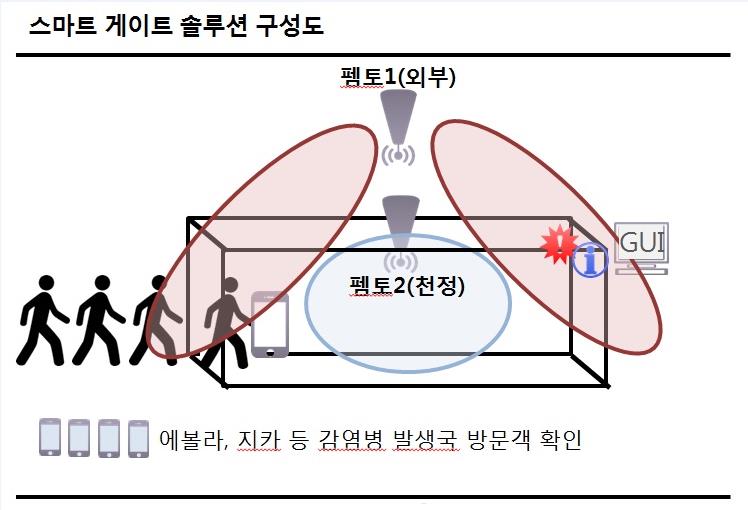
▲ When an entrant passes through here, the entrant's mobile phone roaming data is subject to prior approval from the government agency.
Bring your history and check whether you have visited a country with an infectious disease outbreak.
The smart gate utilizes handover technology, which occurs when a mobile phone changes base stations as it moves. By installing femtocells (small base stations) inside the passageway, when a traveler passes through, the gate retrieves the roaming data history of the mobile phone, which has been approved in advance by the government agency.
Smart Gate utilizes the transmission and reception of 3G and LTE network signals, so it can be recognized simply by turning on the mobile phone without any separate operation.
Yoon Hye-jeong, head of KT’s BigData Business Promotion Team, said , “ The smart gate solution was demonstrated at MWC2017 as a way to identify and confirm in advance people who have visited countries contaminated with infectious diseases using roaming data,” adding, “I hope that the efforts of telecommunications companies to block infectious diseases coming from overseas will resonate with visitors.”
Comments
Related news

KT Opens Global Digital Healthcare Market with Australia's Madison
KT has signed a Memorandum of Understanding (MOU) with Medisonics, an Australian mobile healthcare startup, for global digital healthcare business cooperation. The two companies plan to advance collaboration in the global digital healthcare field by integrating Medisonics' mobile stethoscope with KT's digital healthcare solutions.
2017.02.14by 서아람 기자
KT and ETRI succeed in developing NB-IoT terminal technology
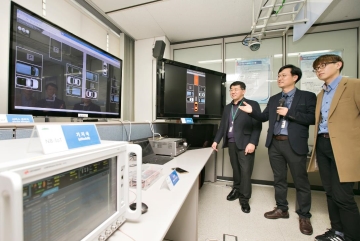
KT announced that it has successfully developed 'NB-IoT' terminal technology that can provide Internet of Things services over wide areas with low power consumption through technical collaboration between ETRI (Electronics and Telecommunications Research Institute) and small and medium-sized enterprises. KT provided an open IoT service platform and terminal verification environment, while ETRI was responsible for NB-IoT system design.
2017.02.16by 김지혜 기자
KT to Provide GiGagenie Service Experience at Major Weekend Locations
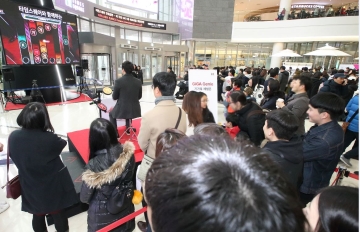
KT announced that it will hold events allowing customers to directly experience the services of GiGagenie, an AI TV that was launched on January 31st. GiGagenie is a convergence service combining IPTV with network technology and artificial intelligence, providing home secretary functions. Based on domestic wired and wireless networks, it is equipped with a full range of smart features including TV and music viewing, schedule management, traffic guidance, home IoT device control, and video calls.
2017.02.20by 서아람 기자
European Patent Applications Surpass 200,000 for the First Time… South Korea Maintains 5th Place, Led by Batteries and Telecommunications
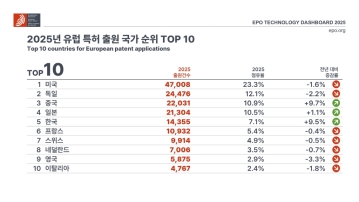
According to the European Patent Office (EPO)'s 'Technology Dashboard 2025', European patent applications last year reached 201,974, surpassing 200,000 for the first time. Korean companies and inventors filed 14,355 applications, representing a 9.5% increase from the previous year and maintaining 5th place by country. Battery, digital communication, and semiconductor technologies led the growth, with Samsung ranking as the top EPO applicant for the second consecutive year and LG reaching 3rd place. The presence of major domestic cities such as Seoul, Suwon, and Yongin was also confirmed. It was also revealed that Korea's European patent strategy is expanding beyond individual technologies to span the entire industry.
2026.03.24by 명세환 기자

SK Telecom First Applies AI-Based Network Operations at Gwanghwamun K-Pop Concert
SK Telecom announced that it applied an AI-based network operation system for the first time at a large-scale K-pop concert held in the Gwanghwamun area of Seoul on March 21st, managing communication quality throughout the event. Mobile data usage during the three hours before and after the concert reached 12.15TB, approximately doubling compared to the same time slot the previous weekend. SK Telecom monitored traffic using the AI system 'A-One' in five-minute and 50-meter units to respond to potential overload situations, while also operating temporary communication facilities and on-site personnel in parallel. This case is interpreted as confirmation of the practical applicability of AI-based autonomous network operation in an environment where demand from dense events and foreign users increases simultaneously.
2026.03.23by 명세환 기자











