



[Promising Future Technology ⑦] Drones, with their autonomous flight systems gaining increasing attention, are evolving into practical robots.
 Published2017.02.27 09:06
Market size expected to grow to over $10 billion by 2020
Mr. S recently purchased a drone for timber management. In agriculture and forestry, tasks such as tree counting and inventory surveys, previously performed manually, are now handled by drones. State-of-the-art drones equipped with aerial forest inventory systems can now measure the entire forest population. They provide information on the diameter of individual trees, as well as the number of trees. The drones also monitor for intruders. They capture images continuously in real time, analyze them, and transmit the data to the system. This represents the future of smart agriculture. Networks between drones allow for even more information to be collected from above. Multiple cameras are installed on a single drone, capturing all areas without blind spots. Based on the coordinates generated by each camera, the images are compared in real time with existing historical templates to determine the location and predict the direction of travel. The display, which contains all information, including aerial zone classification, surrounding object size, and speed, is also transmitted to the user's screen on the ground. This is another example of the era of intelligent drones.
Drones, currently used for unmanned photography and delivery, will be responsible for field investigations in various fields and even big data collection through road networks.
A drone is an unmanned aerial vehicle (UAV) similar to a fixed-wing or rotary-wing aircraft. It is commonly referred to as an Unmanned Aerial Vehicle (UAV) or Unmanned Aircraft (UA), though it is more commonly referred to as a "drone." Interest in autonomous flight technology has been growing recently due to active development of technologies related to ground control and control systems.
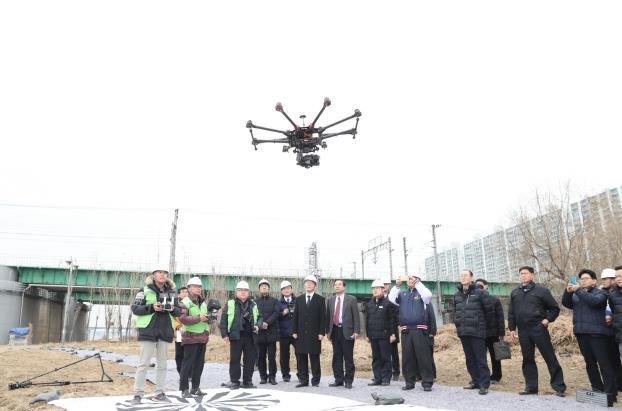
▲ On the 16th, Minister of Land, Infrastructure and Transport Kang Ho-in visited the Han River Bridge safety diagnosis site and discussed with external experts the direction of financial investment to prepare for aging facilities, the introduction of a smart facility maintenance management system that incorporates new technologies of the 4th Industrial Revolution, and ways to enter overseas aging SOC markets. He also inspected every nook and cranny of the Han River Bridge using a drone to check the stability of the structure.
The drone industry began with Israel's Scout drone, marking the beginning of its commercialization. While the market has steadily expanded since then, primarily for military applications, it has recently expanded into civilian applications. Drone technology is closely linked to warfare, and while the military drone market is the largest in terms of market size, it is now expanding into consumer business models. Internet companies like Google and Facebook have popularized wireless internet, and Amazon has pioneered services for logistics innovation.
The global drone market is projected to grow from $7.1 billion in 2015 to over $10 billion by 2020. The commercial drone market, currently accounting for just 1% (KRW 66 billion) of the total drone market, is expected to grow to 7% by 2023. The market size is expected to continue growing, driven by increasing future applications such as early warning systems, emergency services, news reporting, monitoring delivery operations, sports, entertainment, and marketing.
The trend in drone products is evolving into practical robots. Breaking beyond the traditional framework of unmanned aerial vehicles, future-oriented models featuring passengers and unmanned systems are emerging. This requires technology that ensures passenger safety in emergency situations. It will continue to develop into a form that integrates into everyday life, such as city patrols, by being utilized in police work.
Korean patent applicants have the highest share in the mission equipment field at 23.7%.
Drone patent technology is divided into data and communication/security, simultaneous operation of manned and unmanned aircraft, mission equipment, autonomous flight systems, ground control and control systems, ground support systems, and system integration (design of external shape and flight method, etc.). The number of patent applications has gradually increased since the early 2000s, and patent application activity increased significantly in 2012. In 2012, data and communication/security, mission equipment, ground task and control systems, ground support systems, and system integration fields showed higher growth rates than other fields. In all fields, the United States has the most patent applications, and based on the number of applications filed with the Korean Intellectual Property Office, the order is mission equipment, ground control and control systems, and data and communication/security. In the case of ground support systems, the difference in the number of applications filed with the USPTO and the Korean Intellectual Property Office was the largest, at 417 cases.
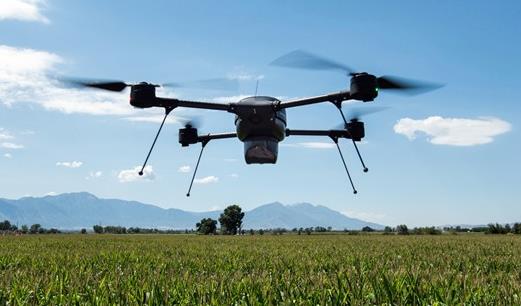
▲Lockheed Martin Drone capture
In terms of patent share, US applicants lead in all seven technology fields. Korean applicants had the highest patent share in mission equipment at 23.7%, surpassing leading countries in this field by 57.9%. Looking at patent trends by company, Boeing ranked among the top 10 applicants in five periods (2011-2014), while Lockheed Martin ranked among the top 10 applicants in four periods. Yamaha Motor, Lockheed Martin, and Northrop Grumman were among the top 10 applicants, actively filing patents during periods 1 through 4, but have recently dropped out of the top 10. Honeywell International, Korea Aerospace Research Institute, Korea Aerospace Industries, and AEROVIRONEMENT, which were not among the top 10 in periods 1 and 2, have continued to actively file patents since then and are now among the top 10 applicants since period 3.
Boeing, Honeywell International, and others have many patents in autonomous flight systems.
Agriculture, self-portraits, logistics delivery, and internet services are areas where efforts are needed to reduce human labor and where drones can operate without human control. Among the various drone technologies, autonomous flight systems are becoming increasingly important. When supported by autonomous flight system technology, they can reduce labor costs and enable drones to be used more freely and in a wider range of fields. Major patent applicants in the autonomous flight system field include Boeing, Honeywell International, AEROVIRONEMENT, and RAYHEON, in that order.
Boeing focuses on ground control and control systems, Honeywell on ground control and control systems and system integration, Yamaha Motor on system integration and ground control and control systems, Lockheed Martin on ground control and control systems, and Raytheon on mission equipment. The top three patent applications in the drone sector were Boeing, Honeywell, Yamaha Motor, Lockheed Martin, and Raytheon, in that order.
In 2012, Boeing filed a patent for a technology to measure the diameter of trees using an unmanned aerial vehicle controlled by a sensor system that generates tree measurement information and obstacle information, and in 2014, it registered a technology to capture continuous images using an image capturing device and calculate them to enable real-time detection of objects. Based on current technology, it is expected that in 2018, a research drone product capable of obtaining information and confirming location through a sensor system will be developed, and a product capable of real-time object detection by calculating continuous images will also be released.
Based on Honeywell's current technology for forming precise formations to maintain altitude and position, the company anticipates future product launches that produce image data and display signals, or enable services that enable effective communication when capacity is limited, utilizing remote control stations. (Reference: Korea Intellectual Property Strategy Institute (KISTA) Future Promising Product and Service Analysis Report)
Comments
Related news
Autonomous vehicles, drones, healthcare... Ultimately, the key lies in the development of "smart sensors." Where are we now?
As emerging strategic industries such as future automobiles, healthcare, smart factories, robots, and drones have become hot issues, the importance of so-called 'smart sensors' is growing day by day. Smart sensors are sensors that have been given intelligence, referring to intelligent advanced sensors in the IT convergence era. As the types of sensors and their application objects have increased, the role of sensor hubs that can control sensors and collect data at low power consumption has also become increasingly important.
2016.10.10by 신윤오 기자
Future products and services found in smart car, drone, and robot patents
Analysis of patent application trends in representative future convergence industry sectors including smart cars, drones, and robots has revealed the emerging outline of products and services that will gain prominence in the future. Smart cars, which refer to vehicles that combine automotive and IT technologies and are continuously connected to networks, center on products and services that contribute to user safety and convenience through enhanced connectivity both inside and outside the vehicle. This includes autonomous driving systems, HMI (Human Machine Interface) systems, sensing/accident prevention/avoidance systems, and driving assistance/occupant support systems.
2016.12.19by 신윤오 기자
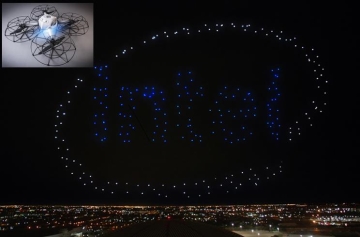
[Decisive IT Scene] 300 Intel Drones Appear at Super Bowl Show
Intel, in collaboration with the NFL and PepsiCo, showcased a drone light show featuring Pepsi Zero Sugar during the Super Bowl halftime show. The performance, which utilized 300 Intel Shooting Star drones moving in predetermined choreography, marks the first drone show ever presented at the Super Bowl and on television.
2017.02.07by 서아람 기자
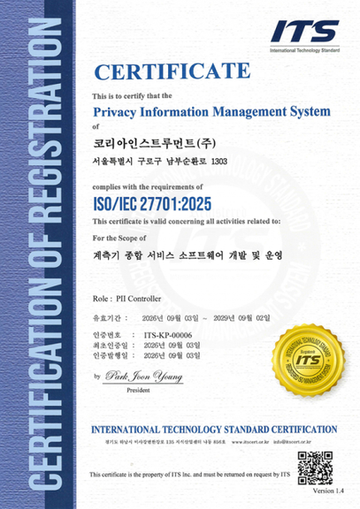
Korea Instrument, KOLAS Accredited Calibration Agency First to Simultaneously Acquire ISO/IEC 27,001·27,701
Korea Instrument has become the first among KOLAS accredited calibration agencies to simultaneously acquire ISO/IEC 27,001 and ISO/IEC 27,701 certifications. Through its proprietary platforms CWIZ Enterprise and CWIZ Partners, the company has embedded information security and personal data protection requirements across all business processes including customer information, equipment data, and calibration reports, with plans to continuously advance its management system through regular audits and security inspections.
2026.10.12by 배종인 기자
TeamViewer One, IT Incident Automation Workflow and Resolution Center Enhanced
TeamViewer has added IT incident automation capabilities and an advanced Resolution Center to its integrated digital workplace management platform 'TeamViewer ONE'. Recurrent service disruptions, configuration errors, and capacity shortages are automatically handled according to preset policies, and device status verification through script deployment can be managed in a unified interface, significantly reducing repetitive tasks for IT teams.
2026.10.12by 배종인 기자











