



[Promising Future Technologies ⑧] Smart Car Windshield Hazard Detection: Augmented Reality Service: "Is This Possible?"
 Published2017.03.06 16:07
Development of core patents, including sensing systems, HMI, and V2X, is in full swing.
Mr. S doesn't need a driver's license. Instead, he was granted "autonomous vehicle driver qualifications" after undergoing tests to demonstrate basic cognitive abilities, such as spatial perception and risk management, as well as system operation capabilities. As soon as he gets in, the smart car begins driving after confirming his destination and route. Following the preceding vehicle's trajectory and generating data from that trajectory, the car maintains an appropriate speed. There's no instrument panel inside the car. A head-up display displays basic information like speed, mileage, fuel level, and engine consumption, as well as a variety of other information. The navigation screen, including the car's suggested route and lane guidance, is also displayed on the head-up display. The car also warns of road hazards. It recognizes distant hazards and intuitively informs passengers of their presence and direction. Mr. S always feels safe and comfortable riding in the smart car.
Smart cars are vehicles that are constantly connected to a network, integrating automotive and IT technologies. They are evolving toward improved safety and convenience by enhancing sensors that detect surrounding conditions and connectivity between the interior and exterior of the vehicle.
Joint development is actively underway to develop smart cars that integrate automotive and other fields. The market size is dominated by safety, autonomous driving, and entertainment, in that order, based on smart car technology elements. Starting with Audi in 2017, a number of automakers plan to launch self-driving cars by the 2020s.
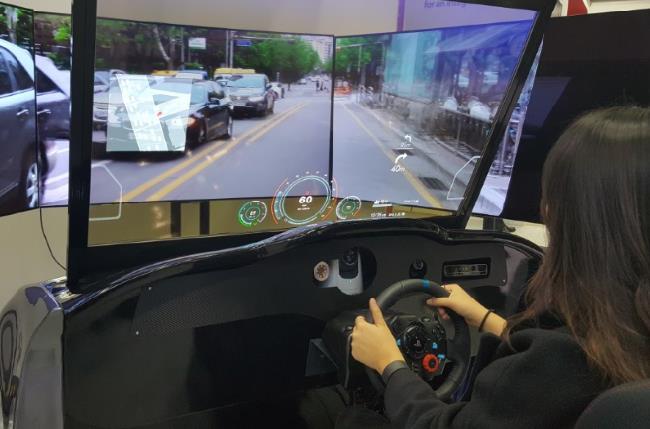
▲ LG Display demonstrating an automotive head-up display (HUD) at an exhibition.
Specifically, Audi plans to release its next-generation, fully autonomous A8 in 2017, Tesla plans to release a fully autonomous vehicle in 2018, and Ford plans to release a mostly autonomous vehicle in 2020. Toyota plans to release a highway-capable autonomous vehicle in 2020, and BMW plans to release its self-driving iNext in 2021. Uber also aims to make self-driving Uber taxis common by 2030.
Research on sensing systems and human-machine interfaces (HMIs) for autonomous vehicle development is also accelerating. Sensors used in smart cars are categorized into power control, safety control, convenience control, and ICT integration, with approximately 200 sensors per smart car. Camera sensors are often ineffective in terrain with limited visibility and poor weather conditions, so vehicle communication technologies such as V2X (Vehicle to Everything) are also attracting attention. Furthermore, from a safety perspective, a HUD allows the driver to obtain visual information most efficiently without distraction.
In particular, V2X services are attracting significant attention from major countries, particularly in relation to road infrastructure. The United States, with its "IntelliDrive" project, is implementing new services to maximize stability and mobility by establishing V2X communication systems and infrastructure across the country. Europe has adopted the slogan "SAFESPOT" for smart vehicles on smart roads, while Japan has allocated frequencies for V2X communications and established an "ITS Japan" strategy based on V2I communications. South Korea is pursuing a smart highway strategy through its ITS Plan 2020 for the automobile and road traffic sectors.
Japan has a high patent share, while Korea has a strong electrical and electronic architecture patent base.
As competition in smart cars becomes fierce, patent technology is also waging an invisible war. Smart car patents are broadly categorized into HMI, wireless communication, accident prevention/avoidance, sensing, actuators, autonomous driving, electrical and electronic architecture, driver assistance, passenger assistance, and damage mitigation. A study of the number of patents by patent office (Korea, the U.S., Japan, and Europe) for each specific technology from 1995 to the present reveals that sensing (5,948) was the most frequently registered patent, followed by actuators (4,276), accident prevention/avoidance (4,096), HMI (3,380), driver assistance (3,151), damage mitigation (3,059), autonomous driving (2,382), and wireless communication (2,285).
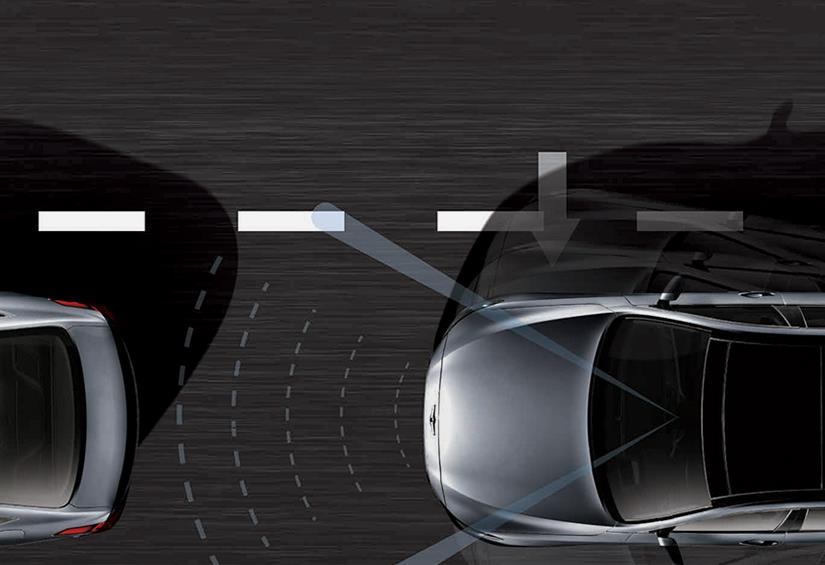
▲Hyundai Motor Company's autonomous driving system (captured from Hyundai Motor Company website)
Looking at the patent application trends by year, we can see that the number of patents in the 3rd section (03'-06') and 4th section (07'-10') recorded 6,653 and 6,911 cases, respectively, but has increased significantly to 10,148 cases in the recent 5th section (11'-14'). Comparing patent share by applicant nationality and by sub-technology, Japan (39.6%) ranked highest, while Korea (18.9%) ranked fourth. Korea particularly outperformed leading countries in electrical and electronic architecture (33.5%) and also achieved a market share exceeding 20% in driver assistance, autonomous driving, and wireless communications. Japan also led overall in citations by applicant nationality, while Korea ranked fourth.
In terms of market share by key technology, Japanese companies such as Toyota Motor, Denso, and Honda are focusing on sensing, while Nissan is strong in driver assistance. Hyundai Motor Company is focusing on damage mitigation, HMI, and driver assistance.
Drivers Need More Information, HUD Patent Applications Continue to Rise
Patents for multi-modal, driver-load/emotion-aware, and adaptive personalized interfaces are also on the rise.
Smart cars also feature countless other technologies. These include Smart Cruise Control (SCC), Lane Departure Warning (LDWS), Driver Status Monitoring (DSM), Adaptive Cruise Control (AFLS), Vehicle Dynamic Control (VDC), Parking Guidance System (PGS), and forward blind spot cameras. Head-up displays (HUDs) are becoming increasingly important, particularly as drivers demand more information. Looking at recent trends in HMI technology patent applications, we can see that following HUD (26%), technologies such as multi-modal information (11%), driver load/emotional recognition (12%), adaptive personalized interface (12%), natural language voice recognition system (5%), intelligent security (12%), vehicle haptics (15%), and next-generation integrated HVI (7%) are being actively applied for.
Looking at examples of companies with HUD patents, Denso currently has technology to integrate into the inner surface of the windshield or use a projector in front of the windshield to project onto a screen, and in the next 1-2 years, it is expected to release a product that allows for a clearer image by controlling the diffraction width of the light flux through the surface of the optical element on the screen. In 3-4 years, a product is expected to be released that displays the direction of a hazardous object so that it can be intuitively recognized or suppresses brightness stains to provide a cleaner image.
For Hyundai cars, based on the current technology that projects a screen onto a portion of the driver's field of vision, they plan to provide an augmented reality service utilizing the windshield in the next 1-2 years, and in 3-4 years, they plan to introduce a service that can change lanes from the current driving lane to the destination lane, or a service that provides information to the driver by changing the location depending on the distance of an obstacle ahead.
In this way, smart car head-up displays will not only improve visibility, but also provide driving assistance and safety, serving as a safe and convenient information delivery tool. (Reference: Korea Intellectual Property Strategy Institute (KISTA) Future Promising Product and Service Analysis Report)
Comments
Related news
Augmented Reality (AR) Patents Surge 12-fold in 10 Years, Smart Car-Related Patents Are High
Virtual Reality (VR), which displays virtual spaces and objects on a computer graphics screen, and Augmented Reality (AR), which combines and displays the real world with virtual information, are approaching our daily lives through integration with smartphones or commercialized HMDs. According to the Korean Intellectual Property Office (Commissioner Choi Dong-gyu), an analysis of domestic patent applications for AR over the past 10 years (2005–2014) revealed that from 2005–2009, an average of 52 applications per year (261 applications over 5 years) were filed, and from 2010–2014, an average of 619 applications per year (3,094 applications over 5 years) were filed, indicating that patent application volume increased approximately 12-fold.
2016.04.22by 신윤오 기자
[Reporter's Notebook] Regulatory Improvements 'Boldly' Like Autonomous Vehicle Test Runs
What will Korea's industrial economy look like in 2017? In a situation where international conditions and economic circumstances are rapidly changing day by day, it is not easy to foresee even a step ahead. Next year is no exception. While Korea's key industries such as computers, displays, and wireless communication devices are facing difficulties, China is rapidly catching up or has already surpassed Korea in an increasing number of industries. What is concerning is the reality that the industries being fostered as new growth engines for the future are also losing competitiveness compared to advanced countries.
2016.12.12by 신윤오 기자
Future products and services found in smart car, drone, and robot patents
Analysis of patent application trends in representative future convergence industry sectors including smart cars, drones, and robots has revealed the emerging outline of products and services that will gain prominence in the future. Smart cars, which refer to vehicles that combine automotive and IT technologies and are continuously connected to networks, center on products and services that contribute to user safety and convenience through enhanced connectivity both inside and outside the vehicle. This includes autonomous driving systems, HMI (Human Machine Interface) systems, sensing/accident prevention/avoidance systems, and driving assistance/occupant support systems.
2016.12.19by 신윤오 기자
[e4ds Tech Day 2026 ⑨] Sim Sang-gyu, Autocrypt CTO: "In the Physical AI Era, Automotive Security Must Extend Beyond the Vehicle"
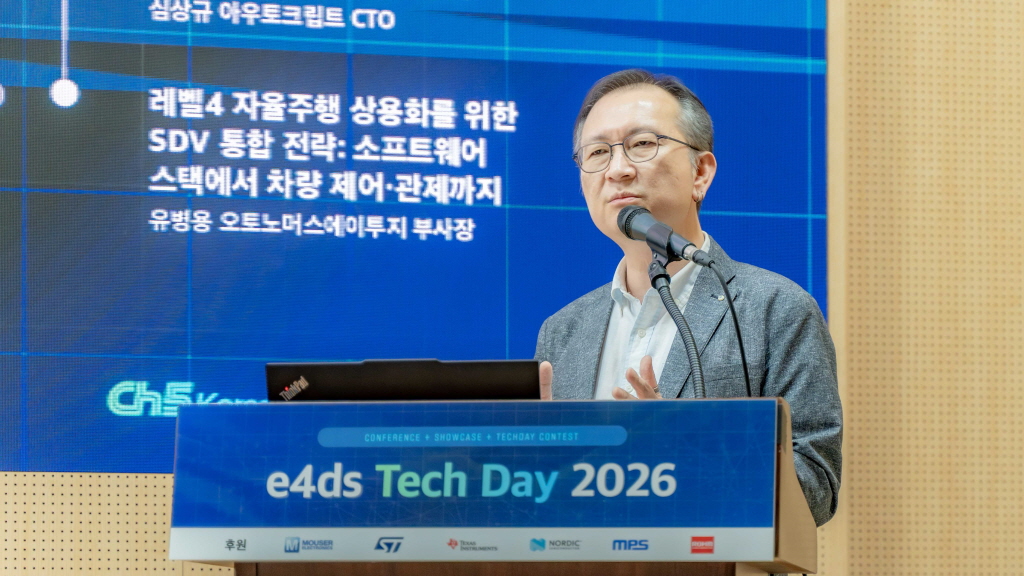
At e4ds Tech Day 2026, Sim Sang-gyu, CTO of Autocrypt, explained automotive cybersecurity strategies in the era of Physical AI and SDV (Software-Defined Vehicle). Automobiles are evolving as part of an ecosystem connected to AI, cloud, chargers, IoT, and robots, and he emphasized that the scope of security must expand beyond the vehicle interior to the entire connected environment. In particular, AI model tampering, adversarial attacks, OTA updates, and EV charger hacking were identified as major threats. He explained that response measures require zero trust, AI model integrity protection, intrusion detection, Security by Design and Default, and full lifecycle security management, and that proactive security system establishment beyond regulatory compliance is critical for securing future mobility competitiveness.
2026.10.12by 배종인 기자

Practical HIL Construction Strategy for Automotive and Off-Highway Controller Validation
As vehicle E/E architecture transitions to zonal structures and shifts to software-defined vehicles (SDV), the number of controllers (ECUs) requiring validation and software complexity are surging dramatically. Meanwhile, real vehicle testing cannot provide repeated verification under identical conditions and entails lead time and safety concerns. This white paper explains the principles of HIL (Hardware-in-the-Loop) validation and the structure of the NI platform composed of PXI, SLSC, and VeriStand, and through two actual implementation cases—Camera Record & Replay HIL for In-Cabin Monitoring Controller (ICMU) and Forklift Controller (VCU) HILS—describes how controller-level regression testing becomes possible. Additionally, it explicitly states application boundaries and limitations, such as lack of A2B support.
2026.10.12by 편집부











