


From casual chatter to expert information, I talk to chatbots.
 Published2017.03.06 15:42
Interest is growing as messenger use increases over social media.
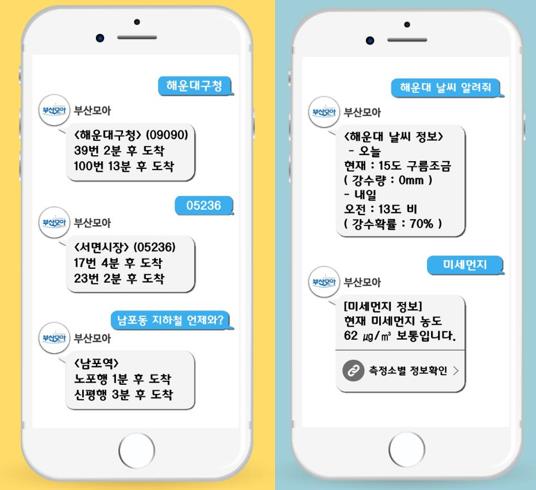
On your busy commute, text KakaoTalk with "Tell me today's weather" or "Tell me when the bus is coming." It will provide hourly weather updates and real-time bus arrival information. Information that used to require searching through apps is now accessible with a simple text input on Messenger.
Chatbot is a combination of the words chatting and robot, and is a conversational interface that operates in messenger environments (KakaoTalk, Line, etc.), and chatbot services are expanding.
In overseas countries where companies like Facebook, Google, and Microsoft are already operating AI chatbot services, they are helping with everything from simple conversations to weather information, movie ticket purchase information, real-time road information, and even shopping.
Interest in chatbots is heating up in Korea as the number of companies and organizations introducing chatbot services is increasing one by one this year.
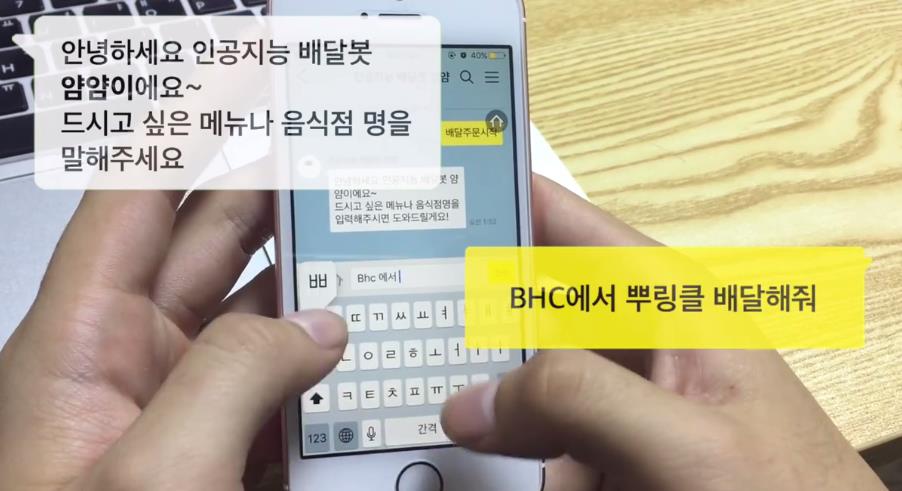
Daishin Securities, which introduced the chatbot 'Benjamin' on the 20th, has created a system that allows customers to easily consult by digitizing frequently asked questions and answers. Daegu City also unveiled "Ddubot," a service that handles passport-related inquiries, earlier this month. "Busan Moa," which provides information about Busan, has been available on KakaoTalk and Facebook Messenger since last year.
Recently, Naver added a chatbot feature called "TokTok" to its existing shopping site to assist customers with their shopping. Furthermore, financial institutions like Nonghyup, Dongbu Insurance, and Lina Life Insurance are using chatbots for consultations, and Money Brain is preparing to launch "YamYam," which will handle delivery orders. This expansion of corporate chatbot adoption, encompassing everything from consultations to ordering and reservations, is another recent trend.
Is it possible to have a free conversation with artificial intelligence?
A chatbot can be thought of as a human-to-machine conversation that uses messengers to facilitate human-to-human conversations. Simply put, it's like having a conversation between your iPhone's Siri and a messenger.
Interest in chatbots began as more people around the world used messengers than social media like Facebook, Twitter, and Instagram. The terms "gantalk" (personal KakaoTalk) and "dantalk" (group KakaoTalk) have become commonplace, demonstrating the familiarity of messengers. Furthermore, mobile users' reluctance to install new apps has fueled their rapid growth.
So how do current chatbot conversations unfold? There are two types of chatbot conversations: open conversations, which involve free-flowing speech without any direction, like everyday conversations, and closed conversations, which involve a pre-planned structure that prompts choices.
To speak freely, as if you were having a conversation with a friend, it's crucial to understand the intent of the question. For a machine to accurately understand the intent and provide an answer, artificial intelligence (AI) is necessary. Last year, Microsoft's AI chatbot, Tay, was shut down just 16 hours after its release. This was because Tay, having learned from some users' discriminatory comments, began using profanity and other discriminatory language. This suggests that free conversation with AI is difficult.
Conversation with machines can be primarily used in conversational commerce and O2O (on-demand) services, such as reservations and ordering; personal assistant services, such as weather information or healthcare; and public services, such as legal consultations or real estate information. Currently, the most common use cases are consulting, reservation, and ordering services.
Park Jeong-nam, CEO of GentlePie, a chatbot developer, said, "The purpose of a chatbot isn't to have good conversations. It's about getting people to use the bot, what kind of conversations they have with it, and what kind of results they lead to." He emphasized that the bot should be planned according to business objectives.
At a chatbot planning and development case study seminar held on the 27th, Infrabank CEO Kim Min-yeol presented examples of how chatbots have been applied in the healthcare sector. He stated that the most suitable industries for chatbots include e-commerce, content, and healthcare.
Vitus, a healthcare widget introduced by CEO Kim Min-yeol, remotely checks patients' health and helps manage their health. This chatbot is being serviced by GSK, a British global pharmaceutical company.
Businesses that are suitable for chatbots include e-commerce, content, and healthcare.
Vitus's defining characteristic is its active and chatty nature. While typical chatbots are passive, responding only after being spoken to, Vitus initiates conversations based on timely greetings and individual activity and sleep data. Furthermore, it can communicate 24 hours a day. Leveraging this capability, the company is developing an e-commerce chatbot in Korea. It aims to provide consumers with information on health supplements they desire, recommend products, and provide links to online shopping malls and payment buttons for purchase.
CEO Kim plans to implement text input and multiple responses in the upcoming Chatbot 2.0 upgrade. The Black Consumer issue that caused problems during Chatbot 1.0 testing allowed him to identify and improve the issue. Questions the chatbot couldn't answer caused errors and malfunctions. To address this, Chatbot 2.0 includes an age option. Users in their 20s and 30s are more adept at text input, so they can use text input. Users in their 40s and older will be limited to multiple responses. He anticipates that this approach will broaden the user base.
He said, “A chatbot is something that allows humans to have conversations with 100 experts that they would not normally have access to,” and “A chatbot is not something that you use once a year. “Requiring users to download an app to use a chatbot is a business-centric, not user-centric, approach,” he said, pointing out a problem in the domestic chatbot market.
It will continue to get smarter this year, but AI won't be introduced.
General-purpose chatbots, such as those currently used by Facebook and Google for call centers and Q&A, are being launched in the domestic market as well. However, they are being released in-app rather than messenger-based, thus diminishing the advantage of chatbots that eliminate the need for app downloads.
Despite these challenges, chatbots are expected to undergo a transitional period last year and reach full-scale growth in 2017. While chatbots are expected to continue to become smarter this year, the industry predicts that full-scale adoption of artificial intelligence will not occur.
Gentle Pie CEO Park predicted, “The chatbot platform’s service area will expand into various fields related to individual user experiences, such as shopping and fitness, and along with the growth of corporate messengers, it will greatly contribute to improving the productivity and efficiency of internal work.”
Comments
Related news
[Promising Future Technologies⑥] Korea is strong in robot vacuum cleaners, the US in manufacturing, and Japan in personal robots.
An era is approaching where intelligent robots that perceive external environments, independently assess situations, and act autonomously are becoming commonplace. This is because intelligent robot technology is evolving alongside artificial intelligence development, progressing toward forms that support collaborative work with humans or provide highly specialized services.
2017.02.06by 신윤오 기자
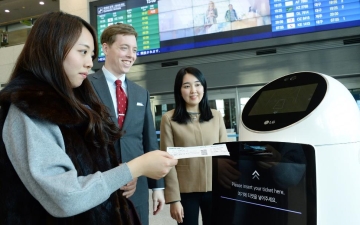
[Critical IT Scene] LG Electronics' AI robot appears at the airport.
LG Electronics has begun on-site testing of airport guide robots and cleaning robots at Incheon International Airport this month. On the 20th, LG Electronics' airport guide robot undergoing functional testing to provide flight boarding information to Incheon International Airport visitors.
2017.02.21by 김지혜 기자
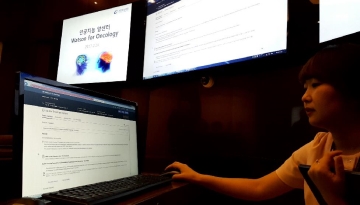
Gil Hospital, which adopted Watson, says, “Humans have started to trust artificial intelligence.”
If a patient chose Watson over a human doctor when comparing diagnostic prescriptions between a human physician and IBM's artificial intelligence Watson? One media outlet reported this result as if it were an 'victory' for artificial intelligence. In response, Ian Lee, director of Gachon University Gil Hospital's AI-Based Precision Medicine Initiative (professor of neurosurgery), stated, "While there are somewhat exaggerated aspects, the important thing is that people have unconsciously developed trust in artificial intelligence. This is a very important signal." He emphasized, "The river that artificial intelligence must cross is gaining human trust. The fact that a patient changed their mind to follow Watson's treatment method is not an ordinary event."
2017.02.21by 신윤오 기자
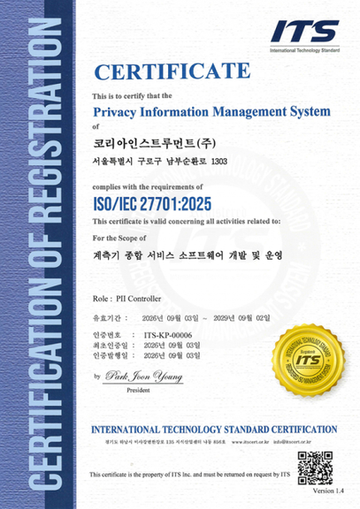
Korea Instrument, KOLAS Accredited Calibration Agency First to Simultaneously Acquire ISO/IEC 27,001·27,701
Korea Instrument has become the first among KOLAS accredited calibration agencies to simultaneously acquire ISO/IEC 27,001 and ISO/IEC 27,701 certifications. Through its proprietary platforms CWIZ Enterprise and CWIZ Partners, the company has embedded information security and personal data protection requirements across all business processes including customer information, equipment data, and calibration reports, with plans to continuously advance its management system through regular audits and security inspections.
2026.10.12by 배종인 기자

TeamViewer One, IT Incident Automation Workflow and Resolution Center Enhanced
TeamViewer has added IT incident automation capabilities and an advanced Resolution Center to its integrated digital workplace management platform 'TeamViewer ONE'. Recurrent service disruptions, configuration errors, and capacity shortages are automatically handled according to preset policies, and device status verification through script deployment can be managed in a unified interface, significantly reducing repetitive tasks for IT teams.
2026.10.12by 배종인 기자











