



Fluke Captures Both “Portability and Precision” in Industrial Pressure Calibrator
 Published2017.03.13 09:46
Application of manual pump system to sites where AC power supply is difficult
As various pressure sensors are used in plant industrial sites, Engineer L has a concern.
“I need to calibrate the sensor on-site. What should I do?”

When I thought about whether I should bring the expensive, precision-grade equipment from the research institute, and even if I did, whether the electrical wiring could be properly connected on-site, I realized there were more than a few things to check.
So, I looked for portable sensor calibrators on the market, but none were suitable. This is because while portability is a given, accurate measurements and ease of use are paramount. After weighing these requirements, Mr. L's options narrowed even further. If portability was satisfied, the pressure range was insufficient, and if convenience was satisfied, portability was compromised.
Fluke, a company specializing in measuring equipment, focused on finding a way to solve the concerns of field engineers, and the resulting field pressure calibrator (2271A) appears to be a product that has achieved its intended purpose.
To calibrate various sensors used in industrial settings, such as analog gauges, digital gauges, transmitters, and transducers, it is necessary to complete fast and accurate verification and calibration using a suitable calibrator. To this end, calibration devices such as deadweight pressure gauges, pressure comparison pumps, pressure controllers, and piston gauges are used.
Among these, Fluke's manual pressure pump was adopted as a suitable option for industrial sites where AC power is not properly supplied. The operating principle of this pump is not complex, as it applies pressure to internal piping just like a standard pump. There are methods of applying pressure by pressing up and down or by rotating it forward like a dart; simply apply pressure in this way and compare it to an accurate gauge for measurement. In other words, you can think of it as blocking the tip of a syringe and pushing the back part forward.
In addition, since the pressure ranges of pressure sensors vary, each must be used appropriately. Portable and mobile field calibrators cannot generate more than approximately 2 MPa. However, Fluke's new product (700Hppk) is capable of up to 21 MPa. This has significantly expanded the scope of field applications.
Lee Seok-tae, a manager at Fluke Korea, stated, “Calibration work must literally be performed on-site, so portability and mobility are essential. Furthermore, since most industrial sites cannot use AC power instead of battery power, field calibrators that meet these constraints are required.”
Field-use equipment offers excellent portability but lower accuracy. Conversely, bench-mounted equipment has poor portability but offers good accuracy. Since precision-grade sensors cannot be calibrated on-site, they are brought to a calibration lab for testing. Accordingly, Fluke also provides bench-type multimeters for precise sensor measurements.
In this regard, Fluke plans to present methods for logging measurement data and various measurement tips using field pressure calibrators and bench multimeters at the online seminar EEWebinar ( http://www.eewebinar.co.kr ) on April 4.
Comments
Related news
.jpg)
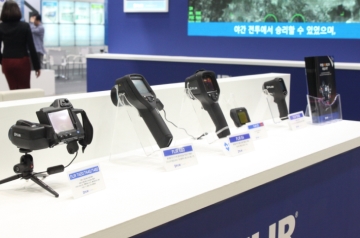
FLIR Introduces Various Thermal Imaging Measurement Equipment at International Electric Power Show
FLIR Systems Korea (Korea Representative: Andrew Calton Tyke) announced that it will participate in the 2016 International Electrical and Power Exhibition to be held from May 11 (Wednesday) to 13 (Friday) at Hall C of the COEX Exhibition Hall in Samseong-dong, showcasing a wide range of thermal imaging measurement equipment for the electrical and power industries. At this exhibition, FLIR will display various thermal imaging measurement equipment including the FLIR C2, FLIR Ex and Exx series portable thermal imaging cameras, the FLIR T-series thermal imaging cameras offering thermal imaging resolution and accuracy of up to 1.2 megapixels, as well as the new clamp meter CM174 and Extech infrared thermometers.
2016.05.12by 명세환 기자
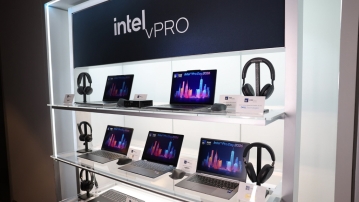
Intel Unveils Next-Generation 'Core Ultra Series 3' and vPro Platform for Enterprise PCs
Intel has officially unveiled the "Intel Core Ultra Series 3" for next-generation enterprise PCs and the latest vPro platform, addressing a wide range of demands from enterprise notebooks to high-performance workstations.
2026.03.26by 배종인 기자
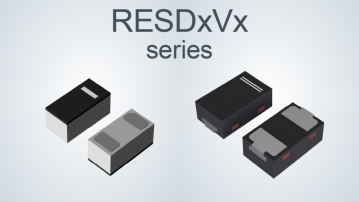
ROHM Launches ESD Protection Diode Compatible with High-Speed Interfaces of 10Gbps or Higher
Semiconductor specialist ROHM has developed the 'RESDxVx series' of ESD (electrostatic discharge) protection diodes capable of responding to next-generation high-speed data communication environments exceeding 10Gbps, simultaneously enhancing both signal quality maintenance required in high-speed interfaces and IC protection performance.
2026.03.26by 배종인 기자











