



Could VR Rooms, Where Virtual Experiences Take Place, Become the Next PC Room?
 Published2017.03.13 14:55
A lecture on trends and future directions to watch in the VR industry.
Will there come a time when we will naturally visit VR rooms like we would go to PC rooms or karaoke rooms?
As the VR room craze heats up in the US, Europe, and China, interest in the domestic market is also heating up. With successful B2B businesses, including PC rooms, in Korea, attention is focused on whether VR rooms will spread further. Since the first VR room opened in Gangnam, Seoul, in July of last year, VR rooms have since appeared in Daejeon, Busan, and Bupyeong. However, contrary to expectations, it is not spreading quickly due to issues with content and devices.
Andy Kim, Vice President of HTC VIVE, who participated in the keynote speech at 'VR Expo 2017' held on the 9th, said that Korea is a very attractive market and presented recent trends in the VR business and problems that need to be solved. Andy Kim, Vice President of Digital Platform at HTC VIVE, gave a lecture on the key trends and evolution direction that we should pay attention to in the VR industry, which is still considering the platform and appropriate business model.
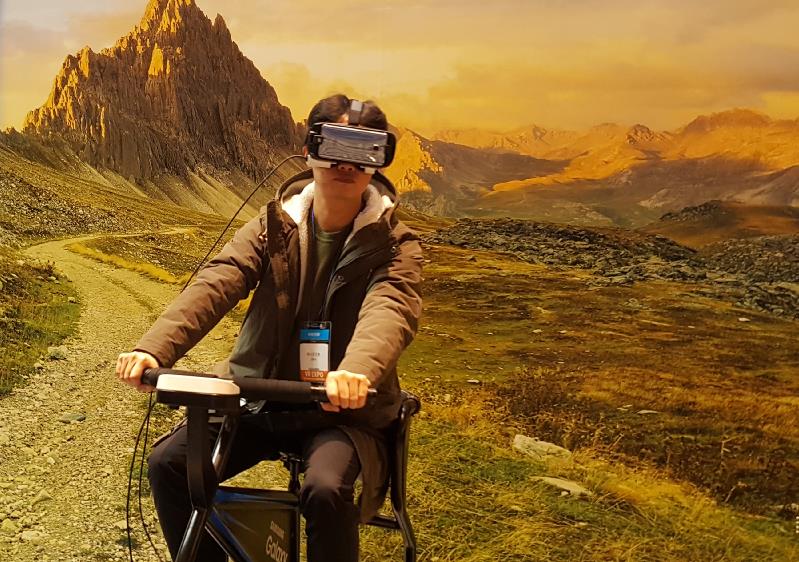
Vice President Kim first defined the VR industry with the keyword "convergence" of the Fourth Industrial Revolution. "VR, AR, and MR are focused solely on deceiving the user's senses. The first challenge has begun: integrating various senses—auditory, tactile, gustatory, olfactory, and even a sixth sense. However, because the sensory aspects are still lacking, immersion in virtual reality is problematic."
One trend worth paying attention to is how to integrate the senses. As new devices emerge and accessories are updated, the tools for creating games that prioritize visuals are expanding to include auditory and olfactory elements. Businesses must consider how to respond to this shift. The domestic market is focused on immediate profits, and there is a lack of consideration for platform operators.
Furthermore, with the wireless VR trend, both high-end and low-end HMD products are expected to enter the market. The boundaries between the high-end market, which required complicated setups by connecting to a PC or console, and the low-end market, which was easily accessible via mobile, are gradually disappearing and colliding. Vice President Kim said, “With the advent of the 5G era, VR will be realized with technology that transmits large amounts of data at high speeds without delay. VR will become the core content of 5G,” and emphasized the need to consider services that can be enjoyed not only in the room but also outdoors.
VR is expected to be implemented as MR in the future, and in the arcade game field, the need for multiplayer is more prominent than single-player, and it is expected that a unique SNS communication method unique to VR will begin.
VR maps are also becoming increasingly important. They foresee that easily converting 2D building drawings into 3D VR, allowing users to experience the building inside, will enable VR commerce. For example, if a VR service that allows you to travel around a country allows you to enter a store inside a building, select items, and even make a payment, it can lead to commerce.
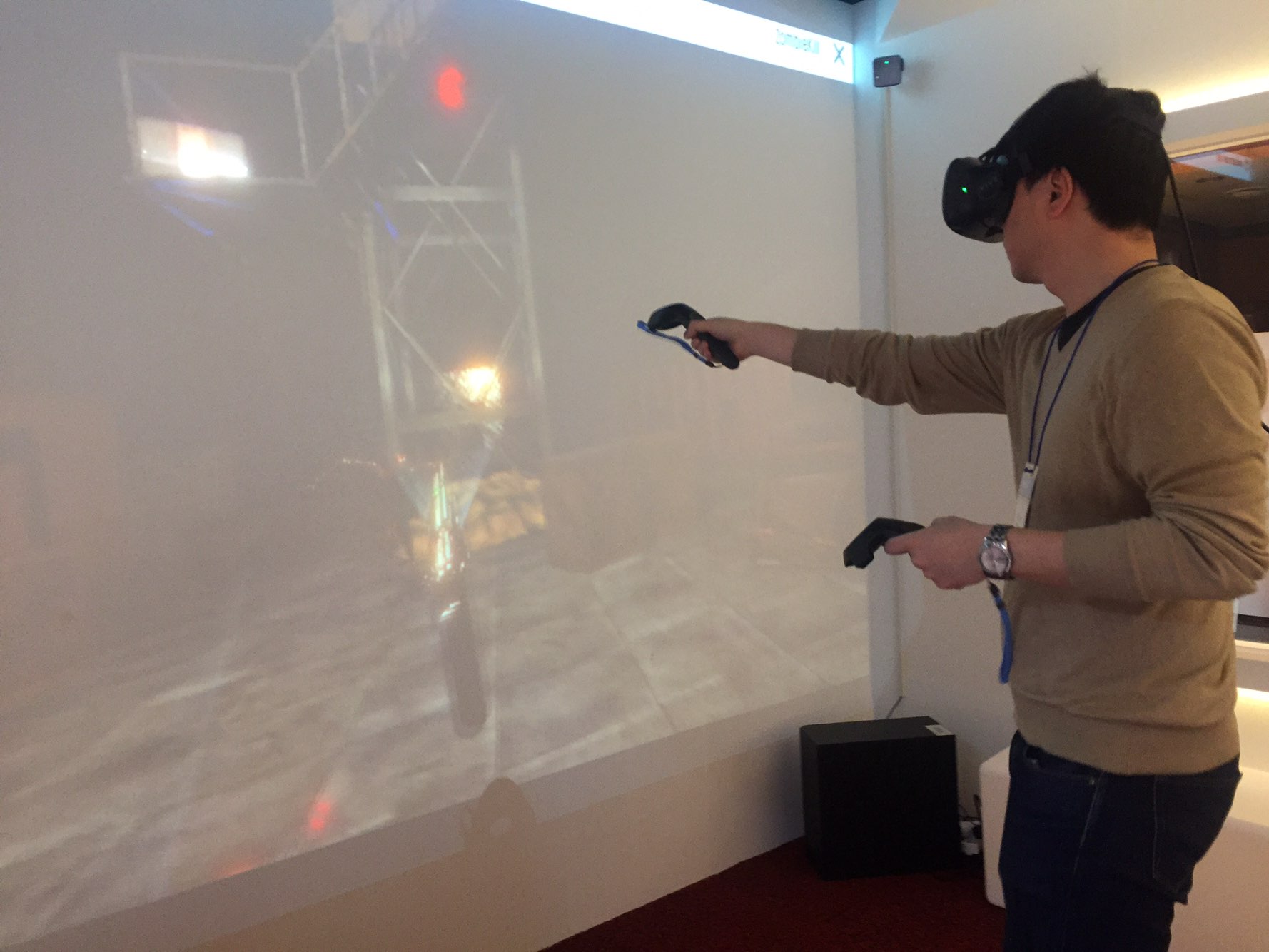
Vice President Kim specifically emphasized the differences between B2B and B2C businesses, particularly regarding VR rooms. The first thing to note is the content. Producing VR content costs approximately 5 to 10 billion won. If content is consumed in VR rooms, individuals will purchase fewer devices and content. This will limit demand in the content market. Korea is prioritizing the revitalization of the VR industry, so there are currently no regulations in this area. If this trend continues, the ecosystem is highly likely to be unsustainable.
Devices suitable for B2B businesses are also crucial. Most device manufacturers produce devices for both B2B and B2C markets without distinguishing between them. Consideration and research are needed to determine whether VR room businesses can increase user numbers and impact device sales.
The VR industry is more suited to B2B than B2C.
Regulatory issues also need to be addressed. Who created the content and what certifications it received are crucial. In China, commercial transparency is often lacking. In this situation, the market will not be active, so we need to create policies that allow for legal and stable business operations.
Another consideration is location. In the VR room business, profitability varies depending on location. VR rooms can be broadly categorized into several types. One option is to convert PC rooms and internet cafes into VR rooms. However, users are accustomed to accessing high-end PCs at lower prices, so this transition to VR rooms may not be feasible due to price competition. A second option, similar to the approach used in the US and Europe, is to add VR equipment to bars.
Additionally, creating VR rooms in large shopping malls is the most active form of VR. A future form is movie theaters. While movie theater operators are considering IMAX VR, it's still in the experimental stage. The next form is stand-up VR, where VR itself becomes a theme park. While there are no clear success stories yet, this is an area we expect to see the most adoption in the first half of this year.
Vice President Kim stated that B2C businesses face many challenges in satisfying consumers at competitive prices, adding, "VR room businesses are crucial among B2B businesses. Korea already has a business model and the experience to grow it into a franchise." He added, "VR still has a lot of uncharted territory. I hope that through extensive consultation and joint investment, many promising cases will emerge."
Comments
Related news
SK Telecom Launches 360 VR Live Broadcasting Service at MWC 2017
SK Telecom announced on the 20th that it will showcase '360 Live VR,' a 360-degree VR live broadcasting service, at the 'Mobile World Congress (MWC) 2017' to be held in Barcelona, Spain for four days starting on the 27th. 360 Live VR is a live broadcasting platform that provides 360-degree omnidirectional video feeds. In order to simultaneously provide 360-degree video, six camera feeds must be transmitted at the same time, requiring significant transmission capacity. 360 Live VR is expected to become a service that will see full-scale activation with the advent of the 5G era, which enables ultra-high-capacity wireless data transmission.
2017.02.20by 서아람 기자
Samsung Electronics to Present VR-Related Projects at MWC 2017
Samsung Electronics will showcase VR-related C-Lab (Creative Lab) projects at MWC 2017, held in Barcelona, Spain from February 27 to March 1. Samsung Electronics will set up a C-Lab exhibition booth at Fira Barcelona 4YFN in Barcelona to meet MWC visitors. The C-Lab projects being showcased at MWC 2017 include Relumino, Monitorless, Buildus, and Traveler.
2017.02.21by 서아람 기자
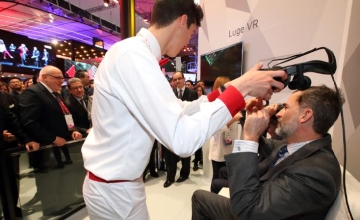
[Photo News] King of Spain experiencing VR
[Photo caption] At the KT booth at MWC 2017, King Felipe VI of Spain is experiencing the Luge event of the PyeongChang Winter Olympics in VR and expressing amazement.
2017.03.02by 신윤오 기자
ESP32 Development Environment Selection and GPS Application Implementation
The ESP32 is a microcontroller that integrates Wi-Fi, Bluetooth, 12-bit ADC, capacitive touch, PWM, DAC, and UART in a single SoC. However, the abundance of features does not by itself solve the designer's problems. The real challenges lie in selecting the appropriate development environment, determining which pins can be used and which must be avoided, and converting raw data from modules into usable information. This document addresses ESP32 peripheral constraints (ADC2 and Wi-Fi coexistence limitation, UART1 occupancy, ADC non-linear regions), the trade-offs between Arduino IDE and ESP-IDF, and the process from connecting NEO-6M/NEO-M8N GPS modules to UART2, parsing NMEA sentences, and visualizing routes in Google Earth, all organized based on documented references.
2026.10.12by 편집부
MIPI CSI-2, DSI-2, C-PHY, D-PHY Test Solution Technical White Paper
The MIPI interface adopts a burst mode that transitions between low-power (LP) and high-speed (HS) states for low-power consumption, and in return, strict timing rules are imposed on state transitions. Additionally, the high-speed section operates as a packet-based protocol with headers, ECC, and CRC, so verification engineers must handle waveforms and protocols simultaneously. Traditional configurations combining general-purpose oscilloscopes and AWGs reveal limitations in setup complexity, measurement uncertainty, and lack of reproducibility when faced with these requirements. This white paper, based on webinar materials, organizes the structure of this problem and describes how the SV5C-DPTXCPTX generator for receiver testing and SV5C-DPRXCPRX analyzer for transmitter testing integrate state transition testing, stressed eye testing, and protocol analysis into a single bench, along with their application boundaries.
2026.10.12by 편집부











