


The power component you need when designing ultra-small devices is 'this'
 Published2017.03.27 16:57
Maxim MAX17222 Recommended for Low Standby Current and True Shutdown
It is not uncommon to see people carrying portable electronic devices and charging them with a power bank. Now, it has become natural to carry a power bank with you. That is why battery life and weight have become important considerations when purchasing laptops, smartphones, and other portable electronic devices.
New wearables, smartwatches, earbuds, video game controllers, IoT, mobile, and other connected products are getting smaller and battery life is becoming a criterion for selection. Battery life is especially important for devices that need to operate stably for long periods of time. What are the factors that determine this battery life?
A significant number of IoT node devices are stored in shutdown mode after they are manufactured until they are used by users. These devices spend most of their battery life in standby mode, waking up periodically to perform specific tasks or sending data to the cloud. A typical example is a wearable fitness monitor that is used while exercising. Finding ways to save power when the device is in standby mode is an effective way to reduce battery life.
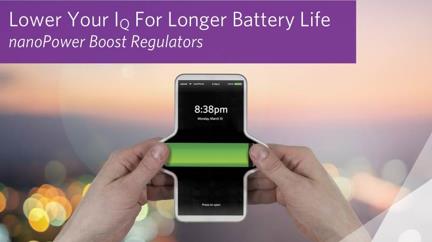
Standby current affecting battery life
Designers measure battery life based on the operating, sleep, and hibernation standby currents of a central control unit, such as a microcontroller (MCU). Associated sensors and wireless communications also work with the MCU. The power supply consists of regulators such as step-up, step-down converters or low-dropout (LDO) converters. Some power supplies include multiple power architectures or even power management ICs (PMICs) that include battery chargers. Battery runtime is ultimately affected by the time spent in each power mode.
When the power supply is in standby mode, the power consumption is determined by the standby current (IQ). This refers to the power consumed to maintain the ready state before operation, even when the power plug is plugged in and not actually used.
Lower standby current can extend battery life. Considering ultra-small designs, low standby current and small form factor are necessary. Consumers and designers prefer smaller and lighter products. Typically, the battery is the largest and heaviest component on the entire board. Efficient power management requires a balance between battery capacity and size. Current wearable, mobile, and IoT designs are not low enough to affect battery life even in the milliamp (mA) range. Nanoamp (nA) range is required.
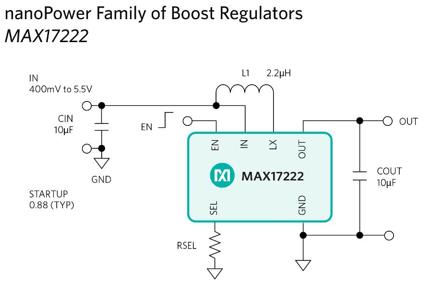
Boost converter is a DC-DC converter with a high output voltage compared to the supply voltage. The optimal boost converter for extending battery life improves the efficiency of the final product and extends its life by cutting off the current output from the input when shutting down.
Maxim's boost DC-DC converter with ultra-low quiescent current (300nA) and true shutdown technology is ideal for applications that require long battery life. The MAX17222 nanopower boost regulator has an inductor current limit of 0.5A. It provides a post-startup ETP function that continuously adjusts the output even at input voltages as low as 400mV depending on the load current. It is also available in 0.88 x 1.4mm2 6-bump WLP and 6-pin uDFN packages, and minimizes heat generation with up to 95% efficiency.
Maxim emphasized that “the MAX17222 combines low quiescent current, true shutdown, low input voltage range, and high µA-class efficiency to create products that ensure long operating times.”
Comments
Related news
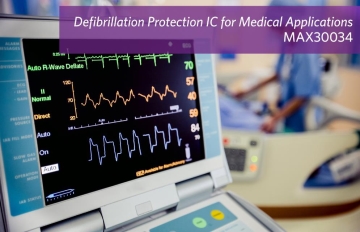
To protect medical equipment from electrostatic discharge
Maxim Integrated Korea has announced the 'MAX30034' for medical equipment such as defibrillators, electrocardiogram (ECG) diagnostics, and monitoring systems. The MAX30034 defibrillation protection device safely protects medical equipment from defibrillation pulses and electrostatic discharge (ESD). Compared to conventional component configurations, it simplifies the design to save more than 75% of space, reduces bill of materials (BOM), and enhances performance.
2017.03.06by 김지혜 기자

Maxim Launches Embedded Security Platform to Protect IoT Devices and Data Paths
Maxim Integrated Korea has launched 'MAXREFDES155#', a DeepCover embedded security reference design that protects Internet of Things (IoT) devices and data paths. IoT application developers can now easily and quickly design robust cryptographic authentication that ensures the reliability and integrity of small data transactions between devices and the cloud.
2017.03.13by 김지혜 기자

Maxim Announces Nano Power Boost Regulator Providing Lowest Standby Current
Maxim Integrated Korea has announced the nanopower boost regulator 'MAX17222'. The MAX17222 achieves the longest battery life in ultra-compact form factors for wearable, consumer, and Internet of Things (IoT) product designs with a minimum standby current (IQ) of just 300nA.
2017.03.14by 김지혜 기자

Intel Unveils Next-Generation 'Core Ultra Series 3' and vPro Platform for Enterprise PCs
Intel has officially unveiled the "Intel Core Ultra Series 3" for next-generation enterprise PCs and the latest vPro platform, addressing a wide range of demands from enterprise notebooks to high-performance workstations.
2026.03.26by 배종인 기자
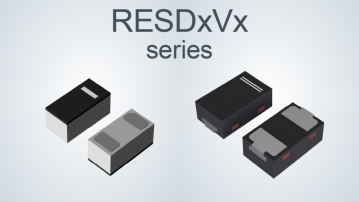
ROHM Launches ESD Protection Diode Compatible with High-Speed Interfaces of 10Gbps or Higher
Semiconductor specialist ROHM has developed the 'RESDxVx series' of ESD (electrostatic discharge) protection diodes capable of responding to next-generation high-speed data communication environments exceeding 10Gbps, simultaneously enhancing both signal quality maintenance required in high-speed interfaces and IC protection performance.
2026.03.26by 배종인 기자











