



AWS: How Far Has It Come?
 Published2017.04.24 14:12
GE, a manufacturing company with a 140-year history, calls itself a "startup," indicating that it's at the beginning stages of its cloud adoption.
In his keynote speech at the AWS Summit held on the 19th, CEO Dong-Hoon Yeom mentioned DevObs, a hybrid form of development and operation, and said, “In the past, we had to purchase new versions, but now we need to think about updates rather than purchases.”
Additionally, CEO Yeom said, "Many companies have already considered and are implementing the cloud," adding, "The cloud is no longer something to worry about."
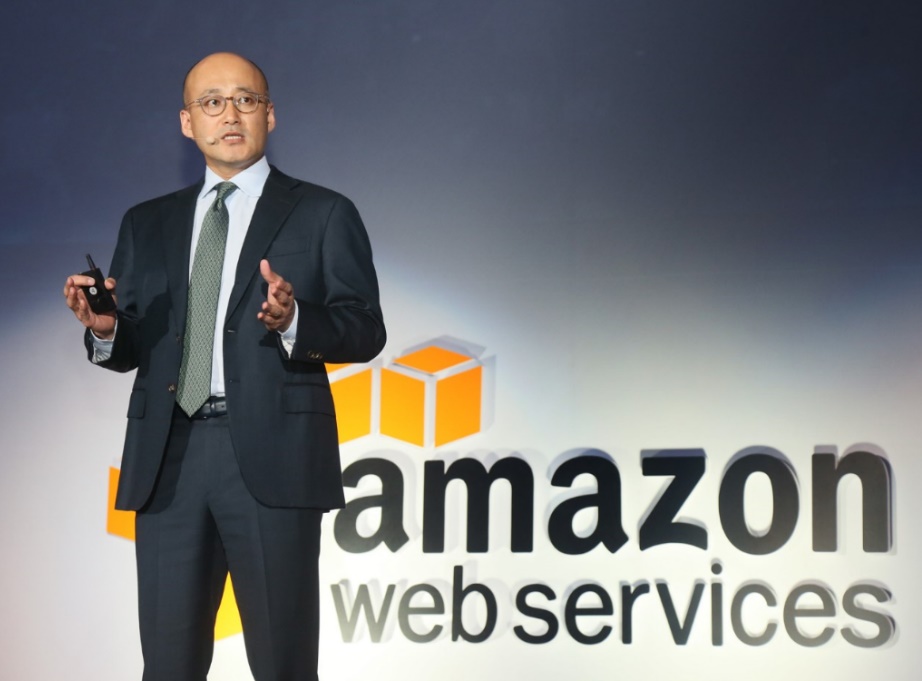
According to him, GE has migrated 9,000 enterprise workloads to AWS and plans to reduce its 34 data centers to four within three years. Following the AWS transition, GE's current performance scores include a 52% cost reduction, a 77% increase in business application delivery speed, a shortened operational deployment cycle from days to hours, and a 240% improvement in customer and market responsiveness.
Amazon's R&D process involves conducting simulations directly within the company. This is how the data lake cloud storage S3 was formed. S3 offers a variety of options, including Siemens, Honda, and GE, and can be converted to suit your needs. It also features Amazon's deep learning, providing programming, data algorithms, and GPU capabilities.
Samsung SDS's Case Study of Cloud Utilization for Advanced Supply Chain Management (SCM)
Last year, the Journal of Commerce, a U.S. logistics journal, published a special article on Samsung SDS titled "A Company Driving Growth in the Logistics Industry." At the heart of Samsung SDS's logistics business is Cello.
Cello Plus divides its support into four areas: ▲Big data-based performance measurement and integrated control of logistics operations; ▲Statistics-based market analysis, demand forecasting, and sales planning; ▲Operational support for warehouse and transportation management; and ▲Master management and integrated settlement management.
Shin Woo-yong, Managing Director of the SDS Business Unit, said, "Cello, which I introduced in my keynote speech at last year's AWS Summit, has been upgraded to the next level within the past year," and cited "speed" as AWS's key keyword. He also cited the ability to quickly and appropriately scale infrastructure based on business needs, the ability to use a relational database (RDB)-based relational data system (RDS) service, and advanced security services as reasons for using AWS.
For example, he cited the logistics crisis last year, when a shipping company's operations were suspended due to court receivership. The crisis was overcome by using Cello in the Gulf Cooperation Council (GCC) to assess the status of vessels and containers, secure alternative shipping lines, change the company's routers, and conduct emergency aircraft airlifts.
Market analysis based on statistics included examples of new product launch promotions. "Based on machine learning, we trained the system on three years of sales performance, promotional information, pricing, advertising, and other predictive factors like weather and holidays," he said. "We inputted 20 weeks of data and received predictions in minutes. The results were faster and more accurate than previous work."
The AWS Summit Seoul, held for the third time this year, featured a keynote address followed by over 80 industry- and technology-specific presentations on cloud technology over two days. The keynote address was held in COEX Exhibition Hall D rather than a conference room, and around 30 partner booths and side events were held throughout the venue.
■In the industry now
Careful Cloud Adoption: Where to Start
61% of domestic cloud adoption rates remain unadopted.
Four out of ten large domestic companies have adopted cloud computing. However, according to research from marketing services firm IDG Research, only 39% of Korean companies were using cloud computing in 2017. Fifty-five percent said they had not adopted it, and 6% were unsure. Companies other than large corporations remain cautious.
Throughout the conference hall where the AWS Summit was taking place, I encountered people talking about their "debate about adopting the cloud." Many of them asked, "It's working well enough now, so why bother?" Park Sang-wook, director of AWS partner Megazone, said, "There's still a culture of distrust in 'what can't be seen,'" and that "people hesitate to adopt until a blanket directive is given." Beyond this, there are still barriers to cloud adoption, including security and regulatory concerns, service disruptions, questions about network connectivity and quality, and low skill and understanding among practitioners.
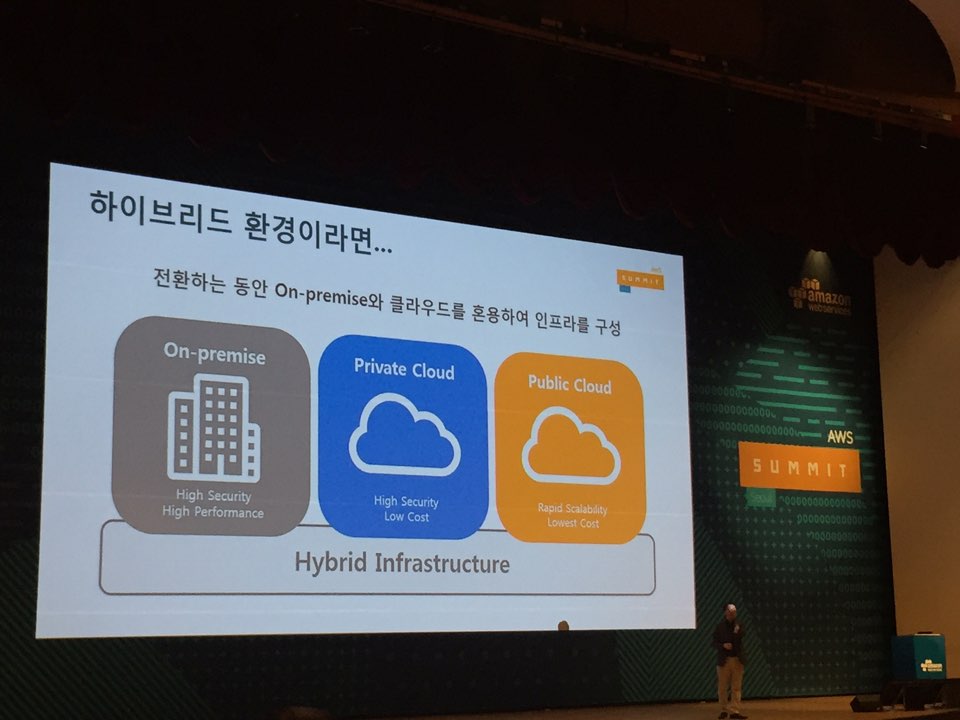
Megazone's Team Leader Yang Man-soo divided hybrid architecture, a solution to overcome these barriers, into two types: one that strengthens security and expands services to the cloud, and the other that connects directly to AWS for cost savings and faster service. The former connects to a Virtual Private Network (VPN) and uses agents to implement security solutions on third-party storage. Initial investment costs are covered by on-demand payments, system scale is adjusted after launch, and large-scale events are supported through cloud expansion and auto-scaling. Companies involved include Zadara and Trend Micro.
The latter involves standardizing resources and establishing a dedicated network directly connected to data centers, enabling unlimited expansion of development, verification, and operational infrastructure. KINX is working on this initiative.
Beyond hybrid cloud, Team Leader Yang also suggested a step-by-step approach. These include starting with individual modules, building cost-effective analytics systems rather than operational or execution systems, and integrating new construction rather than existing legacy systems.
Comments
Related news

Commvault Launches Reference Architecture for AWS Data Management
Commvault has launched new 'reference architectures' for Amazon Web Services (AWS) data management. The reference architectures introduced this time are pre-optimized solutions that have completed functional validation within the AWS environment, enabling customers to easily and conveniently install Commvault products, protect data, and manage their data.
2017.01.25by 김지혜 기자
Baidu Cloud Enhances AI Capabilities by Embracing NVIDIA Deep Learning
The new Baidu Cloud adopts cutting-edge GPU computing technologies, including NVIDIA Tesla P40 GPUs based on Pascal architecture and NVIDIA deep learning software. It also supports training and inference acceleration for open-source deep learning frameworks such as TensorFlow and PaddlePaddle. Artificial Intelligence Platform NVIDIA's deep learning frameworks are being accelerated through NVIDIA platforms available in services offered by major cloud enterprises worldwide, including Alibaba, Amazon, Google, IBM, and Microsoft. From startups to leading multinational enterprises, various companies can leverage GPU advantages in the cloud to achieve rapid results without going through significant capital expenditures or complex infrastructure management procedures.
2017.04.20by 김자영 기자

Limelight Networks Announces 'Cloud Security Service' to Block Unauthorized Access
Limelight Networks announced the launch of 'Cloud Security Services' that strengthens cybersecurity measures across the CDN infrastructure by enhancing capabilities to block cyberattacks, content theft, and unauthorized access. Limelight Networks' 'Cloud Security Services' features enhanced 'Security Alert' and 'WAF Express' functionality. Security Alert provides more comprehensive protection for websites and web applications. It delivers DDoS attack detection and alerting capabilities, enabling customers to accurately identify malicious attacks against their websites and applications. Additionally, the customer content delivery service minimizes attack vectors exposed to the internet and enables Limelight Networks' defensive protection to be executed effectively.
2017.04.21by 김지혜 기자
.jpg)
SalePoint Signs Multi-Year Partnership Agreement with AWS… Promoting Identity Security that Integrates Even AI Agents
Sailpoint has entered into a multi-year strategic partnership agreement with AWS and is moving forward with establishing an integrated governance system that manages both human and non-human identities together. The plan is to consistently manage access permissions in an environment where AI agents are increasing as work execution entities, while applying the principle of least privilege and automated policy enforcement. The two companies plan to jointly expand capabilities to manage the identities of various entities, including AI agents, within a single layer in the AWS environment. This collaboration is interpreted as a move to design security and governance together in corporate environments where AI adoption is expanding.
2026.03.26by 배종인 기자
.png)
Databricks Unveils Open AI Security Monitoring 'Lakewatch'
Databricks entered the security market on March 24 by unveiling LakeWatch, an open-source agentic SIEM. The core functionality of this product is to integrate and analyze security, IT, and business data in a single environment to support AI-based threat detection and investigation. The company explained that it reduces the limitations of existing security operations centers, which have had to forgo some data due to high cost structures, and enables large-scale data analysis and automation based on open formats and ecosystems. LakeWatch is currently offered as a private preview, with Adobe and Dropbox mentioned as early customers. Databricks also announced an expanded partnership with Anthropic as well as the acquisition of Antimatter and SiftD.ai.
2026.03.26by 배종인 기자











