



NVIDIA Announces 'PilotNet,' AI That Learns Human Driving Styles
 Published2017.05.10 06:06
Recognize different road environments depending on lane markings, road pavement conditions, time of day, and weather.
NVIDIA developed 'PilotNet,' a neural network-based system that learns vehicle driving by observing drivers' behavior. Furthermore, they developed a tool to verify which factors this neural network system prioritizes during decision-making while driving. Utilizing this, they built a self-learning system and made it possible to verify how the vehicle makes decisions.
AI that learns driving by observing human driving styles
NVIDIA is utilizing its proprietary AI vehicle, BB8, for the development and testing of DriveWorks software. To date, NVIDIA has used Ford, Lincoln, and Audi vehicles with BB8 and plans to use vehicles from other manufacturers in the future; therefore, vehicle manufacturer and model information are not key factors in the development of this AI vehicle. The element that enables BB8 to demonstrate the power of deep learning as an AI car lies in the deep neural network that interprets images from the front camera to issue driving commands.
Training was conducted to enable a deep neural network to learn the driver's driving behavior and drive the vehicle autonomously. The network utilized cameras mounted on the vehicle to record what the driver was looking at, and then correlated those images with data from the driver's decision-making during driving. NVIDIA recorded a significant amount of driving data across various environments. In addition to diversifying road environments, such as roads with and without lane markings, unpaved roads, and highways, records were recorded at different times of the day under varying lighting conditions, and a variety of weather conditions were also incorporated.
The trained network autonomously learned how to drive BB8 through observation, without any code-based commands. The trained network became capable of issuing real-time driving commands even in new environments. You can see it in action in the following video.
The thought process of artificial intelligence
As PilotNet went into operation, NVIDIA developed a visualization map to examine its decision-making process, which shows which elements PilotNet prioritizes when observing an image.
Through this visualization map, NVIDIA was able to identify what PilotNet prioritizes most when receiving new information from vehicle cameras, as shown below. The example below shows a visualization overlaid on an image recorded by a vehicle camera, with points where PilotNet places high priority marked in green.
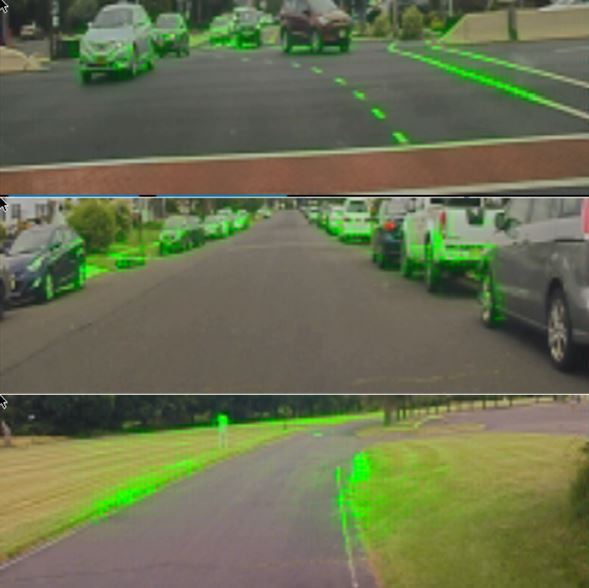
Through these visualizations, NVIDIA was able to confirm that PilotNet focuses on the same elements that drivers focus on, such as lane markings, road edges, and other vehicles. PilotNet learned without direct commands, just as real people learn to drive; it learned through observation which factors are important for decision-making in a driving environment.
“The advantage of using deep neural networks is that vehicles can perceive situations on their own, but it is difficult to achieve substantial progress if developers do not understand how these networks make decisions,” said Muller, Head of Development. “Through this tool developed to verify the network’s decision-making process, NVIDIA can identify the information needed to improve the system. Developers cannot explain to the vehicle exactly what it needs to do, but they can show the driver’s driving behavior so that the vehicle can learn on its own, and the vehicle can now show developers what it has learned.”
If autonomous vehicles enter mass production, various artificial intelligence neural networks and diverse technologies will be utilized for vehicle operation. In addition to the pilot network that controls driving, various networks trained to focus on specific tasks such as pedestrian detection, lane detection, sign recognition, and collision avoidance will be installed in the vehicles.
By utilizing diverse AI networks dedicated to specific fields of expertise, the safety and stability of autonomous vehicles can be enhanced. NVIDIA’s development work has applied this advanced AI to the complex situation of driving. The BB8 autonomous vehicle demonstration can be seen in the following video.
More information about NVIDIA’s automation solutions, such as the AI autonomous driving supercomputer DRIVE PX2 and the open platform for developers NVIDIA DriveWorks, can be found at the following link (NVIDIA.com/drive). Research data on the method for identifying the priority process of deep neural networks can be found in the following white paper.
Comments
Related news
NVIDIA Hosts Deep Learning Day 2017 to Share Deep Learning and AI Technologies
NVIDIA will hold "NVIDIA DEEP LEARNING DAY 2017" beginning in Seoul on May 25th, followed by Daejeon on the 30th and Busan on June 1st, where it will share the latest deep learning and artificial intelligence trends and technologies. As interest in deep learning and artificial intelligence continues to grow and application fields expand progressively, NVIDIA is hosting "NVIDIA Deep Learning Day" for the second consecutive year to broaden the adoption of deep learning. Through NVIDIA Deep Learning Day, NVIDIA experts leading GPU-based deep learning technology will share the latest technologies and information on deep learning and artificial intelligence at the center of the Fourth Industrial Revolution with industry professionals, professors, and students, while providing practical training labs.
2017.04.17by 김지혜 기자
Nvidia to advance AI in collaboration with Facebook
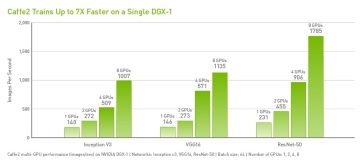
Nvidia strengthens Caffe2 deep learning framework capabilities in collaboration with Facebook Nvidia has announced the results of its collaborative efforts with Facebook to advance artificial intelligence, working with Caffe2, an open-source AI deep learning framework released by Facebook. Facebook is developing artificial intelligence systems that help manage vast amounts of data. These AI systems facilitate efficient communication. Developers and researchers can leverage Caffe2 to configure large-scale distributed training scenarios and develop machine learning applications for user devices. To deliver AI-based services on mobile platforms, complex data processing tasks must be executed instantaneously. Such rapid AI service processing requires deep learning software that can leverage GPU-accelerated computing and fully utilize the performance of accelerated hardware. Nvidia and Facebook are providing AI acceleration through collaborative work on the Caffe2 deep learning framework. Through joint engineering, end-to-end optimization has been implemented to maximize the advantages of Nvidia's GPU deep learning platform. Caffe2 leverages Nvidia's latest deep learning SDK libraries—cuDNN, cuBLAS, and NCCL—to deliver high-performance multi-GPU accelerated training and inference. As a result, users can recognize that Caffe2 delivers optimal performance on Nvidia GPU systems and focus on developing AI-based applications. As part of this collaboration, the Nvidia DGX-1 AI supercomputer is expected to be the first AI system to offer Caffe2 in a software stack optimized for deep learning. Both DGX-1 and Caffe2 deliver high performance and fast training. In the future, customers will be able to access Caffe2 for DGX-1 through the Nvidia DGX-1 Container Registry. To date, Nvidia has supported more than 10,000 developers worldwide through the Nvidia Deep Learning Institute, enabling them to design, train, and build neural network-based machine learning for various intelligent applications and services using the framework. Caffe2 training will be available through the Nvidia Deep Learning Institute at the GPU Technology Conference being held in San Jose, San Francisco from May 8-11 local time.
2017.04.21by 김자영 기자
Nvidia, Meet Everything About Autonomous Vehicles at 'GTC2017'
Nvidia announced that it will prepare various autonomous vehicle-related sessions at 'GTC 2017 (GPU Technology Conference 2017)', the world's largest GPU developer conference, held in Silicon Valley from May 8th to 11th U.S. local time. This year's GTC will feature conferences and hands-on sessions, exhibitions, demonstrations, and networking events. Among them, the autonomous vehicle software session, attended by numerous industry partners and experts, is expected to introduce how artificial intelligence is being utilized in autonomous vehicle software development. First, Mercedes-Benz's head of Connected Car, User Interaction, and Telematics R&D will demonstrate how to implement artificial intelligence in vehicles equipped with embedded hardware for sensor processing and fusion solutions inside the vehicle.
2017.05.02by 김지혜 기자

[e4ds Tech Day 2026 ⑨] Sim Sang-gyu, Autocrypt CTO: "In the Physical AI Era, Automotive Security Must Extend Beyond the Vehicle"
At e4ds Tech Day 2026, Sim Sang-gyu, CTO of Autocrypt, explained automotive cybersecurity strategies in the era of Physical AI and SDV (Software-Defined Vehicle). Automobiles are evolving as part of an ecosystem connected to AI, cloud, chargers, IoT, and robots, and he emphasized that the scope of security must expand beyond the vehicle interior to the entire connected environment. In particular, AI model tampering, adversarial attacks, OTA updates, and EV charger hacking were identified as major threats. He explained that response measures require zero trust, AI model integrity protection, intrusion detection, Security by Design and Default, and full lifecycle security management, and that proactive security system establishment beyond regulatory compliance is critical for securing future mobility competitiveness.
2026.10.12by 배종인 기자

Practical HIL Construction Strategy for Automotive and Off-Highway Controller Validation
As vehicle E/E architecture transitions to zonal structures and shifts to software-defined vehicles (SDV), the number of controllers (ECUs) requiring validation and software complexity are surging dramatically. Meanwhile, real vehicle testing cannot provide repeated verification under identical conditions and entails lead time and safety concerns. This white paper explains the principles of HIL (Hardware-in-the-Loop) validation and the structure of the NI platform composed of PXI, SLSC, and VeriStand, and through two actual implementation cases—Camera Record & Replay HIL for In-Cabin Monitoring Controller (ICMU) and Forklift Controller (VCU) HILS—describes how controller-level regression testing becomes possible. Additionally, it explicitly states application boundaries and limitations, such as lack of A2B support.
2026.10.12by 편집부











