



Ransomware increased by 36% last year; attacks expected to rise in combination with worms.
 Published2017.05.15 11:39
Exploitation of MS Windows Vulnerabilities Rapidly Spreading Worldwide
'Ransom.Wannacry', which encrypts data files and demands a ransom, is spreading widely worldwide, centered in Europe.
According to a survey by Symantec, which stated that special attention to security is required, the WannaCry ransomware encrypts data files and demands that users pay a ransom of $300 in Bitcoin. It warns that if the ransom is not paid within 3 days, the amount will double, and if it is not paid within 7 days, the encrypted files will be deleted.
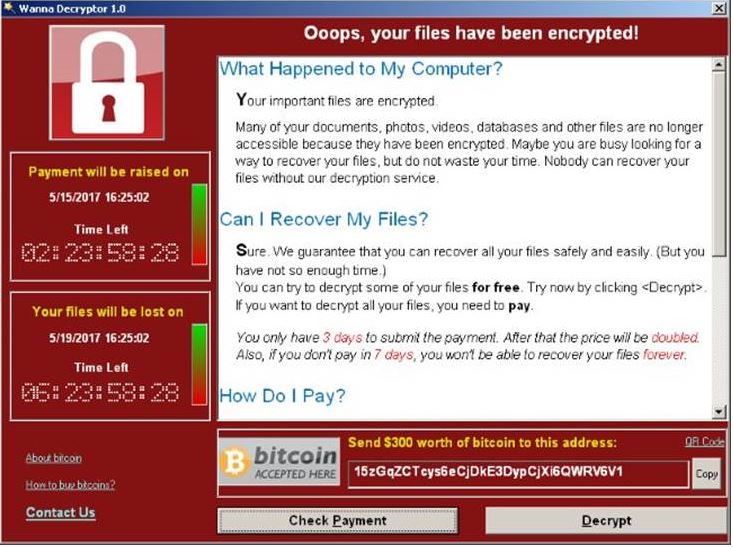
WannaCry ransomware encrypts files with extensions such as .3ds, .ai, .asf, .asm, .asp, .avi, .doc, .docx, .gif, .gpg, .hwp, .java, .jpeg, .jpg, .mp3, .mp4, .mpeg, .ost, .pdf, .png, .ppt, .pptx, .psd, .pst, .rar, .raw, .rtf, .swf, .tif, .tiff, .txt, .wav, .wma, .wmv, .zip, and adds the extension .WCRY to the end of the filenames.
WannaCry ransomware is known to spread to other computers by exploiting an SMB remote code execution vulnerability (MS17-010) targeting computers using Microsoft Windows.
It has been found that the reason the WannaCry ransomware is spreading on a large scale, particularly worldwide, is because it exploits known vulnerabilities in Microsoft Windows and possesses the ability to spread autonomously within corporate networks regardless of user activity. Since computers with Windows security updates not up to date are at risk of infection, it is necessary to download the updates.
You must make it a habit to update patches and keep your software up to date.
Meanwhile, according to Symantec’s 22nd Internet Security Threat Report, global ransomware attacks increased by 36% in 2016 compared to the previous year, and more than 100 new ransomware families (a collection of variant malware classified into the same category) were discovered during the year. Additionally, the average amount demanded by ransomware criminals in 2016 was found to be $1,077 (approximately 1.22 million KRW), an increase of about 3.7 times from $294 (approximately 330,000 KRW) in 2015.
"WannaCry is a combination of ransomware and a worm, and since worms pose a higher risk because there is a high possibility of automatic remote infection if patches are not applied," said Yoon Kwang-taek, CTO of Symantec Korea. "As there is a high possibility that attacks combining ransomware and worms will increase in the future, it is necessary to make it a habit to update patches and keep software up to date." "In particular, as ransomware attacks via email are on the rise, it is safer to delete suspicious emails and back up important files in advance," they advised.
Ransomware Prevention Security Guidelines
- Since new ransomware variants appear regularly, you must keep your security software up to date.
- Keep the operating system (OS) and other software up to date.
You must keep your software updated to the latest version because updates include patches for new security vulnerabilities that ransomware attackers can exploit.
Email is one of the major routes of infection, so special caution should be exercised regarding emails containing suspicious links and attachments.
You should be especially careful with emails containing MS Office attachments that prompt you to view content using macros. Unless you are certain that the email is from a trusted source, do not enable the macros and delete the email immediately.
To prepare for ransomware infection, you must back up important data.
Comments
Related news
VMware: 43% of 500 Office Workers Fully Comply with IT Security
VMware Korea announced research results on the current state of digital workspaces for office workers. The study was conducted based on a survey of 500 office workers employed across various industries including domestic manufacturing, medical and healthcare, consumer goods, and public sectors. According to the research results, office workers showed increased usage of mobile devices and applications during work, demonstrating awareness of the need for flexible work environments. Respondents used an average of 2.4 devices and 5.4 applications, with primary work tasks identified as email and message checking and response, financial transactions, and work file operations in that order.
2017.04.06by 김자영 기자
Domestic IT security market growth driven by intelligent and ransomware attack protection solutions
Last year, South Korea's IT security market saw growth driven by endpoint and messaging security solutions. According to the IT security product market report for South Korea released recently by Korea IDC (CEO Hong Yoo-sook), the domestic IT security product market last year was tallied at approximately 658.2 billion won, representing a 3.3% increase compared to the previous year. As the overall IT security product market has reached saturation, there was no significant growth in individual segments. However, endpoint solutions capable of responding to advanced attacks and messaging security solutions addressing the increase in ransomware attacks showed relatively high growth rates and are analyzed to have driven overall growth in the domestic IT security product market.
2017.04.10by 신윤오 기자
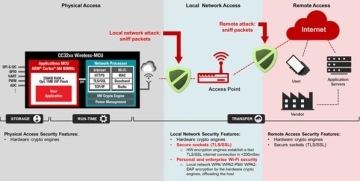
Are you worried about IoT usage and security?
As the Internet of Things (IoT) has become activated, most devices in our surroundings are now connected to the internet. Any and all devices connected to the internet can be subject to local or remote attacks. Attackers can compromise connected devices to steal corporate intellectual property stored in systems, gain access to user data, or maliciously manipulate systems to cause harm to users. Security threats in IoT are a critical issue. We hold several misconceptions about how to address them. As evidenced by the massive distributed denial of service (DDoS) attack that occurred at the end of last year, which experts have called the largest in history, even seemingly innocuous products such as home digital video recorders (DVRs) can be maliciously compromised and used as "botnets" to disrupt the operations of third-party entities. Last year's attack impacted services such as Twitter and PayPal, but similar attacks could be directed at large-scale smart infrastructure technologies such as power grid systems. According to a 2016 survey conducted by Kaspersky Lab, some enterprises and organizations have spent over 1.6 million dollars to address a single DDoS attack.
2017.05.02by 김지혜 기자
.png)
Databricks Unveils Open AI Security Monitoring 'Lakewatch'
Databricks entered the security market on March 24 by unveiling LakeWatch, an open-source agentic SIEM. The core functionality of this product is to integrate and analyze security, IT, and business data in a single environment to support AI-based threat detection and investigation. The company explained that it reduces the limitations of existing security operations centers, which have had to forgo some data due to high cost structures, and enables large-scale data analysis and automation based on open formats and ecosystems. LakeWatch is currently offered as a private preview, with Adobe and Dropbox mentioned as early customers. Databricks also announced an expanded partnership with Anthropic as well as the acquisition of Antimatter and SiftD.ai.
2026.03.26by 배종인 기자
Kaspersky Unveils Revamped 'NEXT' Combining SOC Integrated Management and AI Analytics
As enterprises increase demand for integrated management and automation in the construction and operation of Security Operations Centers (SOC), Kaspersky has disclosed updates to its B2B security product suite 'Kaspersky Next'. This update expands EPP, EDR, XDR, and SIEM integration through a single console based on OSMP, incorporates AI capabilities such as DLL hijacking detection and suspicious account takeover behavior identification, and includes integration with generative AI assistant tool KIRA. The company stated that in large-scale deployment environments, EDR Expert can reduce resource requirements by up to 30%, and XDR Expert by up to 60%.
2026.03.25by 배종인 기자











