



[Interview] Accurate Data Collection Depends on Which ADC You Choose
 Published2017.05.16 17:58
As the importance of data increases, engineers are also increasingly concerned about choosing an ADC (analog-to-digital converter). This is because ADCs, which are essential for electronic devices in various industries and fields, have a significant impact on speed and precision.
Engineers must carefully consider the resolution, accuracy, speed, and response to environmental changes of different types of ADCs and of specific companies.
The ADCs that are currently widely used include the sequential analog-to-digital (SAR) ADC and the delta-sigma ADC. The SAR ADC is fast, but has a resolution of about 10 to 12 bits, while the delta-sigma ADC reduces errors through oversampling and provides an average resolution of 24 bits, but the sampling speed is slow.
For example, as the importance of more precise digital multimeters (DMMs) increases in factory automation and robot development, the role of ADCs is also becoming more important. In such cases, it is appropriate to use a delta-sigma ADC with high precision and signal-to-noise ratio (SNR) performance.

SAR ADCs support fast speeds but have poor resolutions, so they have been used by adding comparators as needed. TI Korea’s Moon Soon-ja said, “As the comparator is installed, the speed becomes slower and the price increases, which is a concern for the research designer.” This is because if the resolution is high, the continuity or SNR may decrease.
Regarding this, Mr. Moon listed 'high resolution, speed, and low price' as the ideal ADC conditions. From a designer's perspective, performance is important, but price is something that cannot be left out. TI's SAR ADC, ADS8900B, integrated the operational amplifier buffer internally because it paid attention to this part. ADS8900B has the characteristics of an ADC, such as a fast speed of 1msps, 20bit resolution, 100db SNR, and noise of plus or minus 1ppm or less. Although the buffer that was external was integrated, it can be manufactured in a smaller size than the external one due to the miniaturization of the manufacturing process.
“Because we go through the internal process of trimming the process, we can reduce errors and distortions and provide accurate reference values,” he said.
Among the related references, he mentioned the ultrasound system circuit design. Mr. Moon said, “In the circuit design design, real-time frequency change is important in the CW Doppler Path, and it is transmitted digitally.” He emphasized the high resolution and fast speed of sending the signal without distortion. Even for ADCs with the same bit, the speed and performance are all different, making a simple comparison difficult.
An online seminar (eeWebinar) explaining the operating principles and related applications of SAR ADC and Delta-Sigma ADC, which are difficult to simply compare because of their operating principles, will be held on Tuesday, the 30th of this month. In addition, time will be spent designing an ADC to see what kind of architecture ADC can be designed for the CW Doppler path of an ultrasound system.
Comments
Related news
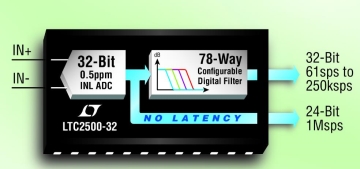
ADI Launches 32-Bit SAR ADC with Maximum Dynamic Range
Analog Devices announced the launch of the LTC2500-32, an ultra-high-precision 32-bit SAR (successive approximation register) ADC (analog-to-digital converter). The LTC2500-32 represents a new implementation approach for precision measurement applications. It combines high accuracy with Linear Technology's proprietary SAR ADC architecture along with a flexible integrated digital filter to optimize system signal bandwidth and facilitate analog anti-aliasing filter requirements. The LTC2500-32 simultaneously provides (1) 32-bit low-noise digital filtered output (achieving a maximum dynamic range of 148dB) and (2) 32-bit 1Msps zero-latency output (consisting of an overrange detection bit, 24 bits representing the input voltage difference, and 7 bits indicating common-mode input voltage).
2017.04.05by 김지혜 기자

What is important in a battery analysis system is the ADC
As portable devices have proliferated, battery-powered systems have become commonplace. Since battery defects occur frequently, it has become important to identify and replace battery defects early. Whether individual batteries used in mobile phones or battery banks for storing renewable energy, any battery defect can lead to system downtime. A precision analog-to-digital converter (ADC) is used as a key component in battery analysis systems that can assess battery health status. Depending on key specifications of the ADC such as speed, resolution, and latency, battery health status can be analyzed more accurately. Looking at the Randles lead-acid battery model in Figure 1, we can see how critical ADC performance is.
2017.04.18by 김지혜 기자
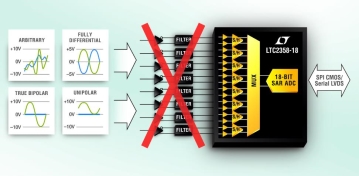
ADI Launches SAR ADC with Built-in Picoampere Input Buffer
Analog Devices announced the launch of LTC2358-18, a new 18-bit 8-channel simultaneous sampling SAR (successive approximation register) ADC with an integrated picoampere (pA) input buffer. In particular, when board space is limited, the LTC2358-18 reduces space and cost by eliminating the front-end signal conditioning circuits commonly required to drive switched capacitor ADC inputs that require buffering. It can reduce 3 amplifiers, 6 resistors, and 2 capacitors per channel, thereby reducing a total of 88 components across 8 channels. This delivers significant reductions in BOM (bill of materials) cost as well as board area, while also providing more than 40% reduction in power consumption.
2017.04.18by 김지혜 기자

Intel Unveils Next-Generation 'Core Ultra Series 3' and vPro Platform for Enterprise PCs
Intel has officially unveiled the "Intel Core Ultra Series 3" for next-generation enterprise PCs and the latest vPro platform, addressing a wide range of demands from enterprise notebooks to high-performance workstations.
2026.03.26by 배종인 기자

ROHM Launches ESD Protection Diode Compatible with High-Speed Interfaces of 10Gbps or Higher
Semiconductor specialist ROHM has developed the 'RESDxVx series' of ESD (electrostatic discharge) protection diodes capable of responding to next-generation high-speed data communication environments exceeding 10Gbps, simultaneously enhancing both signal quality maintenance required in high-speed interfaces and IC protection performance.
2026.03.26by 배종인 기자











