



Try using MCU and RF solutions on a single chip.
 Published2017.05.26 09:43
A motion detector is a device that detects and notifies the presence of a person in a designated area. It is used in homes, office buildings, and other facilities. The detector can transmit sound, light, or wired/wireless notifications to various devices, such as control panels, alarms, and cloud systems.
Wireless motion detectors are easy to install and expand because they do not require wiring through walls. Common detection techniques include PIR (passive infrared), ultrasonic emitters, and microwave emitters.
Wireless motion detectors, installed indoors or outdoors and primarily used as intrusion detection systems, generally utilize Sub-1GHz wireless technology due to their excellent radio frequency (RF) performance and low power consumption and cost.
TI’s System-on-Chip (SoC) Sub-1GHz solution (CC13x0 wireless MCU) integrates a low-power, feature-rich MCU and RF solution into a single chip. In a sensor system (Figure 1), this low-power wireless MCU can operate as the system’s main MCU, directly interfacing with the sensor or through amplifiers, filters, and comparators. Additionally, the CC1350 and CC1310 wireless MCUs integrate I2C, UART, and SPI for peripheral control, and also have a built-in 12-bit analog-to-digital converter (ADC) for analog signal sampling.
By using an SoC wireless MCU instead of a separate MCU and RF transceiver, functional integration can be increased while reducing size and cost. The main MCU provides sufficient flash and RAM for ARM® Cortex®-M3 architecture-based applications and protocols.
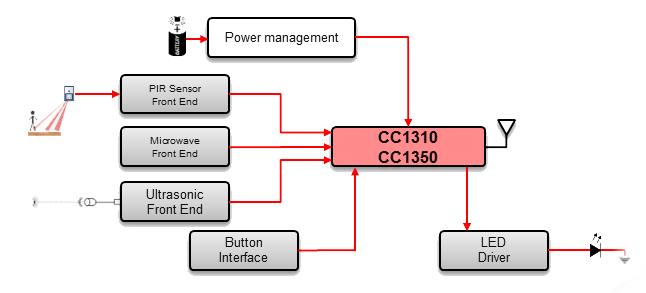
This MCU product provides the foundation for low-power designs with very low shutdown or standby currents (0.185A and 0.7A, respectively), 51A/MHz MIPS (million-instruction-per-second) consumption, and receiver (5.4mA) and transmitter (13.4mA at 10dBm) currents. Additionally, by introducing an innovative low-power execution unit called a sensor controller module, the rest of the system (the main MCU) can enter sleep mode while monitoring sensors. Consequently, the system consumes only 0.95A even while performing ADC readings every second.
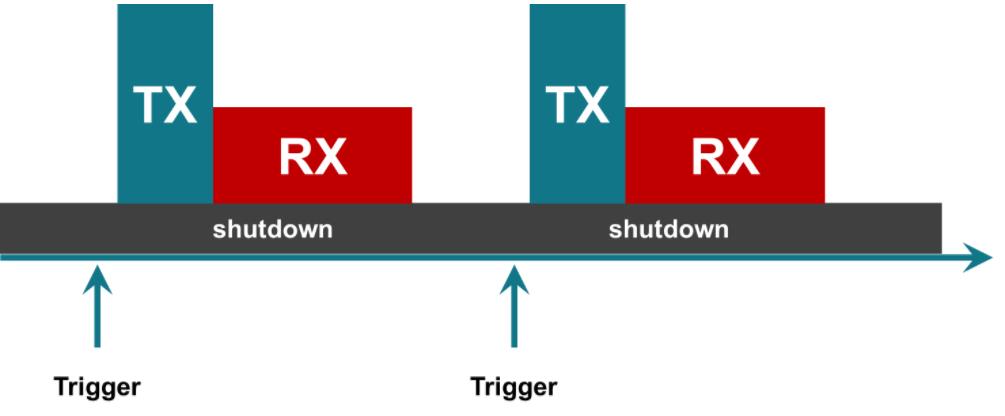
In a typical motion detector system, the sensor controller continuously monitors the sensor. As shown in the figure below, when triggering occurs, the controller activates the main MCU, and the main MCU notifies the central unit.
The SimpleLink Sub-1GHz CC13x0 Software Development Kit (SDK) provides two easy options for RF communication. The first option is Easylink, a proprietary RF interface utilizing a standard-based 802.15.4g stack for one of the supported modulation schemes and star topologies. Easylink allows you to add motion detectors to existing wireless systems using your own proprietary protocol. However, if you do not have a proprietary protocol, using TI's 15.4g stack is more suitable. This stack includes standard access mechanisms such as acknowledgment, security features, and frequency hopping options. This tool can be used to protect systems from RF jamming, cyberattacks, and noisy environments. TI also provides end-to-end sensor-to-cloud solutions that enable two types of communication between sensor nodes and cloud operators for monitoring and control.
The CC1350 wireless MCU supports both Sub-1GHz and Bluetooth Low Energy connectivity. The addition of Bluetooth Low Energy connectivity solutions enables the development of new advanced applications. Bluetooth Low Energy technology allows for the easy addition of user interfaces to motion detector systems (at minimal cost), enabling end users to communicate directly with individual smart devices to configure settings and obtain information from the entire system. Figure 3 shows multiple motion detectors installed inside a house. These sensors all form a Sub-1GHz network, allowing them to connect alarm sirens to one another. Furthermore, since these devices utilize Bluetooth Low Energy connectivity, they can be accessed via smartphones or tablets.
To set up this system, connect a mobile phone or tablet to the motion detector via Bluetooth Low Energy and transmit the network attributes and security secrets of the Sub-1GHz network. Once the network configuration is complete, the motion detector switches to Sub-1GHz mode and connects. You can configure motion sensor-related settings, such as detection mode, sensitivity, and day-of-the-week mode, using the mobile phone or tablet interface. In addition, you can easily test the system by using a mobile phone to check the network status without having to wait for an alarm to sound.
In addition, connecting to a mobile application via Bluetooth Low Energy allows you to easily push software updates from any part of the system, ensuring you always maintain the latest version and fix bugs. You can notify users of updates, push them to mobile app users, and inform them to upgrade the system.
Comments
Related news
Are you worried about IoT usage and security?
As the Internet of Things (IoT) has become activated, most devices in our surroundings are now connected to the internet. Any and all devices connected to the internet can be subject to local or remote attacks. Attackers can compromise connected devices to steal corporate intellectual property stored in systems, gain access to user data, or maliciously manipulate systems to cause harm to users. Security threats in IoT are a critical issue. We hold several misconceptions about how to address them. As evidenced by the massive distributed denial of service (DDoS) attack that occurred at the end of last year, which experts have called the largest in history, even seemingly innocuous products such as home digital video recorders (DVRs) can be maliciously compromised and used as "botnets" to disrupt the operations of third-party entities. Last year's attack impacted services such as Twitter and PayPal, but similar attacks could be directed at large-scale smart infrastructure technologies such as power grid systems. According to a 2016 survey conducted by Kaspersky Lab, some enterprises and organizations have spent over 1.6 million dollars to address a single DDoS attack.
2017.05.02by 김지혜 기자
Methods to lower industrial system design temperatures
Excessively high temperatures are not only harmful to people. Machines also easily suffer damage from temperatures that are too high. As demand for industrial applications such as factory automation and grid infrastructure equipment increases, there is a growing need to add more functionality to systems. Accordingly, the burden of achieving optimal performance while not raising the temperature of power management systems that supply power to various circuits is increasing. Data isolators can easily provide signal isolation, but data isolation alone is not sufficient. Power must also be isolated together. In some cases, two isolated power supplies are provided to directly supply power to the primary and secondary sides of the isolator, but some applications do not have a secondary power source. In these cases, a secondary power source that is isolated from the primary power must be generated.
2017.05.11by 김지혜 기자
Power Scaling, Sequencing, and Analog Implementation
Power sequencing is an essential part of every design. It becomes even more critical in complex systems that utilize multiple power rails. Modern high-performance processing devices such as FPGAs, ASICs, PLDs, DSPs, ADCs, and microcontrollers require multiple voltage rails to supply power to internal circuits such as cores, memory, and I/O. Specialized voltage rail power up/down sequencing is necessary to operate reliably and achieve higher efficiency. Voltage and power scaling technologies are highly effective for small, high-density integrated circuits, enabling the implementation of diverse power management systems that reduce power loss and optimize device temperature while maintaining high system performance. AVSO (Adaptive voltage-scaling optimization) is one of the voltage scaling implementation techniques. AVSO implementation can be accomplished through various methods, including digital or analog approaches. The most commonly used method is employing a PMBus or I2C interface, which allows initial power supply voltage to be programmed to operate ASICs, FPGAs, or microprocessors with appropriate accuracy. Once the processor completes the boot-up sequence, it communicates with the voltage regulator through PMBus or I2C command sets. This communication instructs the regulator to adjust the output voltage level in accordance with the host's performance requirements. The most well-known standard commands are VOUT_COMMAND and VOUT_MARGIN. To facilitate smooth data exchange between them, both the host and voltage regulator must implement the same digital communication protocol.
2017.05.19by 김지혜 기자

Intel Unveils Next-Generation 'Core Ultra Series 3' and vPro Platform for Enterprise PCs
Intel has officially unveiled the "Intel Core Ultra Series 3" for next-generation enterprise PCs and the latest vPro platform, addressing a wide range of demands from enterprise notebooks to high-performance workstations.
2026.03.26by 배종인 기자

ROHM Launches ESD Protection Diode Compatible with High-Speed Interfaces of 10Gbps or Higher
Semiconductor specialist ROHM has developed the 'RESDxVx series' of ESD (electrostatic discharge) protection diodes capable of responding to next-generation high-speed data communication environments exceeding 10Gbps, simultaneously enhancing both signal quality maintenance required in high-speed interfaces and IC protection performance.
2026.03.26by 배종인 기자











