


Autodesk to use Arnold 5 to prepare for video production and future content environments
 Published2017.06.15 15:43
Based on Solid Angle's technology, a leader in production ray tracing, Arnold 5 is expected to provide a productive rendering environment for artists worldwide. In addition to offering various feature updates, it introduces a transition to a new architecture prepared for future content environments. Through core Arnold updates, faster rendering, new features, and enhanced workflows, it helps artists produce exceptional visuals.
The core of Arnold technology is a powerful C++ Application Programming Interface (API) that allows users to create custom tools, such as shaders, geometry procedures, and transformation plugins for major DCC tools. The C++ API in Arnold 5 has been restructured with the removal of legacy features, and through extensions and simplifications, it makes writing new Arnold-based applications easier, enabling faster and more consistent code. Additionally, Arnold 5 introduced a decoupled shading API and a BSDF API that relies on closures. Internally, all of Arnold's built-in shaders now rely on closures.

Melanin content reduction effect of the new Standard Hair Shader (Image source: Zeno Pelgrims)

Comparison of the existing and new samplers in quad and disk lighting represented by samples/pixels
Arnold 5 features several sampling optimizations. New 2D dithered sampling improves the visual dispersion of noise at lower sample rates, significantly enhancing sampling results for soft shadows, indirect lighting, and depth of field. Direct lighting sampling has been redesigned for quad, disk, and cylinder lighting to reduce noise in surfaces and volumetric lighting. Improved indirect lighting rendering also significantly shortens the speed of indoor scenes.
Arnold 5 features new built-in shaders such as Standard Surface, Standard Hair, Standard Volume, and Utility that are accurate and allow artists to expand the boundaries of realism through rendering.

A new standard volume shader has been applied (Image source: Lee Griggs)
Shaders for Arnold 5 can be written in C++ as well as Open Shading Language, an advanced shading language for production GI renderers. OSL shaders placed in the shader search path are automatically registered as Arnold shader nodes, and their parameters are converted into Arnold parameters.
Light Path Expressions are used to extract specific lighting components and create separate AOVs. In addition to the existing simple shader-specific AOV definition mechanism, you can define AOVs of various layers using direct and indirect lighting and general expression syntax within individual shaders to define all the points of contact, such as light scattering and reflections in the scene, that need to be written in each AOV.
Arnold 5 natively supports synColor and OCIO to better handle input (texture) and output (rendered image) color conversions, and can be extended with custom color manager nodes to perform all internal calculations more easily and accurately in radial linear space.
Comments
Related news

Autodesk Launches 'AutoCAD 2018'
Autodesk has announced the release of the latest version of AutoCAD. The newly released AutoCAD and AutoCAD LT enable precise drawing creation and sharing through productivity tools. They provide tools that can correct path errors when referencing external files and support SHX text recognition functionality, allowing for fast character conversion when importing PDFs. Additionally, AutoCAD's work environment speed has been improved through 3D model zoom and rotation capabilities, and membership subscription includes a mobile app that removes location constraints from the workspace. The AutoCAD mobile app can be used without additional separate charges.
2017.03.22by 김자영 기자
Autodesk Enhances Design Support in Revit 2018, Expanding Construction and Manufacturing, and Detailed Design
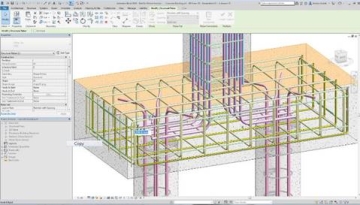
Autodesk announced the release of the latest version of Revit software for BIM workflows. Revit 2018 provides enhanced integrated modeling tools for architects, MEP and structural engineers, detailers, and constructors. The key features of Revit 2018 are ▲Easy script application through the Dynamo Player ▲Newly added notification schedules and the ability to apply parameters to links and groups ▲Use of Navisworks files as underlays in Revit through coordinate-linked models for seamless collaboration with external teams (see photo) ▲Customizable outdoor air settings according to user-defined spaces and building types through enhanced mechanical systems functionality (see photo) ▲Addition of connection features to circulating water systems analysis for easier redesign ▲Calculation of flow and pressure drop within the network before actual connections are made (see photo) ▲Collection of analytical design data through circuit and circuit line modifications in the electrical systems field.
2017.04.20by 김자영 기자

Autodesk Korea Appoints Ki-Young Choi as New CEO
Autodesk announced the appointment of Choi Ki-young as the new CEO of Autodesk Korea. The newly appointed CEO Choi Ki-young will lead efforts to solidify Autodesk's leading market position in 3D design software while further expanding the supply of diverse solutions across various industrial sectors. Additionally, he will also be responsible for managing domestic sales channels and partner companies.
2017.04.27by 김지혜 기자
.jpg)
SalePoint Signs Multi-Year Partnership Agreement with AWS… Promoting Identity Security that Integrates Even AI Agents
Sailpoint has entered into a multi-year strategic partnership agreement with AWS and is moving forward with establishing an integrated governance system that manages both human and non-human identities together. The plan is to consistently manage access permissions in an environment where AI agents are increasing as work execution entities, while applying the principle of least privilege and automated policy enforcement. The two companies plan to jointly expand capabilities to manage the identities of various entities, including AI agents, within a single layer in the AWS environment. This collaboration is interpreted as a move to design security and governance together in corporate environments where AI adoption is expanding.
2026.03.26by 배종인 기자
.png)
Databricks Unveils Open AI Security Monitoring 'Lakewatch'
Databricks entered the security market on March 24 by unveiling LakeWatch, an open-source agentic SIEM. The core functionality of this product is to integrate and analyze security, IT, and business data in a single environment to support AI-based threat detection and investigation. The company explained that it reduces the limitations of existing security operations centers, which have had to forgo some data due to high cost structures, and enables large-scale data analysis and automation based on open formats and ecosystems. LakeWatch is currently offered as a private preview, with Adobe and Dropbox mentioned as early customers. Databricks also announced an expanded partnership with Anthropic as well as the acquisition of Antimatter and SiftD.ai.
2026.03.26by 배종인 기자











