



Why Intel Declared the Evolution of HPC at the Supercomputing Conference
 Published2017.06.20 18:05
Intel participated in the 2017 International Supercomputing Conference (ISC) and announced that HPC systems must evolve to enable new levels of performance, scalability, memory, bandwidth, and I/O capabilities to handle various workloads.
In addition, we discussed how users can obtain value of a magnitude previously unattainable through new approaches to HPC system design and flexible implementation models.
Intel unveiled recent achievements at ISC 17 that can further advance HPC systems and bring new experiences to supercomputing users. Intel announced per-core performance improvements and other enhancements for the upcoming Intel Xeon Scalable processor family, explaining how these improvements can support a wide range of workloads.
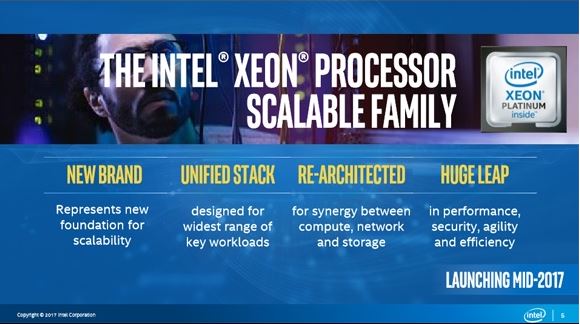
The Intel Xeon Scalable family of processors incorporates Intel Advanced Vector Extensions 512 (Intel AVX-512) to provide the performance boost needed in heavy and demanding usage scenarios through a 2x peak improvement in FLOPs (floating-point operations) per clock cycle. Combined with improvements in cores, cache, and memory, Intel Advanced Vector Extensions 512 delivers up to 2.27x performance improvement compared to the currently used Intel Xeon E5 v4 (codename Broadwell) processors, and up to 8.2x more double-precision gigaflops per second compared to the Intel Xeon E5 family of processors that are four years old.
In addition, the Intel Xeon Scalable processor family combines the Intel Omni-Path Architecture (Intel OPA), a high-bandwidth and low-latency fabric for performance optimization, to provide the performance required for processing today's HPC workloads and the capability to scale to tens of thousands of nodes, while enabling TCO reduction.
In addition, Intel announced the Software Defined Visualization Appliance (SDVis Appliance), an open standard-based turnkey solution. This solution enables HPC users to benefit from an already developed software ecosystem without the need to collaborate with vendors for customization when building or assembling hardware systems themselves.
During the keynote speech at the event, Intel HPC experts Rajeeb (Raj) Hazra and Patricia (Trish) A. Damkroger shared Intel's plans to develop HPC systems capable of high-performance data analysis by combining traditional HPC with artificial intelligence. The goal is to integrate Intel's upcoming products targeting AI applications to enable HPC to process workloads faster and at a lower cost. Intel stated that through this, they aim to make HPC the foundation driving new digital services and experiences while ensuring the stability and efficiency of those services.
Comments
Related news

Intel Supports 5G Devices with XMM 7560 Modem
Intel today announced the Intel XMM 7560 modem, stating it will support the global LTE modem market. The Intel XMM 7560 modem, a fifth-generation LTE modem, is designed based on the tradition of high speed, low latency, and wireless innovation, delivering gigabit speeds in a single, global SKU. The Intel XMM 7560 modem, which provides voice and data connectivity, is an LTE modem manufactured on Intel's 14-nanometer process.
2017.02.23by 서아람 기자

Intel Unveils Fastest Response Speed SSD in Reality
Intel has unveiled the Intel Optane SSD DC P4800X series. This series enhances scalability per server and application speed. By expanding the system memory pool and forming large-capacity, cost-effective memory, it provides users with enhanced insights.
2017.03.21by 김자영 기자
Samsung Finally Surpasses Intel, Will It Become the World's No. 1 Semiconductor?
Samsung Electronics is expected to become the world's leading semiconductor company. IC Insights has issued a forecast that Samsung is likely to surpass Intel and rise to the position of the world's number-one semiconductor company based on second-quarter results. If this occurs, it would mean Intel relinquishing its top position for the first time in 24 years.
2017.05.02by 신윤오 기자
.jpg)
SalePoint Signs Multi-Year Partnership Agreement with AWS… Promoting Identity Security that Integrates Even AI Agents
Sailpoint has entered into a multi-year strategic partnership agreement with AWS and is moving forward with establishing an integrated governance system that manages both human and non-human identities together. The plan is to consistently manage access permissions in an environment where AI agents are increasing as work execution entities, while applying the principle of least privilege and automated policy enforcement. The two companies plan to jointly expand capabilities to manage the identities of various entities, including AI agents, within a single layer in the AWS environment. This collaboration is interpreted as a move to design security and governance together in corporate environments where AI adoption is expanding.
2026.03.26by 배종인 기자
.png)
Databricks Unveils Open AI Security Monitoring 'Lakewatch'
Databricks entered the security market on March 24 by unveiling LakeWatch, an open-source agentic SIEM. The core functionality of this product is to integrate and analyze security, IT, and business data in a single environment to support AI-based threat detection and investigation. The company explained that it reduces the limitations of existing security operations centers, which have had to forgo some data due to high cost structures, and enables large-scale data analysis and automation based on open formats and ecosystems. LakeWatch is currently offered as a private preview, with Adobe and Dropbox mentioned as early customers. Databricks also announced an expanded partnership with Anthropic as well as the acquisition of Antimatter and SiftD.ai.
2026.03.26by 배종인 기자











