


KT Proposes 'Pyeongchang 5G Standard', Adoption Completed by TTA
 Published2017.06.28 16:43
It is expected to be utilized by companies and academia to develop various 5G technologies and services using 28GHz.
KT announced on the 28th that its 'Pyeongchang 5G standard' was adopted as a standard at the 91st General Assembly of Information and Communication Standards held at the Telecommunication Technology Association (TTA) in Bundang-gu, Seongnam-si.
The Korea Information and Communications Technology Association is an information and communications standards organization established in 1988 to promote national economic development and the information and communications (ICT) industry and technology. To date, it has established and distributed over 15,000 standards.
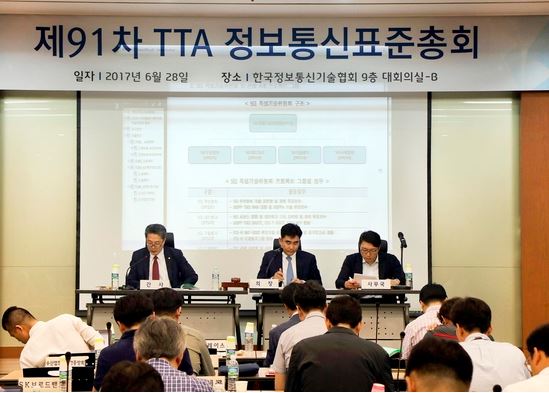
The Pyeongchang 5G standard is the world's first 5G standard, developed starting in November 2015 and completed in June 2016 by the '5G Special Interest Group (5G SIG)' formed by KT with global companies including Samsung, Ericsson, Nokia, Qualcomm, and Intel. It satisfies the key requirements for 5G services defined by the ITU, such as low latency and high speed.
KT proposed the Pyeongchang 5G standard as one of the standardization projects to the Korea Information and Communications Technology Association in March 2017 to promote the 5G pilot service to be showcased in Pyeongchang in 2018 and to revitalize the 5G industry in Korea. A KT official explained that it was adopted as a standard at the 91st General Assembly of Information and Communication Standards after undergoing a review by the Technical Committee and Steering Committee of the Korea Information and Communication Technology Association for about three months.
The Pyeongchang 5G standard, which has been adopted as South Korea's first 5G standard, is expected to be utilized by domestic and international companies and academia to develop and verify various 5G-related technologies and application services using the millimeter wave band (28GHz), including 5G pilot services conducted domestically, until 2020 when the International Telecommunication Union (ITU) completes the establishment of 5G standards.
Jeon Hong-beom, Executive Vice President of the Infrastructure Research Institute at KT Convergence Technology Institute, stated, “With the adoption of the PyeongChang 5G standard, a foundation has been laid for the expansion of the Korean 5G industry,” adding, “Based on the PyeongChang 5G standard, KT will showcase successful 5G services in 2018 and subsequently lead the development of technologies for 5G commercialization.”
Meanwhile, the core technologies of the PyeongChang 5G standard have been finally reflected in the 5G report of the 'Tests of Technology Building Blocks' project of the 'Next Generation Mobile Network (NGMN),' which began operations in November 2016, and are scheduled to be submitted to the 3rd Generation Partnership Project (3GPP) following the NGMN board meeting held in Shanghai, China on the 28th.
Comments
Related news
KT Announces 5G Era at AIIB Annual Meeting in Jeju
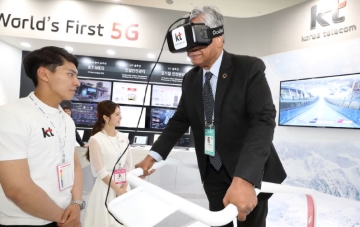
KT announced its participation in the 2nd Annual Meeting of the Asian Infrastructure Investment Bank (AIIB) held from the 16th to 18th at the Jeju International Convention Center (ICC). Oh Seong-mok, President of KT's Network Division, took the stage as the first speaker at the seminar titled "4th Industrial Revolution and Infrastructure" on the first day of the annual meeting on the 16th. Addressing the topic of "5G and the 4th Industrial Revolution," President Oh emphasized that "the 4th industrial revolution is an era of hyper-connectivity, and 5G will serve as its core, becoming the 'Digital Oxygen' of the 4th industrial revolution." He also stated, "We will successfully showcase 5G communication technology at the 2018 PyeongChang Winter Olympics and secure global 5G leadership." On the second day, a "Korean Infrastructure Company Briefing" will be held during the business session to promote Korean companies' technological capabilities and share development experiences. At the briefing, Shin So-hee, Executive Director of KT's Global Business Promotion Division, Asia/Americas Department, will present on "Differential Competitiveness of Korea's Telecommunications Infrastructure and Successful Cases of Overseas Expansion." Having accumulated extensive global ICT business experience over many years, KT plans to present various cases where ICT technology converges with diverse industries such as energy, transportation, finance, and smart cities, resulting in improved efficiency and value.
2017.06.16by 김지혜 기자
KT and SMEs Develop 5G Repeater··· Expanding 5G Ecosystem
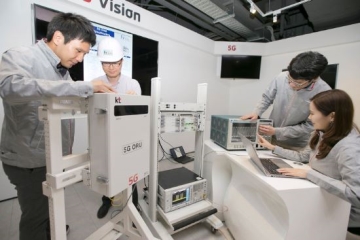
KT announced that it has completed the development of a 5G repeater to be utilized in the 5G pilot service to be showcased in PyeongChang in '18, and has successfully achieved interoperability with base stations compliant with PyeongChang 5G specifications. The 5G repeater successfully developed this time is a device developed to secure stable 5G service coverage even inside buildings, and has been jointly researched and developed by KT and SME partners since 2016. When applying a digital optical repeater currently used in the 4G(LTE) environment to a 5G network, it is difficult for the 5G base station and terminal to connect normally due to delay time generated during the conversion process of analog (wireless) signals to digital signals, and given the 5G characteristic of utilizing a wide frequency bandwidth of several hundred MHz, the transmission capacity (bandwidth) of optical cables cannot accommodate the entire 5G data.
2017.06.21by 김자영 기자
SKT Successfully Demonstrates 5G Communication Using 3.5GHz Frequency Band
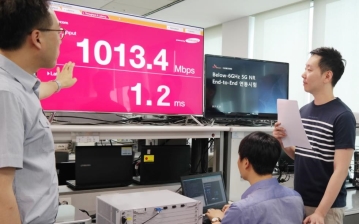
SK Telecom announced that it has successfully demonstrated 5G communication using the 3.5GHz frequency band in collaboration with Samsung Electronics and Nokia. The 3.5GHz band is considered the optimal frequency band for 5G communication, enabling gigabit-level speeds while providing wide radio wave propagation range. Global ICT operators have focused on securing 5G technology centered on ultra-high frequencies (millimeter waves) such as 28GHz. However, ultra-high frequency bands have the advantage of enabling large-capacity data transmission utilizing wide bandwidth, but have the limitation of relatively short radio wave propagation distance. Accordingly, countries around the world including China and Japan have been working to secure low-frequency (frequency bands below 6GHz) 5G technology that can implement gigabit-level speeds while expanding coverage. SK Telecom has focused on securing 3.5GHz communication technology, the nation's 5G low-frequency band, and successfully demonstrated communication in this band with Samsung Electronics and Nokia.
2017.06.28by 김지혜 기자
Nvidia invests $5 billion in Intel
NVIDIA and Intel, leaders in global AI computing technology, are now forging ahead in providing cutting-edge solutions through NVLink-based architecture integration. NVIDIA and Intel have officially announced a strategic partnership and stated that they will jointly develop customized data center and personal computing products to accelerate diverse applications and workloads ranging from hyperscale to enterprise and consumer markets, thereby laying the foundation for the next generation computing era.
2025.09.22by 배종인 기자
.jpg)
Applied Materials Launches Environmental Protection Campaign to Mark World Cleanup Day
Applied Materials Korea (CEO Park Kwang-seon) is carrying out environmental cleanup activities with employees and their families around the Dongtan Sinricheon area on the occasion of World Cleanup Day, evolving into a company that engages with the local community beyond technological innovation.
2025.09.22by 명세환 기자











