



Ransomware Attacks Resuming? Symantec Warns of New Variant
 Published2017.06.29 13:22
일은 물론, 마스터 부트 레코드(MBR)까지 암호화
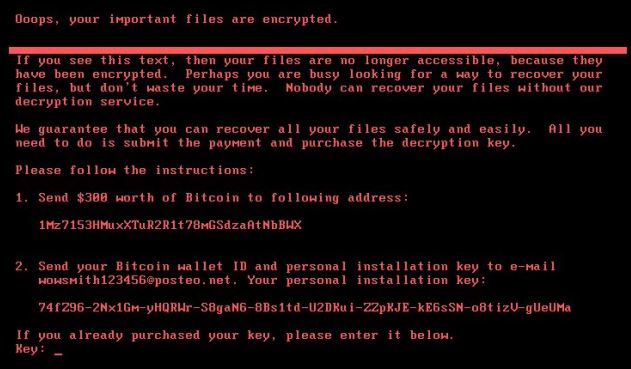
페트야 감염 컴퓨터 화면에 표시된 메시지
Comments
Related news
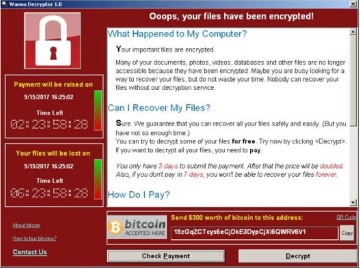
Ransomware increased by 36% last year; attacks expected to rise in combination with worms.
The 'WannaCry ransomware (Ransom.Wannacry),' which encrypts data files and demands a ransom, is spreading widely across the globe, particularly throughout Europe. According to an investigation by Symantec, which emphasized the need for heightened security awareness, the WannaCry ransomware encrypts data files and demands that users pay a ransom of $300 in Bitcoin. The investigation warns that if the ransom is not paid within 3 days, the payment amount doubles, and if payment is not made within 7 days, the encrypted files will be deleted.
2017.05.15by 신윤오 기자
Acronis Provides Ransomware Defense Solutions to Backup Server Customers
Acronis announced today that it will conduct a "Complete Ransomware Defense Campaign" during May and June, providing all customers who purchase Acronis Backup enterprise backup and recovery solution servers with Acronis True Image 2017 New Generation (NG), a personal backup and recovery solution equipped with ransomware defense technology, along with related data management consulting services. Acronis Korea, in response to the rapid global spread of ransomware, urgently requested its headquarters to minimize customer damage from ransomware and decided to provide Acronis True Image 2017 NG, a personal and home backup and recovery solution that includes ransomware prevention functionality, free of charge to enterprise customers. When purchasing Acronis Backup Advanced multiplatform and universal license versions, Acronis True Image 2017 NG, usable by 5 users per server copy, will be provided as a gift. When purchasing standalone server versions such as Acronis Backup for Windows and Linux, Acronis True Image 2017 NG, usable by 3 users per copy, will be provided proportionally to the quantity purchased.
2017.05.16by 김자영 기자
Highly likely that the group behind the WannaCry ransomware attack is the same one that attacked Sony Pictures
Recently, claims have been raised that the "WannaCry ransomware" spreading globally has a high correlation with the Lazarus group, a cyber attack collective. Symantec (www.symantec.co.kr) conducted a thorough investigation and found that the tools and infrastructure used in the WannaCry ransomware (Ransom.Wannacry) attacks are substantially similar to the techniques employed by the Lazarus group, which was responsible for the Sony Pictures hacking and the theft of $81 million from the Bangladesh Central Bank. Based on this finding, Symantec is confident that the attacks were carried out by the same group and analyzed that there is a high likelihood that the Lazarus group is behind the WannaCry attacks.
2017.05.23by 신윤오 기자
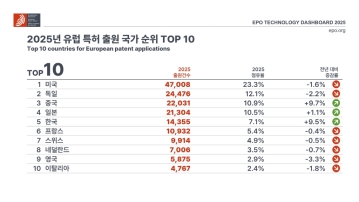
European Patent Applications Surpass 200,000 for the First Time… South Korea Maintains 5th Place, Led by Batteries and Telecommunications
According to the European Patent Office (EPO)'s 'Technology Dashboard 2025', European patent applications last year reached 201,974, surpassing 200,000 for the first time. Korean companies and inventors filed 14,355 applications, representing a 9.5% increase from the previous year and maintaining 5th place by country. Battery, digital communication, and semiconductor technologies led the growth, with Samsung ranking as the top EPO applicant for the second consecutive year and LG reaching 3rd place. The presence of major domestic cities such as Seoul, Suwon, and Yongin was also confirmed. It was also revealed that Korea's European patent strategy is expanding beyond individual technologies to span the entire industry.
2026.03.24by 명세환 기자
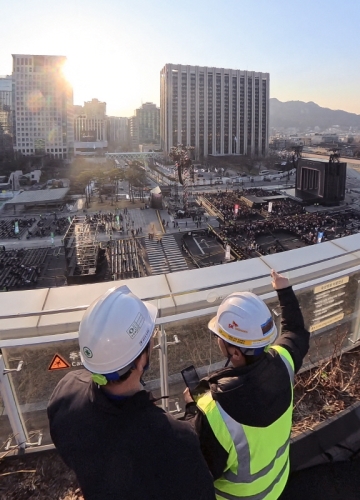
SK Telecom First Applies AI-Based Network Operations at Gwanghwamun K-Pop Concert
SK Telecom announced that it applied an AI-based network operation system for the first time at a large-scale K-pop concert held in the Gwanghwamun area of Seoul on March 21st, managing communication quality throughout the event. Mobile data usage during the three hours before and after the concert reached 12.15TB, approximately doubling compared to the same time slot the previous weekend. SK Telecom monitored traffic using the AI system 'A-One' in five-minute and 50-meter units to respond to potential overload situations, while also operating temporary communication facilities and on-site personnel in parallel. This case is interpreted as confirmation of the practical applicability of AI-based autonomous network operation in an environment where demand from dense events and foreign users increases simultaneously.
2026.03.23by 명세환 기자











