



Domestic semiconductors are experiencing a boom thanks to memory, but manufacturing technology patents are down.
 Published2017.07.07 10:20
2007년 7,583건에서 2016년 4,241건으로 지속적으로 감소
인공지능(AI), 사물인터넷 관련 산업이 부각되면서 정작 그 핵심 기술인 반도체 제조기술 분야의 국내 특허출원 활동이 둔화 상태인 것으로 나타났다.
특허청에 따르면, 최근 10년간(2007년~2016년) 반도체 제조기술 관련 특허출원동향을 분석한 결과, 특허출원건수가 2007년 7,583건에서 2016년 4,241건으로 지속적으로 감소한 것으로 나타났다고 밝혔다.
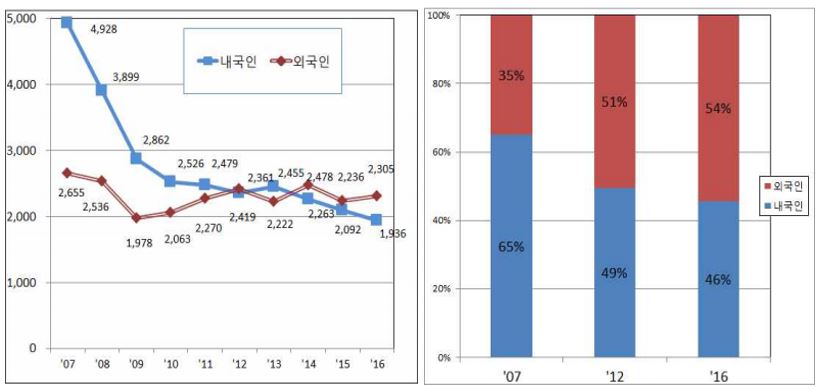
외국인의 특허출원건수는 동기간 매년 2,000건 내외로 유지되어 온 반면, 내국인의 특허출원건수는 2007년 4,928건 대비 2016년 1,936건인 절반 이하로 급감해왔다.
특히, 국내 기업의 특허출원건수가 2007년 4,474건에서 2016년 1,585건으로 감소한 가운데, 그중 대기업의 경우 2007년 2,518건 대비 2016년 568건인 23% 이하로 크게 감소한 것으로 나타났다.

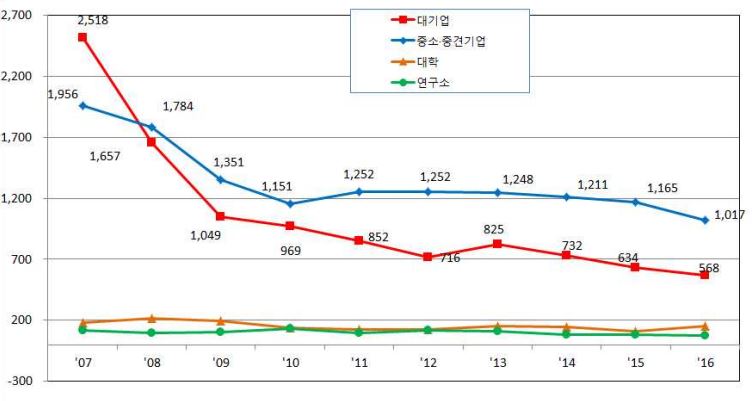
2014년 기준 우리기업의 이 분야 국내출원 대비 해외출원 비율도 대기업과 중소 중견기업의 경우 각각 22%, 8%로 낮게 나타났다.
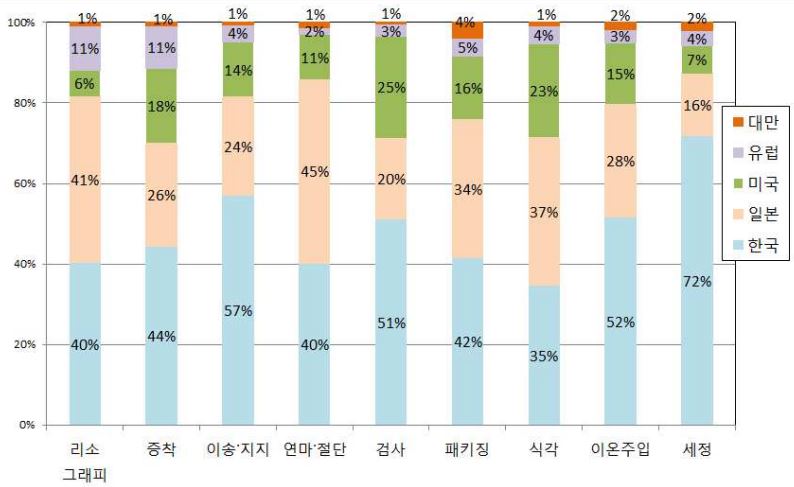
참고로 2016년의 반도체 제조기술 종류별 특허출원비중을 살펴보면, 리소그래피기술(31%)이 가장 높은 점유율을 보였고, 그 뒤로 증착기술(24%), 이송/지지기술(18%), 연마/절단기술(9%), 검사기술(5%), 식각기술(5%), 패키징기술(4%), 이온주입기술(3%), 세정기술(2%) 순인 것으로 조사됐다.
국내 반도체 산업은 주요국과 비교해 볼 때 고부가가치 반도체 제조 기술인 리소그래피기술, 증착기술 및 식각기술 등에 비하여 세정기술 및 이송 및 지지기술 등에서 특허출원비중이 상대적으로 높은 것으로 나타났다.
최근 5년간의 다출원인 현황을 살펴보면, 동경일렉트론(일본, 1,164건), 세매스(한국, 883), 삼성전자(한국, 832건), 어플라이드머티리얼즈(미국, 679건), 동우화인켐(한국, 648건) 순으로 조사되었다.
특허청 제승호 반도체심사과장은 “향후 4차 산업혁명을 통해 폭발적으로 증가할 것으로 예상되는 반도체 수요와 그로 인해 창출될 막대한 경제적 이익을 감안하면, 우리나라가 반도체 제조기술 핵심특허 확보활동을 강화하여 현 상황을 개선해 나감으로써 반도체산업의 절대 우위를 다시 한번 다질 필요가 있다”고 밝혔다.
Comments
Related news
Samsung Finally Surpasses Intel, Will It Become the World's No. 1 Semiconductor?
Samsung Electronics is expected to become the world's leading semiconductor company. IC Insights has issued a forecast that Samsung is likely to surpass Intel and rise to the position of the world's number-one semiconductor company based on second-quarter results. If this occurs, it would mean Intel relinquishing its top position for the first time in 24 years.
2017.05.02by 신윤오 기자
Global semiconductor sales rose 2.6% last year; will this trend continue this year?
Last year, global semiconductor market revenue increased 2.6% compared to the previous year. According to final results announced by Gartner, an IT advisory firm, global semiconductor revenue in 2016 reached $343.5 billion, up from $334.9 billion in 2015, while total revenue of the top 25 semiconductor companies grew 10.5%.
2017.05.17by 신윤오 기자
Will domestic CPU cores bloom in the IoT era?
The first phase of domestic CPU development, which began in June 2015, has entered its final stages. On the 19th, the "Second Domestic CPU Core Roadshow" was held to introduce the achievements of the "Domestic CPU Core Commercialization Project." Over one year, what new cores were developed and what results were achieved? Ha Sang-tae, head of the System and Materials Industrial Technology Division at the Korea Institute of Industrial Technology Evaluation and Planning, said, "There are still negative views on domestic CPU development, but various institutions are producing results," adding "positive effects are expected in securing product competitiveness for 'Things' corresponding to IoT (Internet of Things), where hyper-connectivity and intelligence are being realized." Song Yong-ho, director of the Intelligent Semiconductor Promotion Division, said, "We confirmed the potential for domestic CPUs to be utilized in various ways," and "continuous attention must be paid to development." The domestic CPU core roadshow introduced ADchips' ARK (revised name of emCore), ETRI's Aldebaran, and KETI's MENSA core, the same as last year. SoC development cases using cores included low-power mobile healthcare by Hancom GMD (ARK), tampering prevention and security-enhanced smart meters by S&A (Aldebaran), and voice recognition with built-in ultrasonic data communication capability by Emtec Vision (MENSA), discussing the advantages and disadvantages experienced using domestic CPUs.
2017.05.22by 김자영 기자
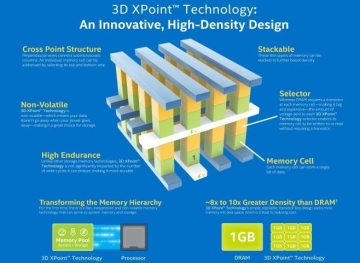
3D NAND on the Rise, Finding Processes and Materials to Solve Stacking Challenges
With 3D NAND supply volumes expected to surpass 2D NAND this year, interest is growing in the processes and materials required for stacking 3D NAND. On the 18th, the Semiconductor Electronic Materials Technology Conference (SMC, Strategic Materials Conference), hosted by the International Semiconductor Equipment and Materials Institute, was held under the theme "Scaling Challenges-The Future of Materials," discussing semiconductor material challenges for next-generation memory, market outlook for semiconductor materials, key process material technologies, and DRAM prospects. Sung-hyun Hong, Executive Director of Ram Research Korea, who presented, addressed the problems that arise as 3D NAND is stacked: "As the number of layers increases, the height becomes extremely high. If the structure is not harmonious, stress changes become severe. When stress becomes severe, the wafer bends, making handling difficult in subsequent processes."
2017.05.22by 김지혜 기자
Silicon wafer shipments in the first quarter increased by 12.6% compared to the same period last year.
First quarter silicon wafer shipments showed continued growth compared to the previous quarter. According to the Semiconductor Equipment and Materials International (SEMI) global wafer industry quarterly report, silicon wafer shipments for the first quarter of this year increased 3.4% compared to the fourth quarter of 2016.
2017.05.25by 신윤오 기자











