


KETI to Develop Korean-Style AI with Carnegie Mellon University
 Published2017.07.14 10:13
The Korea Electronics Technology Institute (KETI) announced that it will develop Korean-style AI technology with Carnegie Mellon University (CMU), the top-ranked university in the U.S. in the fields of computer science and artificial intelligence (AI).
A joint research agreement for social cognition-based AI technology was signed at the CMU campus in Pittsburgh, USA. The subject is digital companion technology. While Watson or robo-advisors are AIs limited to specific fields, digital companion technology is a lifestyle-oriented AI that provides services needed in daily life right by the user's side.
The key feature is a technology that recognizes situations, contexts, and emotions through adaptive machine learning and identifies the user's intent to provide context-specific interactions on its own, distinguishing it from existing digital assistant technologies that perform given tasks, such as playing specific music.
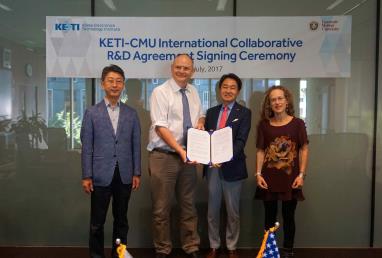
ArticuLab at CMU’s Department of Computer Science, which will collaborate with KETI, is a center that studies human interaction in social and cultural contexts for AI development, and is headed by Associate Dean Justine Cassell, who majored in linguistics and cognitive psychology and led the Gesture and Narrative Language research group at the MIT Media Lab.
CMU plans to share know-how and experience in developing AI with social cognitive functions through cooperation with KETI, while researching human-computer conversation strategies and intimacy-building models for Korean-style digital companion technology suitable for Korean sentiment.
"In order for the interaction between AI and humans to be seamless in the era of the Fourth Industrial Revolution, the key is to secure digital companion technology that continuously observes the user's situation and responds autonomously by comprehensively inferring their intentions, emotions, and context," said KETI President Park Cheong-won. "We will overcome the technology gap through collaboration with leading research universities in the AI field, while strengthening corporate competitiveness by developing Korean-style digital companion technologies and application services and sharing them with our companies."
Comments
Related news
KETI, Customized Technology and Manpower Support for SMEs
The Korea Electronics Technology Institute (KETI) announced the results of technology development and commercialization initiatives conducted jointly with participating companies as the lead organization for industry-academia collaborative projects under the Small and Medium Business Administration since June of last year. The industry-academia collaborative project is a business that comprehensively supports small and medium enterprises through research personnel, cutting-edge equipment, reliability, intellectual property rights, marketing, and other services utilizing dedicated support organizations for SMEs at research institutions, addressing difficulties that small and medium enterprises face in technology development and commercialization processes. The cases of small and medium enterprise support achievements utilizing excellent R&D infrastructure announced this time include △Gounensesan Cosmetics' high-frequency medical devices, △SS Light's lighting fixtures for smart converters, △Piolink's PoE security switches, △Shinjin Future Film's thermal insulation film, and △Intree's luminescent material process test cell for OLED.
2017.06.09by 김지혜 기자
KETI Takes the Lead in Revitalizing the DC Electrical and Electronic Industry
The Korea Electronics Technology Institute (KETI) has opened a DC Electrical and Electronics Industry Promotion Center in Gwangju Metropolitan City. The DC Electrical and Electronics Industry Promotion Center, which has been in preparation since 2014, is the only domestic infrastructure equipped with a one-stop support system for testing and commercialization related to DC electrical and electronics, including electromagnetic and environmental reliability. Direct current has over 40% lower transmission power loss compared to alternating current, and since there is no frequency, there are no electromagnetic interference issues during transmission. Additionally, power lines can be buried underground instead of using transmission towers for power transmission. However, since transformer technology for AC systems was developed first, the current power infrastructure is based on AC.
2017.06.16by 김지혜 기자
KETI Develops 2D Image-Based Light Scattering Signal Analysis Technology
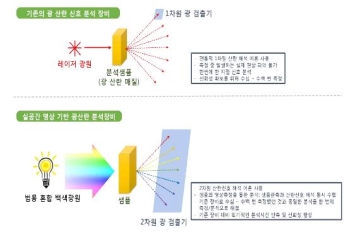
The Electronics and Telecommunications Research Institute (KETI) announced that it has developed a two-dimensional image-based light scattering signal analysis technology that can be utilized for nanoparticle analysis and other applications using universal light sources and digital cameras. Light scattering signal analysis technology is a core foundational technology capable of measuring nanoparticle size, optical material properties, display device inspection, and characteristics of cells and biomaterials by utilizing light scattering phenomena. Previously, point-by-point measurement methods were employed, where light scattering signals generated by laser irradiation were detected using one-dimensional photodetectors at specific angles. This was because physical interpretation of two-dimensional light scattering signals extracted in area units was difficult, and there were limitations in improving the signal-to-noise ratio (S/N ratio).
2017.07.06by 김지혜 기자

[e4ds Tech Day 2026 ⑨] Sim Sang-gyu, Autocrypt CTO: "In the Physical AI Era, Automotive Security Must Extend Beyond the Vehicle"
At e4ds Tech Day 2026, Sim Sang-gyu, CTO of Autocrypt, explained automotive cybersecurity strategies in the era of Physical AI and SDV (Software-Defined Vehicle). Automobiles are evolving as part of an ecosystem connected to AI, cloud, chargers, IoT, and robots, and he emphasized that the scope of security must expand beyond the vehicle interior to the entire connected environment. In particular, AI model tampering, adversarial attacks, OTA updates, and EV charger hacking were identified as major threats. He explained that response measures require zero trust, AI model integrity protection, intrusion detection, Security by Design and Default, and full lifecycle security management, and that proactive security system establishment beyond regulatory compliance is critical for securing future mobility competitiveness.
2026.10.12by 배종인 기자
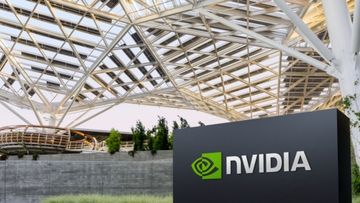
NVIDIA to Invest $1 Billion in U.S. Science Over Next Five Years
NVIDIA has announced plans to invest $1 billion over the next five years to strengthen U.S. scientific and technological competitiveness. The company will enhance cutting-edge artificial intelligence research and development capabilities in key areas including quantum computing, healthcare, and energy security, while expanding support for higher education research institutions and cloud service providers. NVIDIA is participating as a major industry partner in the White House Office of Science and Technology Policy's Genesis Mission, and is promoting supercomputer construction in collaboration with national laboratories including Argonne and Los Alamos.
2026.10.12by 배종인 기자











