


Can Encryption Key Protection Be Secured with Hardware?
 Published2017.07.27 12:18
Built-in EEPROM allows user programming
Last year, a hacking incident occurred in the United States due to a DDoS attack on DNS services. The cause was a case of exploiting webcams and IoT products. How should security be handled in the IoT industry, which is attracting attention as a future food source?
Hacking attacks through networks are also a threat, but there is also a high possibility that IoT devices themselves can be physically manipulated and used as a route for cyber attacks. With this in mind, the Korea Internet & Security Agency (KISA) selected “hardware-based (TPM) IoT terminal security technology” as one of the top 10 information security technologies that the industry should pay attention to in 2017.
Software encryption has the advantage of being cost-effective and easy to update, but it is only as secure as the operating system of the device. If there is a security flaw in the OS, it is easy to exploit. Software is also ineffective in protecting encryption keys, which are the core of security. To attack hardware-based security, you must use a secure microcontroller (MCU) and run software from its internal memory that cannot be changed.
Maxim Integrated's DeepCover solutions for embedded security include secure authentication ICs and secure MCUs that provide core functionality such as fixed-function cryptographic operations and secure key storage. In particular, for security MCUs, dynamic tampering (Active Tamper) response technology is introduced to immediately erase the device's keys and confidential data when an attempt at unauthorized manipulation is detected.
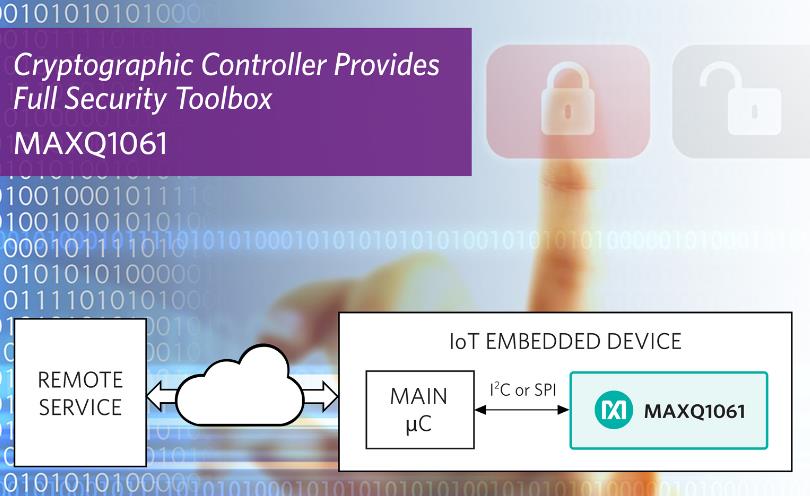
The MAXQ1061 operates in cases where a battery cannot be included in the end application because it uses EEPROM, which requires a battery to operate dynamic tamper-resistant technology. It is suitable for IoT nodes, connected embedded devices, industrial networking, PLCs, and network equipment, and provides a comprehensive cryptographic toolbox that enables key generation and storage that meets SSL/TLS/DTLS.
The MAXQ1061 is Common Criteria EAL4+ rated, enabling rapid integration of security into products and protection of network endpoints. It is a turnkey security solution that eliminates the need for separate firmware development.
The MAXQ1061 has 32KB of secure EEPROM that can be programmed by users to store certificates, public keys, private keys, and arbitrary user data. The EEPROM is managed by a flexible file system to enforce user-defined security policies, and cryptographic algorithms include ECC (up to NIST P-521) ECDSA signature generation and verification SHA-2 (up to SHA-512) secure hash ECB CBC CCM (CBC-MAC) mode supporting AES-128/-256 MAC digest.
The MAXQ1061 provides a separate hardware AES engine supporting AES-GCM and AES-ECB modes over SPI. This allows for rapid stream encryption implementation by off-loading the host processor.
“The MAXQ1061’s comprehensive cryptographic capabilities, which embed security in hardware itself, address a critical security need for future embedded systems,” said Christophe Tremlet, senior business manager for embedded security at Maxim Integrated. “With the MAXQ1061, customers will have a trusted device that not only ensures the integrity and authenticity of their systems, but also protects their communications.”
Comments
Related news
Securing IoT with Hardware-Based Solutions
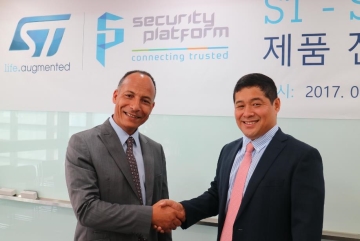
Security has emerged as the biggest barrier to IoT adoption. To address IoT security challenges, ST Microelectronics (ST) has partnered with SecurityPlatform, a domestic startup providing hardware security solutions. Various factors threatening IoT security cannot be replaced with a single solution. Device cloning and tampering require enhanced authentication, while concerns about device damage necessitate identity authentication and integrity verification solutions. The two companies plan to collaborate in providing a solution that combines specially designed ICs and software to safely protect IoT devices by leveraging trust computing principles that validate the authority of all connected devices and verify their integrity.
2017.06.29by 김지혜 기자
Maxim: "The Himalaya Series Reduces Heat and Increases Efficiency in Power Solutions"
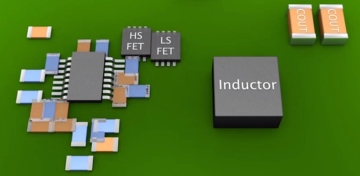
Implement as many features as possible while keeping the design compact. This is a key concern for IC and module design engineers—achieving this while ensuring minimal heat generation. The challenge is that packing multiple functions into a limited space inevitably generates high temperatures, which threatens system stability. For engineers who must account for power loss, thermal issues, and safety standard compliance in confined spaces, Maxim Integrated (www.maximintegrated.co.kr) offers meaningful solutions. Maxim's Himalaya series, which includes voltage regulator ICs and power modules, aims ultimately at enhancing system efficiency. It also ensures compliance with functional safety standards for electronic safety management systems.
2017.07.03by 김지혜 기자

[Planning - Autonomous Vehicles⑧] Cybersecurity is the key to preventing autonomous vehicles from becoming "running weapons."
Security technology is garnering attention for realizing autonomous driving technology at level 4 or higher, where vehicle control is transferred from the driver to the vehicle. This is because drivers must be assured that autonomous vehicles remain safe even when exposed to threat factors such as vehicle system errors or hacker intrusions. Automotive semiconductor companies such as Renesas, Infineon, NXP, and Maxim have been applying Hardware Security Modules (HSM). The HSM supports key management functions by centrally storing keys and transmitting them in encrypted form.
2017.07.17by 김자영 기자

Intel Unveils Next-Generation 'Core Ultra Series 3' and vPro Platform for Enterprise PCs
Intel has officially unveiled the "Intel Core Ultra Series 3" for next-generation enterprise PCs and the latest vPro platform, addressing a wide range of demands from enterprise notebooks to high-performance workstations.
2026.03.26by 배종인 기자
ROHM Launches ESD Protection Diode Compatible with High-Speed Interfaces of 10Gbps or Higher
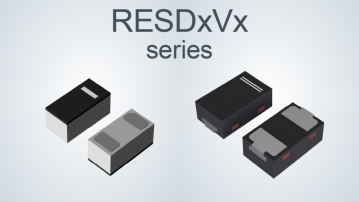
Semiconductor specialist ROHM has developed the 'RESDxVx series' of ESD (electrostatic discharge) protection diodes capable of responding to next-generation high-speed data communication environments exceeding 10Gbps, simultaneously enhancing both signal quality maintenance required in high-speed interfaces and IC protection performance.
2026.03.26by 배종인 기자











