


Large-scale industrial complexes monitor the environment using IoT sensors
 Published2017.07.31 10:48
We will build an advanced smart city using the Internet of Things.
The Ministry of Science and ICT and the Ministry of Land, Infrastructure and Transport announced that they will promote a 'Smart Environment Monitoring Demonstration Project' utilizing IoT and smart city technologies to enable rapid identification of causes and response to situations arising from environmental pollution accidents such as odors and noise.
This demonstration project involves installing 10 IoT environmental sensors that detect various sources and origins of odors in Gangseo-gu, Busan, where large-scale industrial complexes are concentrated and odor complaints are rapidly increasing. The data collected through the sensors is transmitted to the Smart City Center in real-time, 24 hours a day, to identify pollution situations and to facilitate rapid response to environmental pollution through cooperation among relevant agencies, such as the environmental department.
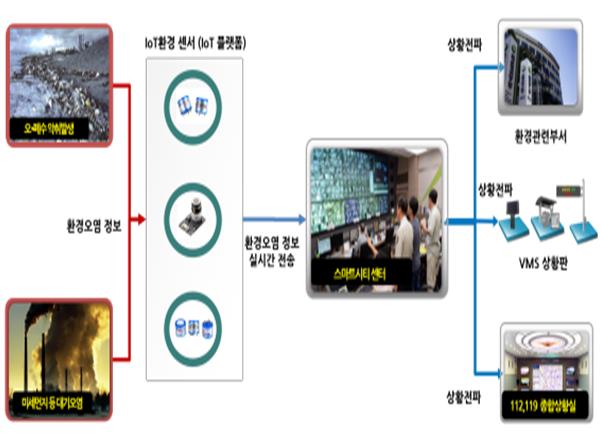
Until now, in the case of environmental pollution accidents such as foul odors and hazardous gas leaks, it has been difficult to determine the cause because a considerable amount of time elapses between the local government receiving a complaint and visiting the site to identify the cause of the accident.
The 'smart environment monitoring service' is expected to contribute to resolving environmental blind spots by utilizing IoT sensors and nearby CCTVs to identify information such as pollution locations and concentrations in real time, thereby significantly reducing related disputes through the rapid identification of causes.
The new smart environment monitoring service is planned to be piloted in Gangseo-gu, Busan by the end of this year, and then expanded to local governments nationwide starting in 2018.
Science and TechnologyJang Seok-young, Director General of Internet Convergence Policy at the Ministry of Information and Communication, emphasized, “The new environmental monitoring method incorporating IoT and smart city technologies is expected to provide a new turning point in solving environmental problems for local governments struggling with issues such as odors and noise.” He further expressed his aspirations, stating, “IoT and smart cities are core fields leading the Fourth Industrial Revolution. We plan to expand inter-ministerial cooperation into various areas such as environment, transportation, energy, and water resources to create new convergence services and develop reference models that can be exported overseas.”
Comments
Related news
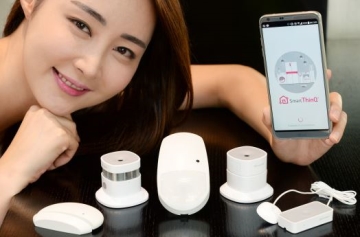
LG Electronics Launches 5 Types of Home IoT Sensors for Detecting Leaks, Smoke, and Carbon Monoxide
LG Electronics is expanding its smart home ecosystem by launching 5 types of home IoT sensors that customers can easily use through partnerships with domestic and international companies. Starting from the 24th, LG Electronics will sell 5 types of home IoT sensors that detect leaks, smoke, carbon monoxide, door openings, and motion at LG Best Shops. These products are manufactured by external companies.
2017.07.24by 김자영 기자
When it comes to IoT business, LPWA technology is essential.
Internet of Things (IoT) has now expanded beyond home IoT to take on an important role in industrial applications such as smart cities and smart farms. As smartphone technology has become increasingly sophisticated, the market has reached saturation, and the Internet of Things has emerged as a successor technology. In home IoT, services could be provided using short-range wireless communications such as Bluetooth or Wi-Fi, but as the service range expands, there is a need to go beyond 'short-range'. It is not sufficient merely to have high speed and extend beyond short-range; the cost of communication chips and modules must be low. Additionally, power consumption must be minimized. As a solution to these challenges, Low-Power Wide Area (LPWA) Internet of Small Things (IoST) technology utilizing Long Term Evolution (LTE) frequencies is emerging. This concept stems from the recognition that there is no need to transmit data at high speeds or in large volumes. By providing small quantities of data across a wide area, it is applied to remote metering, street lights, vending machine tracking, sensing, and meter reading.
2017.07.26by 김지혜 기자
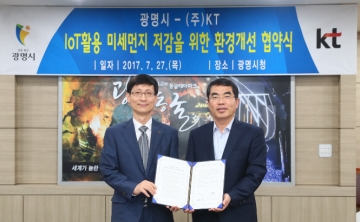
KT Tackles Fine Dust Across Gwangmyeong City
KT and Gwangmyeong City announced on the 28th that they have concluded an 'IoT-based Fine Dust Environmental Improvement Agreement' to systematically address air pollution issues such as fine dust and to enable efficient air quality management in the region. Through this agreement, KT and Gwangmyeong City, as the first municipal-level local government to do so, will analyze floating populations and fine dust vulnerable areas in Gwangmyeong City and construct an IoT-based air quality monitoring network throughout the city at base stations, telephone booths, utility poles, community centers, and bus stops. Both organizations expect to contribute to creating public value through air quality improvement and reduction of social costs by leveraging ICT technology.
2017.07.28by 김자영 기자
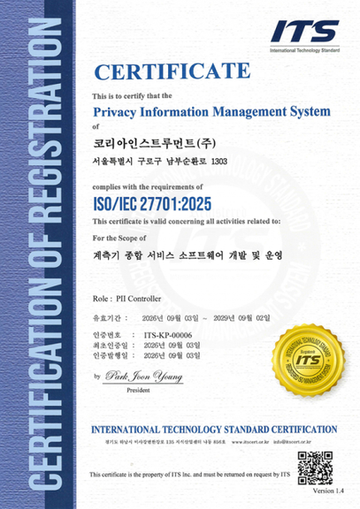
Korea Instrument, KOLAS Accredited Calibration Agency First to Simultaneously Acquire ISO/IEC 27,001·27,701
Korea Instrument has become the first among KOLAS accredited calibration agencies to simultaneously acquire ISO/IEC 27,001 and ISO/IEC 27,701 certifications. Through its proprietary platforms CWIZ Enterprise and CWIZ Partners, the company has embedded information security and personal data protection requirements across all business processes including customer information, equipment data, and calibration reports, with plans to continuously advance its management system through regular audits and security inspections.
2026.10.12by 배종인 기자

TeamViewer One, IT Incident Automation Workflow and Resolution Center Enhanced
TeamViewer has added IT incident automation capabilities and an advanced Resolution Center to its integrated digital workplace management platform 'TeamViewer ONE'. Recurrent service disruptions, configuration errors, and capacity shortages are automatically handled according to preset policies, and device status verification through script deployment can be managed in a unified interface, significantly reducing repetitive tasks for IT teams.
2026.10.12by 배종인 기자











