



TI DLP technology applied to automotive HUDs expands commercial product offerings.
 Published2017.08.22 18:01
Widely applied to various display products such as pico projectors and HUDs.
Texas Instruments (TI) has unveiled its Digital Light Processing (DLP) technology, which expands its application range from lighting control switches to automotive solutions with high resolution and brightness, fast implementation speed, small size, and low price.
DLP technology utilizes a DMD (Digital Micromirror Device) chip to achieve high-precision image display. It involves arranging countless tiny mirrors on the display device's surface, with each mirror corresponding to a single pixel. Therefore, unlike conventional CRT, liquid crystal, and plasma displays, this reflective technology eliminates color bleeding or image distortion caused by magnetism, accurately reproducing the original image.
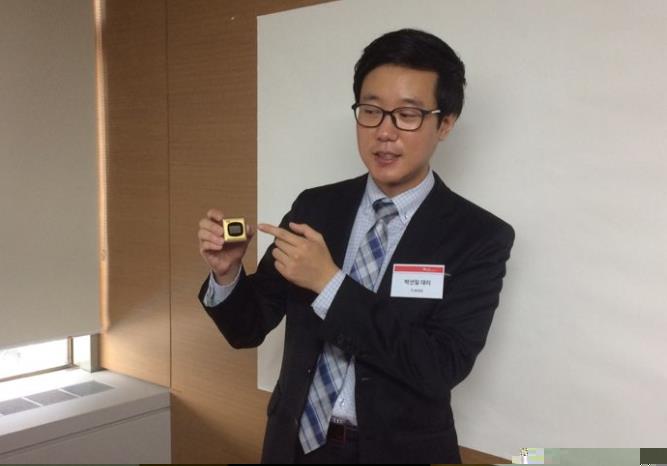
TI first introduced DLP technology in 1996 with the launch of an ultraportable projector, and brought DLP Cinema technology to theaters in 2011. The company expanded its market reach with the launch of the DLP Development Kit in 2012, and now offers pico solutions and heads-up displays (HUDs), extending its reach beyond displays to industrial, sensing, and automotive applications.
Moving images on building facades and digital objects on large stages are achieved using DLP technology. While augmented reality (AR) typically displays a single object, TI can simultaneously display multiple objects at multiple focal points with rapid implementation speed. Supports displays of various sizes, from AR glasses to cinemas.
DLP technology is being used in measuring instruments and 3D scanners that utilize color signals due to its fast implementation speed and low cost. Furthermore, it has received automotive quality certification and is being used in HUDs (Head-Up Displays).
TI's DLP technology allows viewing of the HUD even while wearing sunglasses. While this varies depending on the HUD type, the most common method of transmission is polarization. Since the lenses used in sunglasses are also polarized, the HUD is generally invisible when viewed through sunglasses. The technology will be applied to display AR across the entire windshield of a car.
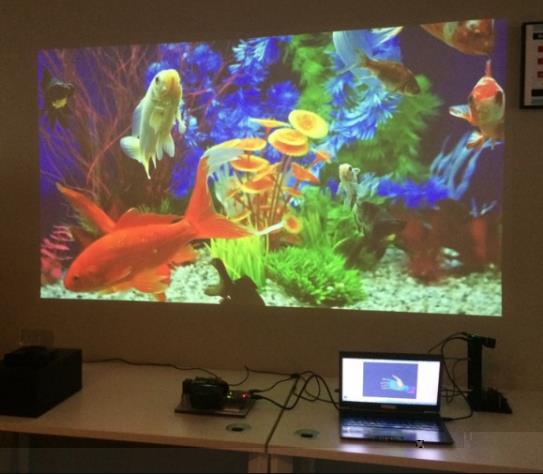
The DLP2000 chipset and the $99 DLP LightCrafter Display 2000 evaluation module (EVM) help developers quickly bring to market on-demand displays such as mobile smart TVs, pico projectors, digital signage, projection displays for smart homes, smartphones, and tablets, and display solutions for control panels and IoT.
“There are so many areas where DLP technology can be applied,” said Juan Alvarez, TI DLP product marketing manager. “Commercial products using DLP technology continue to emerge.”
At the event, demonstrations were held of products such as an ultra-short-throw premium beam projector that displays a large screen even with a short projection distance of 10 cm, a smart beam TV, and a HUD.
Comments
Related news
TI Launches Flexible Charge Controller for Battery Design
TI announced the launch of a highly flexible single-chip buck-boost battery charging controller product designed for 1-cell to 4-cell configurations. By utilizing the bq25703A and bq25700A synchronous charging controllers, efficient charging through USB Type-C and other USB ports is enabled across a wide range of finished products, from notebooks and tablets to power banks, drones, and smart home applications. The bq25703A and bq25700A, which support both I2C and SMBus interfaces, leverage newly advanced battery charging algorithms and maximum power point tracking (MPPT) technology to maximize battery charging power utilization. A proprietary algorithm called input current optimization (ICO) automatically detects the maximum input power and optimizes the current, while maintaining constant system and charging current to enable full utilization of maximum input power.
2017.07.19by 김지혜 기자
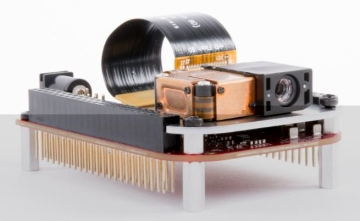
TI Implements High-Performance DLP Displays with Low-Cost Processors
Texas Instruments (TI) has opened the way for developers to implement high-performance DLP displays using low-cost processors. TI's new 0.2-inch DLP2000 chipset and the $99 DLP LightCrafter Display 2000 evaluation module (EVM) enable DLP technology to be applied at reasonable cost, allowing development of on-demand and free-form display applications such as mobile smart TVs, pico projectors, digital signage, projection display solutions for smart homes/smartphones/tablets, and display solutions for control panels/IoT.
2017.08.03by 김지혜 기자
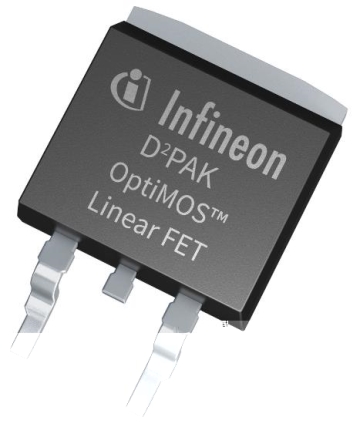
Infineon Launches New OptiMOS Linear FET Series
Infineon Technologies has launched the OptiMOS Linear FET series. The new product family combines the excellent on-state resistance (RDS(on)) of trench MOSFETs with the wide safe operating area (SOA) of planar MOSFETs, resolving the trade-off between RDS(on) and linear mode functionality. OptiMOS Linear FET can operate in the saturation region of enhancement-mode MOSFETs. The OptiMOS Linear FET series is suitable for hot-swap, e-fuse, and protection applications commonly used in telecommunications and battery management systems (BMS).
2017.08.09by 김지혜 기자
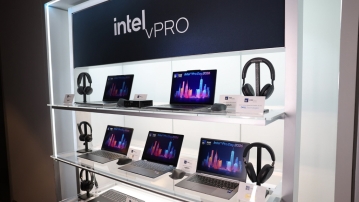
Intel Unveils Next-Generation 'Core Ultra Series 3' and vPro Platform for Enterprise PCs
Intel has officially unveiled the "Intel Core Ultra Series 3" for next-generation enterprise PCs and the latest vPro platform, addressing a wide range of demands from enterprise notebooks to high-performance workstations.
2026.03.26by 배종인 기자
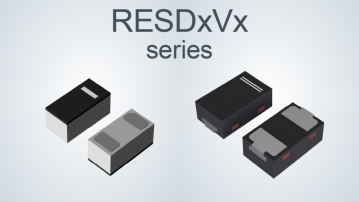
ROHM Launches ESD Protection Diode Compatible with High-Speed Interfaces of 10Gbps or Higher
Semiconductor specialist ROHM has developed the 'RESDxVx series' of ESD (electrostatic discharge) protection diodes capable of responding to next-generation high-speed data communication environments exceeding 10Gbps, simultaneously enhancing both signal quality maintenance required in high-speed interfaces and IC protection performance.
2026.03.26by 배종인 기자











