


KT Receives Approval to Operate Self-Driving Buses
 Published2017.09.22 14:30
Autonomous driving buses have a higher level of difficulty in vehicle control than regular passenger cars.
KT announced on the 22nd that it had become the first company in Korea to receive a permit for autonomous driving buses from the Ministry of Land, Infrastructure and Transport. KT's autonomous buses will be able to conduct test runs on public roads starting this month.
To date, dozens of autonomous vehicles have received certification from the Ministry of Land, Infrastructure and Transport. However, unlike passenger cars, it is difficult to develop autonomous driving functions for buses, so KT is the only company to have received permission for autonomous driving for a bus.
Unlike passenger cars, buses lack electronic control systems for key vehicle components like steering wheels and brakes. Furthermore, the high placement of sensors makes it difficult to accurately perceive surrounding objects. Furthermore, their long and heavy bodies complicate autonomous vehicle control. For this reason, autonomous driving bus technology development is only being carried out by a few automobile manufacturers that boast the world's best technology, such as Mercedes-Benz and SCANIA.
KT's autonomous driving bus not only operates independently, but also implements additional functions such as platooning, where multiple vehicles drive together. In addition to existing sensors such as lidar and cameras, it is also equipped with a precision location measurement system with an accuracy of several centimeters that utilizes KT's wireless network.
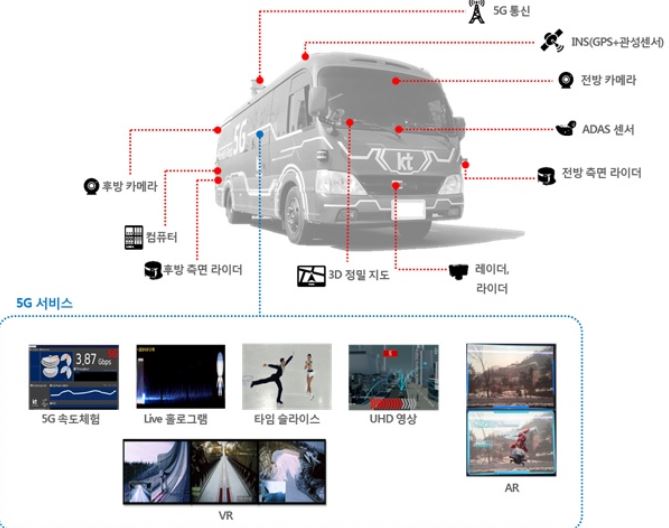
Additionally, compared to existing autonomous vehicles, its safety is expected to be significantly improved through enhanced situational judgment through direct communication with surrounding vehicles, a dramatic increase in the distance of traffic lights, and enhanced prediction of dangers in blind spots.
Since 2015, KT has been developing autonomous passenger vehicles in collaboration with Seoul National University, Unmanned Solutions, and others, and has been verifying various functions such as ▲5G communication, ▲V2X, ▲remote control, and ▲vehicle control in its own test bed, and conducting internal/external VIP demonstrations.
Based on this experience, KT developed a self-driving 5G bus and successfully demonstrated autonomous driving of the 5G bus to the public on a back road within the resort during a test event in February 2017. In addition, we are conducting joint research and development on 5G network-based V2X/autonomous driving in cooperation with vehicle manufacturers.
Currently, KT is verifying autonomous driving functions on highways using self-driving buses, and plans to conduct further tests sequentially in the future.
KT Infrastructure Research Center Director Jeon Hong-beom said, “KT has become the first in Korea to obtain a temporary permit for autonomous bus operation, making research on actual roads possible,” and “Autonomous driving will become safer through communication and convergence, and we will strengthen cooperation with various partners to develop safe autonomous driving technology.”
Comments
Related news
SKT to Begin Test Driving Autonomous Vehicles
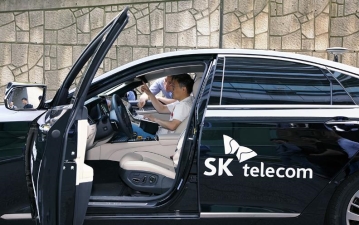
SK Telecom announced that it has become the first domestic telecommunications company to receive temporary operation permission for autonomous vehicles from the Ministry of Land, Infrastructure and Transport. With this approval, SK Telecom's autonomous vehicle will begin test drives not only on the test track established at Seoul National University's Gwanak Campus starting this month, but also on ordinary roads. SK Telecom has been collaborating with Nvidia and Seoul National University in developing autonomous driving technology. Based on this cooperation, SK Telecom's autonomous vehicle successfully demonstrated stable autonomous driving on the day of test operation for temporary operation permission on the 10th, even in heavy rainfall with a daily precipitation of 60mm. SK Telecom plans to accelerate the development of advanced technologies including artificial intelligence software, 3D HD map solutions, and terrain detection sensors (radar, lidar, camera) by utilizing an autonomous vehicle modified from the 'Genesis G80'.
2017.07.19by 김지혜 기자
KT installs 5G network in Daegwallyeong Tunnel on Yeongdong Expressway
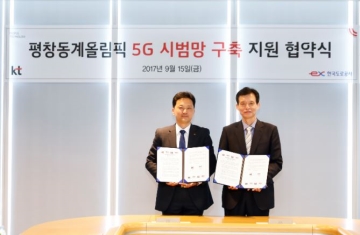
KT announced on the 15th that it has signed a business agreement with Korea Expressway Corporation at the Gwanghwamun headquarters to support "5G network construction for the 2018 PyeongChang Winter Olympics." KT and Korea Expressway Corporation have committed to mutual cooperation to promote Korea's network technology capabilities to all spectators visiting the PyeongChang Winter Olympics in 2018, based on the success of the 2018 PyeongChang Winter Olympics and the world's first 5G. Through this agreement, Korea Expressway Corporation will ▲support 5G network construction by utilizing road closure periods for tunnel improvement projects to enable smooth establishment of KT's 5G network, and ▲cooperate in supporting and operating 5G pilot operation sites and facilities.
2017.09.15by 김자영 기자
KT Holds Contest to See What Innovative 5G Service Will Come Out… Who Will Win?
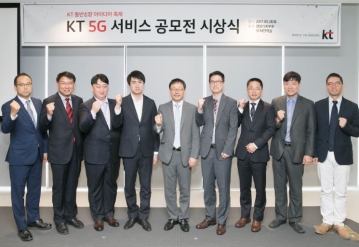
KT held a "5G Service Contest" planned to create the 5G era together with small and medium-sized and venture companies, where Burnect, an AR/VR specialist company, won the grand prize. KT announced on the 21st that it held an awards ceremony for the 5G Service Contest at KT Gwanghwamun Building East in Jongno-gu, Seoul. Key executives from KT's new business divisions, including President Koo Hyun-mo of Management Support, and Executive Vice President Song Jae-ho of Integrated Security Business Division, attended the ceremony to congratulate the award-winning companies. The contest, prepared by KT together with small and medium-sized and venture companies to develop services suitable for 5G networks, received ideas over a one-month period from August 1st to September 1st. In March of this year, KT launched "KT-Eco Alliance," an open-type technical consultation body for collaboration with small and medium-sized and venture companies in 11 new business fields including 5G and fintech. This contest was conducted primarily with participating companies from the KT-Eco Alliance.
2017.09.21by 김자영 기자
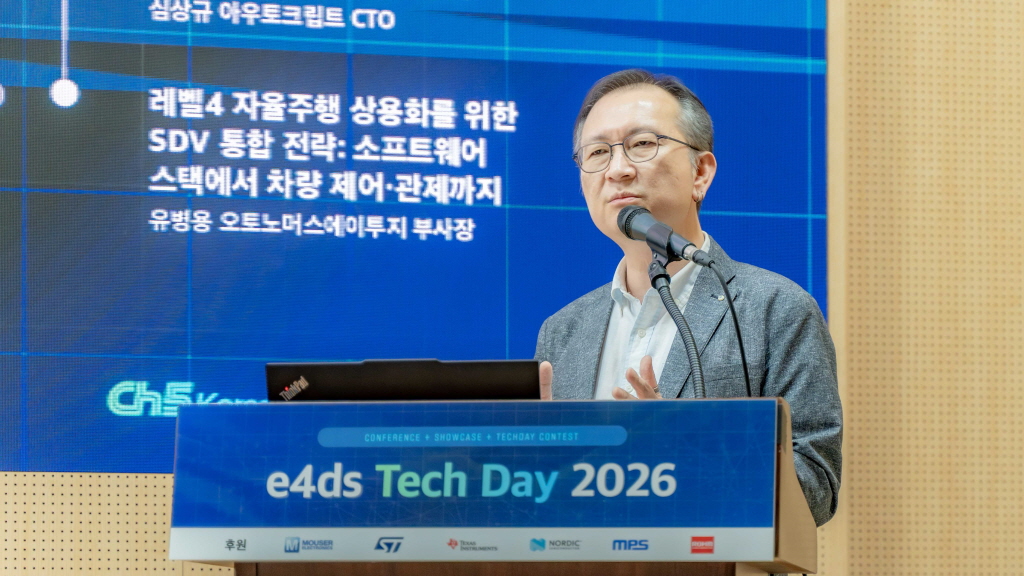
[e4ds Tech Day 2026 ⑨] Sim Sang-gyu, Autocrypt CTO: "In the Physical AI Era, Automotive Security Must Extend Beyond the Vehicle"
At e4ds Tech Day 2026, Sim Sang-gyu, CTO of Autocrypt, explained automotive cybersecurity strategies in the era of Physical AI and SDV (Software-Defined Vehicle). Automobiles are evolving as part of an ecosystem connected to AI, cloud, chargers, IoT, and robots, and he emphasized that the scope of security must expand beyond the vehicle interior to the entire connected environment. In particular, AI model tampering, adversarial attacks, OTA updates, and EV charger hacking were identified as major threats. He explained that response measures require zero trust, AI model integrity protection, intrusion detection, Security by Design and Default, and full lifecycle security management, and that proactive security system establishment beyond regulatory compliance is critical for securing future mobility competitiveness.
2026.10.12by 배종인 기자

Practical HIL Construction Strategy for Automotive and Off-Highway Controller Validation
As vehicle E/E architecture transitions to zonal structures and shifts to software-defined vehicles (SDV), the number of controllers (ECUs) requiring validation and software complexity are surging dramatically. Meanwhile, real vehicle testing cannot provide repeated verification under identical conditions and entails lead time and safety concerns. This white paper explains the principles of HIL (Hardware-in-the-Loop) validation and the structure of the NI platform composed of PXI, SLSC, and VeriStand, and through two actual implementation cases—Camera Record & Replay HIL for In-Cabin Monitoring Controller (ICMU) and Forklift Controller (VCU) HILS—describes how controller-level regression testing becomes possible. Additionally, it explicitly states application boundaries and limitations, such as lack of A2B support.
2026.10.12by 편집부











