


[Survey Results] Smartphones that were supposedly prepared with everything consumers might like, but what features are consumers ignoring?
 Published2017.09.25 14:03
Camera performance: "Image stabilization" most preferred, dual camera preferred, telephoto lens rated "unsatisfactory"
To celebrate the renewal of its news website , E4ds News conducted a special survey titled , "We didn't know what you'd like, so we prepared everything. Mobile War, What's Your Choice?" In September, the market for premium phones priced over 1 million won opened. From the Galaxy Note 8, LG's V30, to Apple's iPhone X and iPhone 8. We asked consumers what features they really wanted and what features they thought were the most unnecessary. This survey was conducted for 13 days from September 6 to 18 through email and Facebook advertisements targeting the general public, with a total of 321 participants . The largest group of respondents were in their 40s (43.3%), followed by those in their 30s (34.2%), 20s (13%), 50s (8.6%), and teenagers (0.6%). <Editor's Note>
Among respondents, the most common phone type is Samsung's Galaxy S and Note series, with 47% using premium phones, followed by iPhone, LG's premium phones, and budget phones.
What do users consider most important when changing their mobile phones?
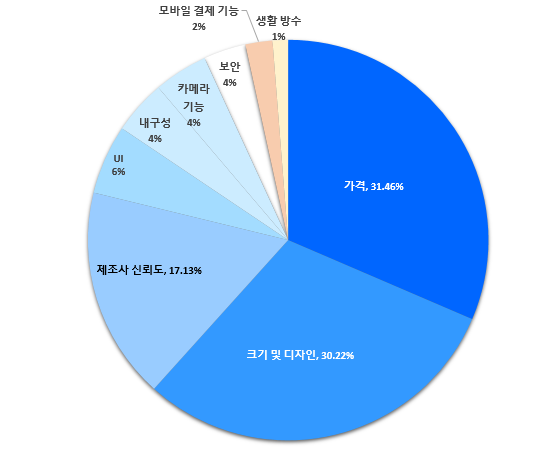
Price, again, ranked first (31%). With the repeal of the Mobile Device Distribution Structure Improvement Act (the Single Mobile Act) this month, a growing number of consumers are anticipating a subsidy crisis. However, at the Galaxy Note 8 launch press conference, Samsung Electronics' President of Wireless Business Koh Dong-jin stated regarding the separate disclosure system, "We plan to maintain marketing strategies consistent with those in the global market."
Size and design followed closely behind, accounting for 30% of the total. Another 17% of respondents said they valued manufacturer reliability. The remaining 20% cited UI, durability, and camera features.
Among design factors, people most valued the "grip" aspect (36%), which allows the device to be held in one hand. Optimized screen ratios for video and gaming, and preferred colors and designs were also not significantly different, with 29% and 27% respectively. The design element least frequently considered was weight (5%).
What are users' responses to the camera performance that each manufacturer emphasizes?
The first place went to hand shake correction (31%). A low aperture value that can take bright pictures even in dark places was in second place (23%), and a wide-angle camera that can capture a wide landscape in one screen was in third place (20%).
A telephoto camera with a zoom function of up to 10x was preferred by 9% of people, smooth video recording was preferred by 8%, and a front camera with various filters was preferred by 6% of people.
The dual lens configuration of the three companies (from the left in the photo)
▲iPhone X standard/telephoto, ▲V30 standard/wide-angle, ▲Note 8 wide-angle/telephoto
It's difficult to say which camera is better based solely on performance, as each manufacturer has its own camera characteristics.
This time, we asked for 'multiple responses' to choose the features you like for each model.
Regarding the Note 8 , 21% of respondents said they were satisfied with the S Pen's enhanced performance compared to its predecessor (the Galaxy Note 7 or Note FE) and the dual camera. 14% of respondents were satisfied with the high-spec processor, and 12% with biometric security. Other features that received less than 10% positive feedback included the evolved Bixby, the Infinity Display design, and Samsung DeX.
Considering that there were multiple responses, it is difficult to say that the preferred performance was ‘evenly distributed.’ The fact that the preferred performance barely exceeded 20% suggests that it failed to appeal to consumers. The V30 and iPhone X are at similar levels.
The V30 had 19% and 17% of people satisfied with its F1.6 aperture and P-OLED, respectively. Notably, only 14% of respondents were satisfied with its highest pixel count (rear: standard 16 million, wide-angle 13 million / front: 5 million) compared to the Note 8 and iPhone X.
The V30's other strengths, its audio system and Bang & Olufsen (B&O) earphones, also received mixed reviews, with only 12% of respondents praising the device. The bezel-less design and its military-standard durability also received 10% of acclaim. Furthermore, the V30's enhanced point zoom feature, which allows users to zoom in on a specific area to capture a video, received only 4% positive feedback.
The most unnecessary feature on premium smartphones is excessive user recognition.
The iPhone X had an enhanced dual camera with 18%, and Face ID, a facial recognition security feature, with 15%. 14% responded positively to the 5.8-inch OLED display that is comparable to the iPhone Plus series, 13% responded positively to the disappearance of the physical home button, and 13% responded positively to the water and dust resistance.
So, what are the features that make you feel like "unnecessary features" were added to justify the price tag of over 1 million won?
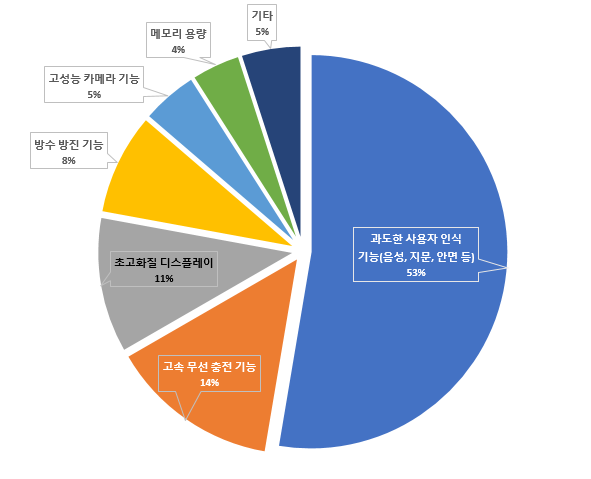
52% of respondents said excessive user recognition features were the top choice. The model with the most user recognition features is the V30, which supports a total of six (face, voice, iris recognition, fingerprint, password, and pattern). The iPhone X supports face recognition and password, while the Note 8 adds iris recognition, fingerprint, and pattern recognition to those features.
Wireless charging ranked second. Fortunately, they seem to have understood consumer sentiment. All three companies' wireless chargers are sold separately. Third place went to the ultra-high-definition display (11%), which emphasizes improved accuracy with OLED. Other features deemed unnecessary included water and dust resistance (8%), a high-performance camera (4%), and high memory capacity (4%).
The final question asked respondents which smartphone models they "want to change" or "plan to change" in September. The Galaxy Note 8 ranked first (38%), followed by the iPhone X or iPhone 8 (21%), and the V30 (17%). Fourteen percent said they "have no intention or plans," while 5% said they would purchase a mid- to low-priced phone priced under 800,000 won. And only 2% of those who answered that they were planning to purchase a foreign phone, such as one from Huawei or Google.
Tip!
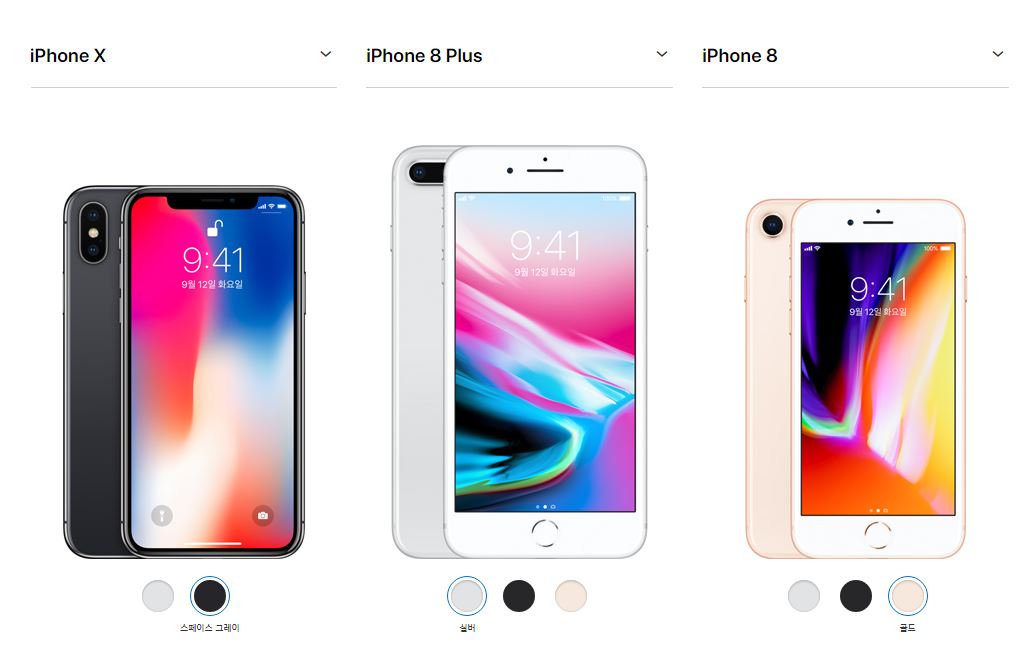
The iPhone X is the first iPhone to feature an OLED display and eliminate the home button and fingerprint recognition. Its key features include a dual camera and Face ID. (The dual camera was introduced with the iPhone 7 Plus.)
Comments
Related news
[Survey Results] Finance and Autonomous Vehicles Rank 2nd and 3rd in AI Trust… 1st is 'This'
If we have to accept decisions made by artificial intelligence (AI), it has been found that people show the most trust in the medical field, while on the other hand expressing considerable concerns about 'safety' that judges humans as animals or enemies. According to a recent artificial intelligence survey conducted by this publication (What Do You Think About AI, Which One Called Forth), when asked in which case they could place the most trust if they had to accept AI decisions, 36.8% of respondents concentrated on the medical field (disease diagnosis and prescription). This was followed by investment-related stock finance at 22.8%, autonomous vehicles at 21%, and legal court rulings at 19.3%.
2017.06.26by 신윤오 기자
[Survey Results] When asked what it was like to have a robot boss in the era of the Fourth Industrial Revolution, the answer was
Technology innovation promoted by intelligent information technology, the integration of digital into human daily life, an era where reality and virtuality are integrated through robots and artificial intelligence (AI) and objects can be intelligently controlled—there are various definitions of the Fourth Industrial Revolution. So what is the actual substance of the Fourth Industrial Revolution? In the current domestic context, the Fourth Industrial Revolution is viewed as timely and necessary, while there appears to be concern that the entities that should lead the Fourth Industrial Revolution are unclear and that it lacks concrete substance. It was found that the concept of the Fourth Industrial Revolution is deemed necessary for industrial restructuring centered on artificial intelligence, Internet of Things, and big data (34.52%), and because a new technological phase has arrived following the Internet information revolution (20.24%).
2017.08.07by 김지혜 기자
"The Galaxy Note 8 has a loyal following, so we're not concerned about the iPhone X and are sticking to the roadmap."
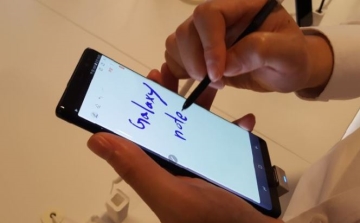
A dual camera allows you to capture two photos in a single shot. The dual capture feature saves both a portrait-focused photo taken at a travel destination and a wide-angle mode photo that includes the background. The Note pen adds water-resistance, enabling you to take photos and write notes outdoors even on rainy days. The pressure sensitivity has been refined to support everything from illustrations to watercolor paintings. Samsung Electronics officially introduced the Galaxy Note8 on Tuesday, the 12th, at Samsung Electronics' Seocho office. Three Galaxy Note series users, who are 'Note fans,' participated in the event and shared their impressions after using the Note8 in advance.
2017.09.12by 김자영 기자
ESP32 Development Environment Selection and GPS Application Implementation
The ESP32 is a microcontroller that integrates Wi-Fi, Bluetooth, 12-bit ADC, capacitive touch, PWM, DAC, and UART in a single SoC. However, the abundance of features does not by itself solve the designer's problems. The real challenges lie in selecting the appropriate development environment, determining which pins can be used and which must be avoided, and converting raw data from modules into usable information. This document addresses ESP32 peripheral constraints (ADC2 and Wi-Fi coexistence limitation, UART1 occupancy, ADC non-linear regions), the trade-offs between Arduino IDE and ESP-IDF, and the process from connecting NEO-6M/NEO-M8N GPS modules to UART2, parsing NMEA sentences, and visualizing routes in Google Earth, all organized based on documented references.
2026.10.12by 편집부
MIPI CSI-2, DSI-2, C-PHY, D-PHY Test Solution Technical White Paper
The MIPI interface adopts a burst mode that transitions between low-power (LP) and high-speed (HS) states for low-power consumption, and in return, strict timing rules are imposed on state transitions. Additionally, the high-speed section operates as a packet-based protocol with headers, ECC, and CRC, so verification engineers must handle waveforms and protocols simultaneously. Traditional configurations combining general-purpose oscilloscopes and AWGs reveal limitations in setup complexity, measurement uncertainty, and lack of reproducibility when faced with these requirements. This white paper, based on webinar materials, organizes the structure of this problem and describes how the SV5C-DPTXCPTX generator for receiver testing and SV5C-DPRXCPRX analyzer for transmitter testing integrate state transition testing, stressed eye testing, and protocol analysis into a single bench, along with their application boundaries.
2026.10.12by 편집부











