


Solving wearable power issues with a compact battery-optimized solution.
 Published2017.09.29 10:00
Current and voltage adjustment possible with battery temperature monitoring function
Wearable devices are being used for a variety of purposes, including smart belts that record daily activity and alert you to overeating, and wearable cameras that attach to bags or clothing to capture daily photos. Furthermore, with the advent of "hearables," wearable devices in the form of earphones inserted into the ear, devices are becoming smaller and more wireless.
Hearable devices must be small and incorporate a variety of sensors, including accelerometers and heart rate sensors, necessitating smaller components. Most PMICs for small devices powered by lithium-ion batteries require current regulators such as boost, buck, LDO, regulator charger, and LED indicators.
Maxim Integrated has introduced the MAX77650 and MAX77651, which enable compact power solutions that are less than half the size (19.2mm2) of conventional PMICs. Both products are designed for low-power wearables where size and efficiency are paramount. Both devices feature three independently programmable power rails on a single inductor and SIMO buck-boost regulation to minimize overall solution size.
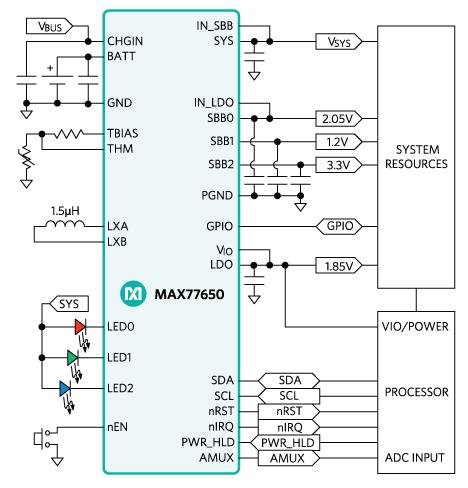
It also includes features such as a current sink for driving LED indicators and an analog multiplexer for switching multiple internal voltage and current signals to external nodes for monitoring with an external ADC. A 150mA LDO provides ripple rejection for audio and other noise-sensitive applications. It supports a wide range of lithium-ion battery capacities and features battery temperature monitoring for safety.
This charger is optimized for small batteries, with a low standby current of 0.3 μA and a programmable fast-charge current of 7.5 mA to 300 mA. Battery temperature monitoring allows for adjustment of the charge current and regulation voltage.
Regarding the demand for battery management chips, Richard Eden, senior analyst for power semiconductors at IHS Markit Technology, said, “A compound annual growth rate of 5% is expected from 2017 to 2020,” and analyzed that “battery management for wearables, including hearables, will show the highest average annual growth rate of 29% during the same period.”
“The MAX77650 and MAX77651 leverage Maxim’s PMIC expertise to deliver ultra-small, ultra-low-power battery-charging solutions that address the growing market need,” said Scott Kim, business manager for mobile power at Maxim Integrated. “Both solutions are optimized for small batteries.”
“The MAX77650, with its rich feature set ideal for wearables, has enabled us to reduce the size of our Bluetooth music headsets,” said Tjapko Uildriks, CEO of Dopple BV. “The MAX77650 integrates essential power management features required for advanced wearables, enabling Dopple to build a high-quality Bluetooth music headset platform.”
Comments
Related news
Maxim Launches Buck Converter Providing Low Standby Current for USB Type-C Devices
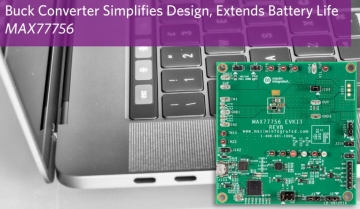
Maxim Integrated Korea has launched the MAX77756, a buck converter that provides flexible options with 24V, 500mA, and low standby current for multi-cell USB Type-C products requiring high current, dual input, and I2C support. USB Type-C products detect USB insertion by generating a constant 3.3V power rail. Utilizing a power supply in the 5-20V voltage range, the MAX77756 uses a step-down converter to generate always-on power (1.8V/3.3V/5.0V) digital supply rails for port controllers. The MAX77756 reduces standby power consumption while operating continuously through its low standby current of 20μA. The MAX77756 features an ideal dual-input diode ORing circuit that allows external USB power to be supplied to the input stage to drive the chip when the battery has no remaining charge, which simplifies system design.
2017.08.11by 김지혜 기자
Simplifying the head unit can solve signal loss and power issues.
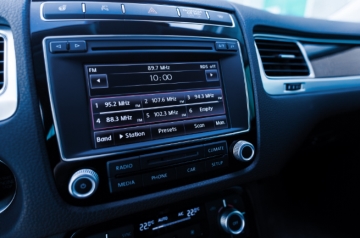
The practice of listening to music or radio in cars has continued from the past until now, but the form of the head unit has gradually changed. From cassette tapes to CDs and MP3s, as audio sources transitioned from physical media formats, head units became simplified. To support such systems in automobiles, cables weighing tens of kilograms are required. Cable routing is often done manually, which is time-consuming and costly. Automotive radios have up to 6 cables connected depending on the car model and the band functions supported. As head units become simplified, the amount of cable required can be reduced, thereby saving space and reducing heat dissipation. To reduce the amount of cabling, Maxim Integrated has proposed a "remote tuner solution." The remote tuner architecture serializes the output of a radio tuner located near the antenna using GMSL (Gigabit Multimedia Serial Link) through a single cable. The single cable transmits not only the desired channel but also control signals (I2C) through the back channel of the GMSL link and supplies power to the remote tuner.
2017.08.24by 김지혜 기자

Maxim launches converter tool to accelerate rapid development of power supply devices
Maxim Integrated Korea has launched the 'EE-Sim DC-DC Converter Tool,' which supports the rapid development of high-quality power supply devices. Powerful development tools are necessary to save time and resources during power design. Power designers can use the EE-Sim DC-DC Converter Tool to develop and simulate complex circuits more easily. Novice designers can complete designs in just a few minutes, while professional designers can visualize and control simulation parameters at an advanced level. The EE-Sim DC-DC Converter Tool recalibrates circuits according to components changed by the designer and compares and evaluates differences between designs. As a best-in-class waveform viewer, it allows users to explore simulation results and perform customized design, and can be utilized bidirectionally. The simple interface eliminates the need for training in customized design.
2017.09.06by 김지혜 기자

Intel Unveils Next-Generation 'Core Ultra Series 3' and vPro Platform for Enterprise PCs
Intel has officially unveiled the "Intel Core Ultra Series 3" for next-generation enterprise PCs and the latest vPro platform, addressing a wide range of demands from enterprise notebooks to high-performance workstations.
2026.03.26by 배종인 기자

ROHM Launches ESD Protection Diode Compatible with High-Speed Interfaces of 10Gbps or Higher
Semiconductor specialist ROHM has developed the 'RESDxVx series' of ESD (electrostatic discharge) protection diodes capable of responding to next-generation high-speed data communication environments exceeding 10Gbps, simultaneously enhancing both signal quality maintenance required in high-speed interfaces and IC protection performance.
2026.03.26by 배종인 기자











