



From individuals to industries, IoT technology is converging into diverse fields.
 Published2017.10.12 10:47
The Internet of Things (IoT), including smart cities, smart farms, smart factories, and smart homes, is being integrated across the public and industrial sectors. Accordingly, a venue was provided to showcase various technologies, including personal IoT, public IoT, and industrial IoT.
At the '2017 International Internet of Things Exhibition' held at Samsung COEX starting on the 11th, the Electronics and Telecommunications Research Institute (ETRI) showcased 12 new IoT technologies to support the growth of small and medium-sized enterprises.
The technologies unveiled on this day included FaaS (Factory as a Service) smart factories and energy IoT-based microgrids for industrial applications, augmented cognitive services for disaster response firefighters, underground space safety IoT, and energy safety IoT for disaster safety applications, and next-generation leading technologies such as a hyper-connected self-learning engine common framework and wearable human care technology based on psychological, emotional, and sleep state recognition.
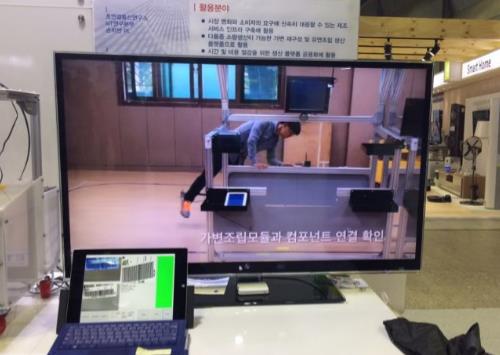
Researcher Son Ji-yeon explained, “As product lifecycles shorten and become more personalized, the market is shifting from a supplier-centric model to a consumer-driven one,” adding, “There is a need for technology to control smart factory manufacturing equipment systems capable of producing a variety of heterogeneous products on a personalized basis.”
Kwang-soo Kim, a principal researcher at the UGS Convergence Systems Laboratory, introduced the UGS Service Platform technology. This technology is a software platform that collects data from IoT devices installed underground to monitor the condition of buried structures and visualize underground spaces. It is used to prevent ground subsidence phenomena, such as sinkholes, in advance.
Researcher Kim stated, “We implemented the project in Songpa-gu, Seoul, as a pilot area in 2015. There is currently no information available regarding accidents occurring in underground spaces or the risk levels of buried utilities.” "When the 'Special Act on Underground Safety Management' goes into effect next year, an underground safety management monitoring system will be necessary," he said.
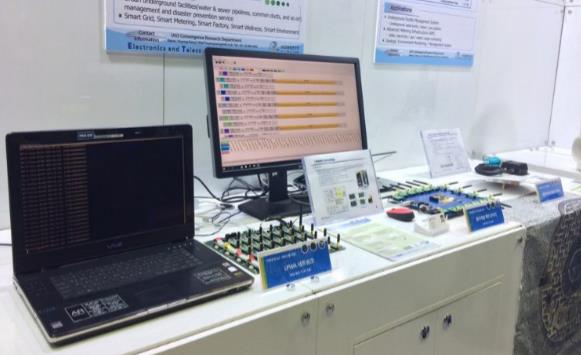
Director Kang Ho-yong explained the LPWA network technology capable of 5km/5-year IoT services. It consists of wide-area/low-power IoT network stack software, UGS nodes, and UGS IP. It supports multi-PHY and uses the 920MHz frequency band. As an international standard technology developed in Korea, it was first developed by ETRI.
Next, high-performance broadband omnidirectional embedded antenna technology capable of being embedded in manhole covers was introduced. Surface-embedded antennas are required to transmit sensor information regarding underground utilities to wireless networks. This technology enables medium-to-long-distance signal transmission, implements omnidirectional radiation characteristics to minimize dead zones, and maintains no height difference from the ground surface.
Energy IoT-based technologies were also showcased. As renewable energy policies expand, distributed energy resources, such as solar energy storage devices, are becoming more widespread. ETRI developed a service that controls and enables independent operation of single and multiple microgrids using IoT protocols, as well as an energy safety service used to prevent safety accidents, such as fires, in traditional markets and underground shopping complexes.
Technology to determine psychological state using wearable devices in daily life was also unveiled. Health risk situations such as respiration, oxygen saturation in the body, and sleep status can be identified, and monitoring is possible with a wrist-type wearable device during sleep.
Kim Hyun, Head of the IoT Research Division at ETRI, stated, “We must drive the era of intelligence across all industrial sectors and social systems through the joint efforts of industry, academia, and research,” adding, “We will strive for industrial commercialization by sharing IoT application technologies, the core of the Fourth Industrial Revolution, with the public and fostering cooperation.”
Comments
Related news
ETRI, Proves Accuracy of Finding Types and Locations of 200 Objects in Photos
Domestic researchers have been recognized for their performance in image object detection and average detection accuracy, which are necessary for artificial intelligence advancement, at an international image recognition competition. ETRI (Electronics and Telecommunications Research Institute) announced on the 27th that it achieved 2nd place in object detection performance by object category and 3rd place in average detection accuracy at the object detection track of the International Image Recognition Competition (ILSVRC, ImageNet) held at the Hawaii Convention Center, competing against research teams from companies and universities worldwide.
2017.08.01by 김자영 기자

ETRI's Technology Enabling Natural Conversation Without Knowing Nationality Adopted as International Standard
A technology enabling automatic interpretation without touching a smartphone—allowing people to converse as naturally as face-to-face dialogue—has been adopted as an international standard. ETRI announced on the 28th of last month that 'Zero UI automatic interpretation technology' received final approval as an international standard at an international standardization conference held by the standards association in Paris, France. Zero UI is an automatic interpretation technology. When A and B are having a conversation, when A speaks, the audio is transmitted from A's headphones to A's smartphone, and B's smartphone interprets this and delivers it to B's headphones.
2017.08.22by 김자영 기자
ETRI Increases Autonomous Vehicle Processor Cores to 9
The Electronics and Telecommunications Research Institute (ETRI) announced that it has developed a chip to process data collected from all sensors in autonomous vehicles. It is a processor chip that executes image recognition and control functions required by autonomous vehicles with low power consumption around 1 watt (W). This processor was named "Aldebaran" last year. It is one of the first-magnitude star designations. The core processor that determines autonomous vehicle performance had previously relied on overseas technology, but with domestication, there is no longer any need for overseas dependence. In this research, following last year, the field where performance was improved is that processor cores were increased from 4 last year to 9. As the number of processing cores increased, processing speed accelerated, enabling clearer and larger image implementation.
2017.09.21by 김지혜 기자
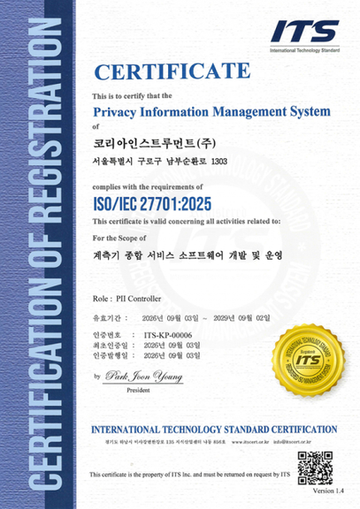
Korea Instrument, KOLAS Accredited Calibration Agency First to Simultaneously Acquire ISO/IEC 27,001·27,701
Korea Instrument has become the first among KOLAS accredited calibration agencies to simultaneously acquire ISO/IEC 27,001 and ISO/IEC 27,701 certifications. Through its proprietary platforms CWIZ Enterprise and CWIZ Partners, the company has embedded information security and personal data protection requirements across all business processes including customer information, equipment data, and calibration reports, with plans to continuously advance its management system through regular audits and security inspections.
2026.10.12by 배종인 기자

TeamViewer One, IT Incident Automation Workflow and Resolution Center Enhanced
TeamViewer has added IT incident automation capabilities and an advanced Resolution Center to its integrated digital workplace management platform 'TeamViewer ONE'. Recurrent service disruptions, configuration errors, and capacity shortages are automatically handled according to preset policies, and device status verification through script deployment can be managed in a unified interface, significantly reducing repetitive tasks for IT teams.
2026.10.12by 배종인 기자











