



KT Successfully Transmits 5G Video on Highway
 Published2017.10.13 09:30
5G network built in tunnels using base stations and data processing equipment developed for the Pyeongchang 5G pilot service
KT announced on the 12th that it has successfully demonstrated '5G-SLT (Skylife LTE TV)' technology, which transmits video by connecting a 5G network to a vehicle moving at high speeds of over 100 km/h. This marks the first time that 5G connectivity has been successfully established in an actual highway environment.
SLT is a technology that combines KT's LTE technology with KT Skylife's satellite broadcasting to provide high-definition video regardless of driving conditions, and was launched last July. It is a method that provides real-time broadcast signals via LTE when the satellite signal weakens, such as during heavy rain or when entering a tunnel, while providing real-time broadcasts via satellite.
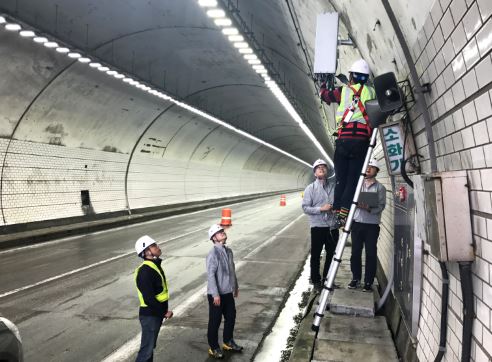
For this technology demonstration, KT, with the cooperation of the Korea Expressway Corporation, installed a '5G base station (RFU, Radio Frequency Unit)' developed for the 5G pilot service to be showcased in Pyeongchang in '18 in Daegwallyeong 1 Tunnel on the Yeongdong Expressway, and connected it to a '5G data processing equipment (BBU, Base Band Unit)' to build a 5G network environment.
KT confirmed that a vehicle equipped with the '5G-SLT system,' which is interconnected with 5G, 4G, and satellite, receives broadcast signals from satellite and 4G networks on a regular highway, and as soon as it enters Daegwallyeong Tunnel 1, the vehicle connects to the 5G network to take over the broadcast signals, enabling seamless real-time TV service even in the tunnel.
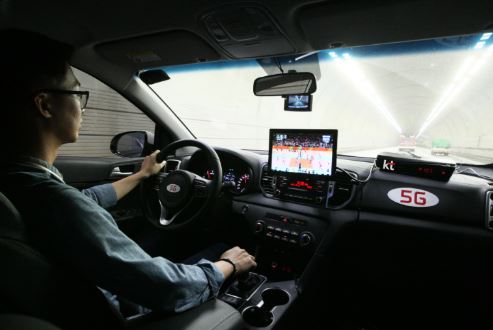
KT explained that the 5G-SLT system developed last July consists of a 5G terminal, a router capable of selecting and utilizing 5G or 4G networks, and a satellite TV terminal, and that it was able to succeed in this demonstration by conducting tests and optimizations to link satellite signals with 4G and 5G for three months starting in August in a laboratory (LAB) environment where a 5G network was established similar to highway conditions.
The success of the 5G-SLT technology demonstration goes beyond a mere 5G interoperability test; it is significant in that it implemented services that consumers can directly experience, such as the real-time transmission of high-definition video over a 5G network. It is very meaningful.
In addition, KT assessed that 5G-SLT technology has laid the technological foundation for the commercialization of 5G-based hyper-connected services, such as autonomous driving and connected cars, which must ensure connectivity even in situations of high-speed movement.
Going forward, KT plans to utilize 5G-SLT technology for 5G experience events for visitors to Pyeongchang in 2018 at the Daegwallyeong Tunnel on the Yeongdong Expressway, which is a gateway from major cities such as Seoul and Incheon to Pyeongchang, and at Pyeongchang and Gangneung, which are major 5G pilot service areas in 2018, after undergoing additional field testing and 5G network optimization processes.
"With the successful connection of 5G with high-speed moving vehicles, we have once again proven that we can provide the best communication services in any environment based on 5G," said Seo Chang-seok, Executive Vice President and Head of KT's Network Strategy Division. "Based on the world-class technological capabilities we have built in the ICT field, we will continue our efforts to provide KT's unique high-quality specialized services."
Comments
Related news
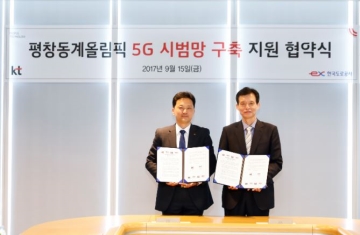
KT installs 5G network in Daegwallyeong Tunnel on Yeongdong Expressway
KT announced on the 15th that it has signed a business agreement with Korea Expressway Corporation at the Gwanghwamun headquarters to support "5G network construction for the 2018 PyeongChang Winter Olympics." KT and Korea Expressway Corporation have committed to mutual cooperation to promote Korea's network technology capabilities to all spectators visiting the PyeongChang Winter Olympics in 2018, based on the success of the 2018 PyeongChang Winter Olympics and the world's first 5G. Through this agreement, Korea Expressway Corporation will ▲support 5G network construction by utilizing road closure periods for tunnel improvement projects to enable smooth establishment of KT's 5G network, and ▲cooperate in supporting and operating 5G pilot operation sites and facilities.
2017.09.15by 김자영 기자

Samsung Electronics Successfully Demonstrates 4G-5G Mobile Communication Interworking in Moving Vehicles
Samsung Electronics and SK Telecom have successfully demonstrated interworking between 4G and 5G mobile communications. The successful communication seamlessly switching between 4G LTE using the 2.6GHz frequency band and 5G networks in the 28GHz and 3.5GHz frequency bands is a world first. Samsung Electronics and SK Telecom recently established 4G and 5G base stations supporting different frequency bands and next-generation virtualized core networks at Euljiro in Seoul, and installed integrated terminals supporting both 4G and 5G in a vehicle to successfully demonstrate continuous communication service between the base station and terminal even during driving.
2017.09.29by 신윤오 기자
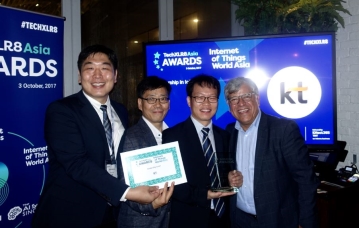
KT Recognized for 5G Research Contributions in Asia
KT announced that it has been selected as the outstanding operator in three categories at the '5G Asia Awards 2017' held on the 3rd at Marina Bay Sands in Singapore among leading telecommunications and manufacturing operators: 'Outstanding Contribution to 5G R&D', 'Leadership in IoT', and 'Best Network Development'.
2017.10.10by 김자영 기자
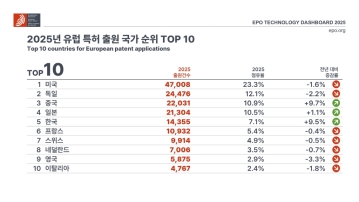
European Patent Applications Surpass 200,000 for the First Time… South Korea Maintains 5th Place, Led by Batteries and Telecommunications
According to the European Patent Office (EPO)'s 'Technology Dashboard 2025', European patent applications last year reached 201,974, surpassing 200,000 for the first time. Korean companies and inventors filed 14,355 applications, representing a 9.5% increase from the previous year and maintaining 5th place by country. Battery, digital communication, and semiconductor technologies led the growth, with Samsung ranking as the top EPO applicant for the second consecutive year and LG reaching 3rd place. The presence of major domestic cities such as Seoul, Suwon, and Yongin was also confirmed. It was also revealed that Korea's European patent strategy is expanding beyond individual technologies to span the entire industry.
2026.03.24by 명세환 기자

SK Telecom First Applies AI-Based Network Operations at Gwanghwamun K-Pop Concert
SK Telecom announced that it applied an AI-based network operation system for the first time at a large-scale K-pop concert held in the Gwanghwamun area of Seoul on March 21st, managing communication quality throughout the event. Mobile data usage during the three hours before and after the concert reached 12.15TB, approximately doubling compared to the same time slot the previous weekend. SK Telecom monitored traffic using the AI system 'A-One' in five-minute and 50-meter units to respond to potential overload situations, while also operating temporary communication facilities and on-site personnel in parallel. This case is interpreted as confirmation of the practical applicability of AI-based autonomous network operation in an environment where demand from dense events and foreign users increases simultaneously.
2026.03.23by 명세환 기자











