


KT Receives First Approval for 5G International Standard with '5G Orchestration'
 Published2017.10.13 09:56
The first example of a 5G international standard managing virtualization and network slicing technology
KT announced on the 13th that its self-developed '5G network slice orchestration' standard has been finally approved as one of the 5G standards by the ITU (International Telecommunication Union).
'5G Network Slice Orchestration' is designed to efficiently manage 'network slices,' a core networking technology of 5G. It is a technology that enables the provision of high-quality 5G services tailored to the diverse needs of customers by simultaneously managing virtualized networks and existing wired networks for each service within a 5G communication network.
This standard was proposed as an international standard by KT, which took on the role of Standard Document Editor and developed it. After being approved at the 'ITU-T IMT-2020 Working Party' meeting held in Geneva, Switzerland last July, it was finally approved this time following circulation to all 193 member countries. As the final approval process was completed, the ITU assigned the official standard number 'ITU Standard Y.3110' to this standard in accordance with international standard management procedures.
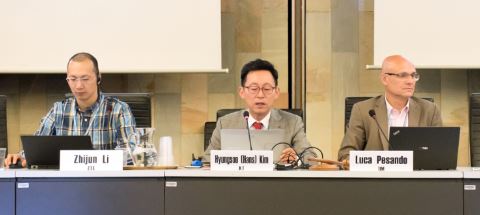
In addition, 'ITU Standard Y.3111,' approved simultaneously on this day, was jointly developed by ETRI and KT and contains detailed procedures and a framework for '5G network slice orchestration.'
In order for 5G to stably provide various services, overall network operation management technology must be developed. In this regard, the recently approved '5G Network Slice Orchestration' standard contains advanced features that precede existing 5G technologies. It is expected that the application of this technology will significantly reduce construction and operating costs for telecommunication operators, as it will enable the simultaneous utilization of functions from both 5G networks and existing wired networks.
Meanwhile, the Korea ITU Research Committee under the National Radio Research Institute has been responding to international standardization trends by operating a special task force for IMT-2020 response since 2015, and has been strategically responding to Korea's ITU IMT-2020 international standardization activities by forming a national delegation including domestic experts from industry, academia, and research institutes and dispatching it to the ITU. In particular, at the World Telecommunication Standards Assembly (WTSA), it presented the direction for IMT-2020 international standardization to the ITU and secured a related resolution, thereby creating an opportunity for Korea to play a leading role in the field of 5G international standardization.
In addition, this standard was adopted as a standardization project by the 5G Special Technical Committee of TTA (Korea Information and Communications Technology Association) on September 6, 2017, and domestic standardization began. This is expected to provide technology implementation opportunities to domestic small and medium-sized enterprises that develop and supply network management solutions.
Jeon Hong-beom, Head of the Infrastructure Research Institute at KT's Convergence Technology Institute, said, "The successful international standardization of this 5G technology will serve as an opportunity to provide new customer experiences by utilizing 5G network slice orchestration technology."
Comments
Related news
KT, “Intelligent Networks Are the Core of the Fourth Industrial Revolution”
KT delivered a keynote speech on the 25th at BEXCO in Busan at 'ITU Telecom World 2017,' the world's largest information and communications forum hosted by the International Telecommunication Union (ITU), announcing that evolution toward an 'intelligent network' through the convergence of artificial intelligence and 5G is the key to leading the fourth industrial revolution. Jeon Hong-beom, head of KT's Infrastructure Research Institute, presented KT's artificial intelligence-based communication network technology at the keynote speech of the 'AI, Telcos & Intelligent Network' session on that day and conveyed to the international community KT's vision for realizing the 5G era.
2017.09.25by 김자영 기자
KT Recognized for 5G Research Contributions in Asia
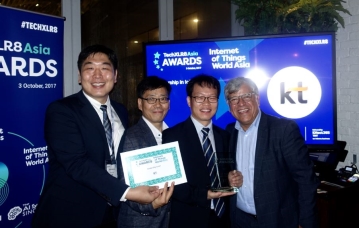
KT announced that it has been selected as the outstanding operator in three categories at the '5G Asia Awards 2017' held on the 3rd at Marina Bay Sands in Singapore among leading telecommunications and manufacturing operators: 'Outstanding Contribution to 5G R&D', 'Leadership in IoT', and 'Best Network Development'.
2017.10.10by 김자영 기자
KT Successfully Transmits 5G Video on Highway
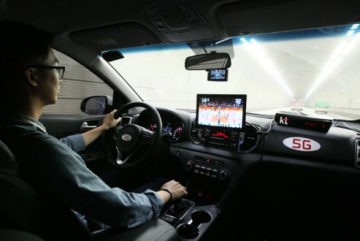
KT announced on the 12th that it successfully demonstrated '5G-SLT (Skylife LTE TV)' technology that connects vehicles traveling at speeds exceeding 100 km/h with 5G networks to transmit video. This marks the first time successful 5G integration has been achieved in an actual highway environment. SLT is a technology that integrates KT's LTE technology with KT Skylife's satellite broadcasting to provide high-quality video regardless of driving conditions, and was launched last July. It provides real-time broadcasting via satellite, and when satellite signals weaken due to heavy rainfall or entry into tunnels, it switches to providing real-time broadcast signals through LTE.
2017.10.13by 김자영 기자
Nvidia invests $5 billion in Intel
NVIDIA and Intel, leaders in global AI computing technology, are now forging ahead in providing cutting-edge solutions through NVLink-based architecture integration. NVIDIA and Intel have officially announced a strategic partnership and stated that they will jointly develop customized data center and personal computing products to accelerate diverse applications and workloads ranging from hyperscale to enterprise and consumer markets, thereby laying the foundation for the next generation computing era.
2025.09.22by 배종인 기자
.jpg)
Applied Materials Launches Environmental Protection Campaign to Mark World Cleanup Day
Applied Materials Korea (CEO Park Kwang-seon) is carrying out environmental cleanup activities with employees and their families around the Dongtan Sinricheon area on the occasion of World Cleanup Day, evolving into a company that engages with the local community beyond technological innovation.
2025.09.22by 명세환 기자











