


[Smart City] Location-tracking streetlights and trash cans announcing collection times, the city is getting smarter
 Published2017.10.13 11:11
Unlike hardware-centric U-CITY, rapid expansion expected as a 'software' platform
In autumn, the yellow-tinged maple trees and the yellow streetlights are truly beautiful. However, one day, the streetlights were replaced with white LEDs. I thought, "What a civil servant who knows nothing of romance." I never dreamed that those pale LED lights were actually smart lights that pinpointed my exact location when I was coming home late.
Smart streetlights equipped with IP cameras and LoRa communication modules can transmit a user's location to others via an application while returning home late at night, and can also connect with relevant agencies to request assistance. Controlled via beacons, they can also be expanded to support services for finding missing children.
Smart cities are selecting demonstration areas to verify about 20 ideas from local residents. Goyang has been conducting projects for the second year focusing on the environment, and Busan for the third year focusing on safety and transportation.
Sensors have been installed at the Lotte Department Store in Centum City, Busan, to prepare for disaster situations. The sensors detect fires or disasters and provide route guidance even if communication power is cut off.
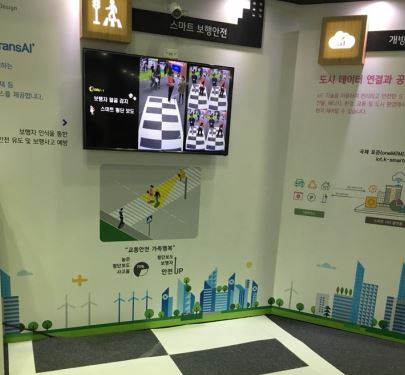
Smart crosswalks designed to promote pedestrian safety have been introduced in school zones. They utilize existing CCTVs. They provide guidance to pedestrians crossing against a red light using safety lights or voice prompts. A system that displays vehicle speeds on electronic display boards to encourage slowing is also in operation. An employee of Deliai, which provides related services, stated, “We have introduced and are operating it in 47 locations in Busan and Daegu.”
Busan City operates a wireless traffic information application. In the vicinity of Gwangan Bridge, a section that is always congested during the summer due to beachgoers and complex road conditions, the application analyzes traffic volume, vehicle speed, and density to guide users to alternative routes.
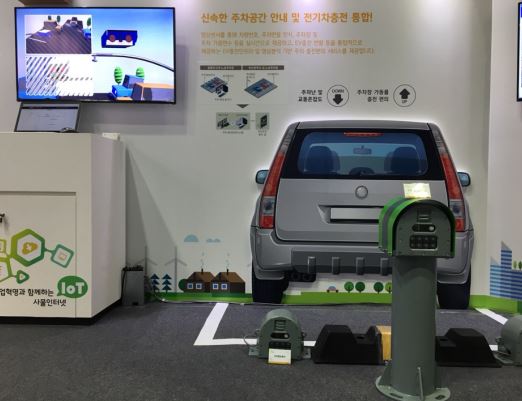
For large-scale above-ground parking lots like the BEXCO parking lot, you can check for available spaces via the app. In the case of BEXCO, electronic display boards are installed within the parking lot to guide users to available spots. Vehicles are detected using CCTV footage and sensors, and the update time is approximately 5 to 10 seconds.
Environmental services introduced in Goyang City include water quality, air quality, trash cans, and security lights. Sensors are installed in the fountain where children play in the summer to analyze water quality in real time and manage the water supply.
The air quality environment provides health indicator information on fine dust, weather, and climate, centered on daycare centers, to help children refrain from going outside and maintain appropriate indoor temperatures.
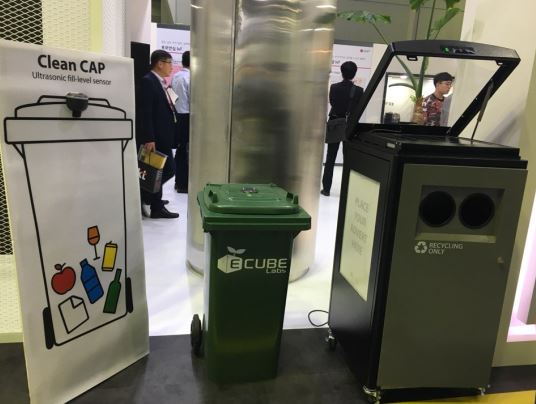
Lee Myeon-seong, a team leader promoting smart cities at the Ministry of Science and ICT, stated, “The most representative service is the smart trash can, which compresses waste using solar power and sends an alarm to sanitation workers when the trash can is full,” adding, “Its utility has been recognized internationally, and the same service has been installed and is currently operating in Washington D.C., USA.”
Team Leader Lee stated that a key task during the smart city initiative was the “establishment of an open platform.” The ultimate goal is to enable the collection and utilization of data via sensors. He believed that if the government-led project establishes a platform, corporate participation would be facilitated, thereby realizing sustainable operations. He added, “Unlike U-CITY, which is centered on control platforms, the smart city is structured around IoT technology, service platforms, and software, so the speed of service expansion is expected to be rapid.”
Comments
Related news
[Smart City] Smart City Completion: Not Just Technology but Administrative Functions as Well
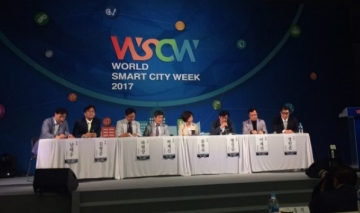
"Smart cities should become the complete form of technological elements that are considered core to the Fourth Industrial Revolution, such as big data, artificial intelligence, and robotics." Speakers who participated in the 'Smart City Public Service Innovation Conference' held at KINTEX in Ilsan, Gyeonggi Province on the 7th emphasized that ultimately smart cities should become a future where smart people live and smart governance exists, stressing that administrative aspects must progress alongside technology. Professor Nam Tae-woo from Sungkyunkwan University cited Barcelona and Stockholm as successful overseas smart city adoption cases. Barcelona set its smart city goal as improving citizens' lives and communities by converging urban planning, ecosystems, and information technology. It is also a representative pilot city for smart cities applying low-carbon technology. Overall implementation is carried out by the city council, while the project management committee carries out detailed planning, execution, and cooperation duties as well as project performance supervision. Stockholm aims for sustainability across four dimensions: ecological, financial, social, and democratic. By leveraging big data, it controls signals prioritizing buses, pedestrians, and bicycles, and quickly notifies users of free parking spaces. There are service examples such as street lights where illumination is adjusted according to daylight hours and demand, and electric bicycles.
2017.09.07by 김지혜 기자
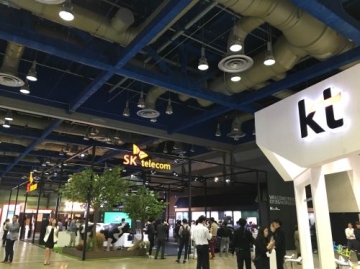
[Photo News] Meet the smart world at the 'IoT International Exhibition'
The Internet of Things International Exhibition, where you can see at a glance the various application fields of the Internet of Things such as smart cities, smart farms, smart metering, smart factories, smart cars, and smart homes, was held at COEX for three days starting on the 11th.
2017.10.11by 김자영 기자
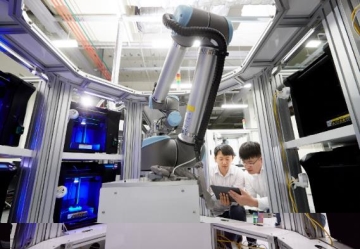
From individuals to industries, IoT technology is converging into diverse fields.
Smart cities, smart farms, smart factories, and smart homes—Internet of Things (IoT) is converging across the public and industrial sectors. With this development, an opportunity has been created to showcase diverse technologies including personal IoT, public IoT, and industrial IoT. At the "2017 Internet of Things International Exhibition" held at Samsung COEX from the 11th, the Electronics and Telecommunications Research Institute (ETRI) showcased 12 new IoT technologies to support the growth of small and medium enterprises. The technologies unveiled that day span application fields in industry, including ▲FaaS (Factory as a Service) smart factory ▲Energy IoT-based microgrids; disaster safety applications such as ▲Augmented cognition services for firefighters in disaster response ▲Underground space safety IoT ▲Energy safety IoT; and next-generation leading technologies including ▲Ultra-connected self-learning engine common framework, ▲Wearable human care technology based on psychological emotion and sleep state recognition.
2017.10.12by 김지혜 기자
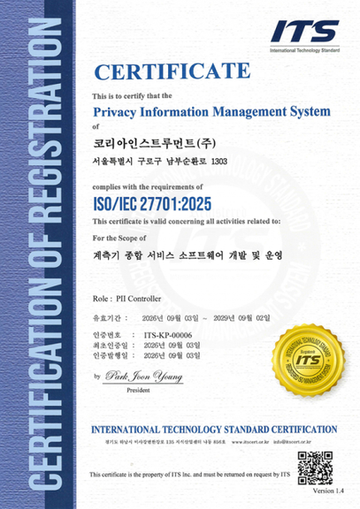
Korea Instrument, KOLAS Accredited Calibration Agency First to Simultaneously Acquire ISO/IEC 27,001·27,701
Korea Instrument has become the first among KOLAS accredited calibration agencies to simultaneously acquire ISO/IEC 27,001 and ISO/IEC 27,701 certifications. Through its proprietary platforms CWIZ Enterprise and CWIZ Partners, the company has embedded information security and personal data protection requirements across all business processes including customer information, equipment data, and calibration reports, with plans to continuously advance its management system through regular audits and security inspections.
2026.10.12by 배종인 기자
TeamViewer One, IT Incident Automation Workflow and Resolution Center Enhanced
TeamViewer has added IT incident automation capabilities and an advanced Resolution Center to its integrated digital workplace management platform 'TeamViewer ONE'. Recurrent service disruptions, configuration errors, and capacity shortages are automatically handled according to preset policies, and device status verification through script deployment can be managed in a unified interface, significantly reducing repetitive tasks for IT teams.
2026.10.12by 배종인 기자











