



TI Launches MSDI Products with Lower System Power Consumption
 Published2017.10.18 13:05
TI announced the launch of two new MSDI products that consume up to 98 percent less system power than existing solutions.
The TIC12400 and TIC12400-Q1 are the first switch sensor monitoring devices capable of directly interfacing with resistive-coded switches.
The TIC12400 and TIC12400-Q1 can solve this problem by fundamentally monitoring the inputs and decoding the resistive paths of as many as 54 switches in a single device, offloading the processor from having to decode the switching signals.
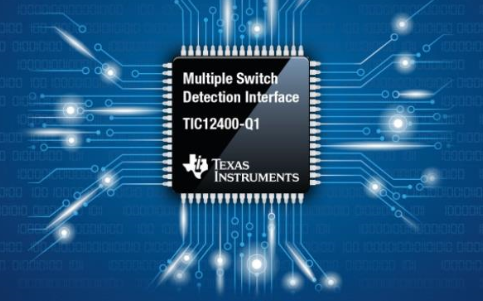
Additionally, it can significantly reduce system power consumption in applications such as automotive body electronics and factory and building automation equipment by directly monitoring 24 channel inputs, providing internal diagnostic capabilities, and reducing system microcontroller execution time using a polling sequence architecture.
In applications requiring high efficiency, system power consumption can be reduced from milliamps to microamps. Direct on-device monitoring allows the microcontroller to enter a low-power sleep mode, consuming less power when idle. This is essential for vehicles with start/stop functionality or when the vehicle is parked for extended periods.
The TIC12400-Q1 reduces the number of individual components by up to 120, enabling the monitoring of up to 54 switches and sensors through input sharing and matrix mode. Additionally, as a highly integrated solution, it can control wetting current, timing control, threshold values, and includes redundant circuitry for protection, thereby increasing system-level reliability and reducing potential failure points.
Comments
Related news

Using Self-Charging Electronic Lock System for Public Bicycles
Public bicycles have begun appearing in major cities over the past few years. Anyone can rent a bicycle from a docking station installed throughout the city and return it, with payment available via credit card or mobile phone. In London, bicycle users rent and return bicycles at docking station kiosks at designated locations as shown in Figure 1. While this method works well for bicycle tourists, it is inconvenient for commuters who do not have a nearby docking station. If a system were established where bicycles could be rented and returned anywhere, it would be efficient and convenient for commuters.
2017.08.08by 김지혜 기자
TI Launches Buck Converter with ACM Control Topology
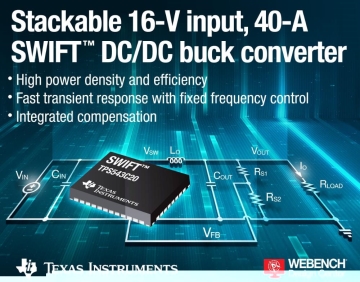
TI announced the launch of the industry's first 16V input, 40A synchronous DC/DC buck converter with frequency synchronization capability by adopting an embedded compensated advanced current mode (ACM) control topology. The TPS543C20 SWIFT converter delivers enhanced efficiency by integrating the latest generation of low-resistance high-side and low-side MOSFETs in a thermally enhanced small footprint package. Additionally, two converters can be stacked side-by-side, enabling them to drive loads reaching up to 80A for processors in space-constrained and power-intensive applications across various fields including wired/wireless communications, enterprise and cloud computing, and data storage systems. The innovative embedded compensated advanced current mode (ACM) control topology and fast transient response capability maintain stable operation across a wide range of input/output voltages. The distinguishing feature of ACM is that, as a control topology similar to peak current mode, it internally generates a ramp waveform while dynamically adjusting to maintain stability across a wide range of operating switching frequencies. Therefore, without external compensation, it provides the benefits of both conventional fixed frequency operation for low-noise operation and constant on-time (COT) control for fast transient response.
2017.09.25by 김지혜 기자

TI launches MCU with integrated ultrasonic sensing analog front end
Texas Instruments (TI) has announced the launch of a new MSP430 microcontroller (MCU) product family that integrates an ultrasonic sensing analog front end. This product family enables the manufacture of more precise and low-power smart water meters. Additionally, TI has launched two new reference designs that allow easy addition of automatic meter reading (AMR) functionality to existing mechanical water meters. The new MCU products and reference designs meet the demand for precise water metering and remote reading solutions necessary to enable efficient water resource management, accurate metering, and timely billing.
2017.09.28by 김지혜 기자

Intel Unveils Next-Generation 'Core Ultra Series 3' and vPro Platform for Enterprise PCs
Intel has officially unveiled the "Intel Core Ultra Series 3" for next-generation enterprise PCs and the latest vPro platform, addressing a wide range of demands from enterprise notebooks to high-performance workstations.
2026.03.26by 배종인 기자

ROHM Launches ESD Protection Diode Compatible with High-Speed Interfaces of 10Gbps or Higher
Semiconductor specialist ROHM has developed the 'RESDxVx series' of ESD (electrostatic discharge) protection diodes capable of responding to next-generation high-speed data communication environments exceeding 10Gbps, simultaneously enhancing both signal quality maintenance required in high-speed interfaces and IC protection performance.
2026.03.26by 배종인 기자











