


Intel and Mobileye Develop Mathematical Formula to Prevent Autonomous Vehicles from Causing Accidents
 Published2017.10.19 17:34
At the World Knowledge Forum held in Seoul, Amnon Shashua, CEO of Mobileye and Vice President at Intel, presented a method to prove the safety of autonomous vehicles. He unveiled a formal mathematical formula designed to ensure that self-driving vehicles operate responsibly and do not cause blameworthy accidents.
Mobileye, an Intel subsidiary, is a leader in automation technology and the world's largest supplier of cameras for ADAS (advanced driver assistance systems). Based on years of successful experience in automotive automation and the evolution from ADAS to fully autonomous driving technology, Professor Shashua and his colleague Shai Shalev-Shwartz developed a mathematical formula that can bring certainty to questions regarding responsibility and blame when accidents occur in unmanned autonomous vehicles.
The Responsibility Sensitive Safety model (hereinafter RSS model) developed by them provides specific and measurable parameters for human concepts of responsibility and attention. It also defines a “Safe State” in which an autonomous vehicle cannot be the cause of an accident regardless of the movement of other vehicles.

In his keynote, Professor Amnon Shashua urged industry and policymakers to “collaboratively establish standards to misdefine accidents” when human-driven vehicles and autonomous vehicles cause accidents. He stated that all current rules and regulations are based on the idea that there is a driver capable of controlling the vehicle, and that new parameters are needed for autonomous vehicles.
Professor Amnon Shashua stated, “The ability to define fault is key. Just like the best drivers in the world, autonomous vehicles cannot avoid accidents caused by uncontrollable behavior. However, the most responsible, cognitively superior, and prudent drivers very rarely cause accidents due to their own faults. In particular, autonomous vehicles, with their 360-degree field of vision and lightning-fast reaction times, have a very low probability of causing accidents.” He added, “The RSS model will ensure that autonomous vehicles operate only within a framework defined as ‘safety,’ based on clear fault definitions agreed upon across the industry and regulatory authorities.”
Sam Abuelsamid, Senior Researcher at Navigator Research’s Traffic Effectiveness Program, stated, “Since regulators and policymakers around the world are struggling with how to manage the deployment of autonomous vehicles without hindering innovation, I believe using a common, open method to evaluate the efficacy of the technology would be a good starting point.” He added, “The RSS model proposed by Mobileye will serve as a foundation to initiate this conversation. At least through the evaluation method
"It provides a good framework for the decision-making process within the control system without being constrained by specific technology," he said.
Comments
Related news
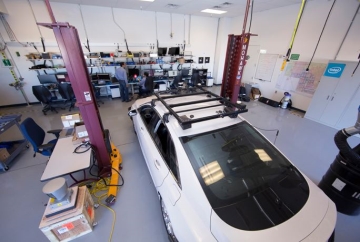
Intel, BMW to Begin Joint Development of Fiat Chrysler Autonomous Driving Platform
The BMW Group, Intel and Mobileye have signed a memorandum of understanding with Fiat Chrysler Automobiles (FCA) for the joint development of an autonomous driving platform. With the signing of the memorandum of understanding, FCA has become the first automaker to jointly develop an autonomous driving platform. The companies participating in the development plan to leverage each company's strengths, capabilities and resources to enhance platform technology, increase development efficiency and shorten product time-to-market. One of the key drivers enabling this is the establishment of a collaborative working environment for engineers located in Germany and other countries. Under this agreement, FCA will provide engineering and other technical expertise and knowledge, and will share its substantial sales volume in the North American automotive market, geographic positioning and know-how gained through long-standing experience already possessed by the company.
2017.08.17by 김자영 기자
Intel to Support 5G Mobile Trial Platform Starting Q4
(A message from Asha Keddy, Vice President of Intel's Internet of Things Business and Architecture) It is remarkable to see how rapidly the entire industry is moving toward 5G today. Even as you read this article, we are quickly approaching the first 5G NR (New Radio) milestone. 5G NR is a wireless standard, equivalent to LTE in the 4G era. In December 2017, work on establishing the 5G non-standalone NR standard is expected to be completed, with the objective of commercial 5G trial services and deployments, and the final non-standalone 5G NR standard will be developed accordingly. This represents a significant step toward 5G that will energize and serve as a catalyst across technology and services.
2017.09.08by 김자영 기자
Intel Unveils 8th-Generation Core Processors Perfect for Gaming
Intel unveiled its 8th generation Intel Core desktop processors and announced that the products will be available for purchase starting October 5, 2017. The new 8th generation Intel Core desktop processors are designed for gamers, content creators, and overclockers who demand high-end performance. The 8th generation Intel Core desktop processor family, featuring a product lineup ranging from Core i3 to Core i7 processors, delivers premium performance for upcoming tasks and opens the door to a new level of faster, easier, and more immersive experiences. The newly launched 8th generation Intel Core desktop processor family introduces the industry's first 6-core Intel Core i5 desktop processor and the industry's first 4-core Intel Core i3 desktop processor. The 8th generation Intel Core desktop processor family provides consumers with unlocked "K" processors that offer maximum tuning flexibility for each brand, as well as up to 40 platform PCIe 3.0 lanes for system scalability and storage and I/O capabilities. Additionally, the 8th generation Intel Core desktop processor family is driven through motherboards based on the Intel Z370 chipset.
2017.09.26by 김지혜 기자

[e4ds Tech Day 2026 ⑨] Sim Sang-gyu, Autocrypt CTO: "In the Physical AI Era, Automotive Security Must Extend Beyond the Vehicle"
At e4ds Tech Day 2026, Sim Sang-gyu, CTO of Autocrypt, explained automotive cybersecurity strategies in the era of Physical AI and SDV (Software-Defined Vehicle). Automobiles are evolving as part of an ecosystem connected to AI, cloud, chargers, IoT, and robots, and he emphasized that the scope of security must expand beyond the vehicle interior to the entire connected environment. In particular, AI model tampering, adversarial attacks, OTA updates, and EV charger hacking were identified as major threats. He explained that response measures require zero trust, AI model integrity protection, intrusion detection, Security by Design and Default, and full lifecycle security management, and that proactive security system establishment beyond regulatory compliance is critical for securing future mobility competitiveness.
2026.10.12by 배종인 기자

Practical HIL Construction Strategy for Automotive and Off-Highway Controller Validation
As vehicle E/E architecture transitions to zonal structures and shifts to software-defined vehicles (SDV), the number of controllers (ECUs) requiring validation and software complexity are surging dramatically. Meanwhile, real vehicle testing cannot provide repeated verification under identical conditions and entails lead time and safety concerns. This white paper explains the principles of HIL (Hardware-in-the-Loop) validation and the structure of the NI platform composed of PXI, SLSC, and VeriStand, and through two actual implementation cases—Camera Record & Replay HIL for In-Cabin Monitoring Controller (ICMU) and Forklift Controller (VCU) HILS—describes how controller-level regression testing becomes possible. Additionally, it explicitly states application boundaries and limitations, such as lack of A2B support.
2026.10.12by 편집부











