



KT Supports Air Quality Management System to Solve Air Pollution Problems
 Published2017.11.07 09:27
KT announced that it will systematically resolve air pollution issues, such as fine dust, and support the establishment of an efficient national air quality management system through its participation in the Ministry of Science and ICT's 'Big Data Flagship Project'.
The 'Big Data Flagship Project' is a public competition initiative by the National Information Society Agency that aims to resolve social issues by discovering and disseminating leading big data success stories (Flagships) in fields such as environment, safety, and transportation.
The KT and OnKWeather Consortium (hereinafter the KT Consortium), which has been carrying out this project since September of this year, supports the government's scientific management and reduction policy formulation by establishing an IoT-based real-time air quality measurement and fine dust big data platform.
The KT consortium is conducting a demonstration project to analyze data from the IoT-based air quality monitoring network, which is the core of the 'Air Map Korea' project announced last September, as well as various environmental big data such as the national air quality monitoring network established by the government in Jeju Island, Changwon City, and Gwangmyeong City, meteorological observation data, industrial complexes and emission facilities, population density, floating population, and traffic volume.

Through a demonstration project, the KT consortium confirmed that there is a difference of up to 2.5 times in fine dust concentrations even between nearby areas (radius 0.5 km), and that fine dust concentrations near air pollutant emission facilities tend to be higher than in other areas. In addition, big data analysis is underway to confirm that fine dust concentration is influenced by wind direction, wind speed, humidity, precipitation, and the location and altitude of the observation network.
Based on the analysis results of the pilot project, Gwangmyeong City and Changwon City are utilizing the 'location-based SMS warning alert/notification' service for health-sensitive citizens and managers within their jurisdictions to respond to fine dust, as well as for the 'optimization of water truck movement routes and effectiveness analysis.'
In addition, it supports the establishment of the government's fine dust management system by providing customized behavioral guides for vulnerable groups such as children and the elderly, predicting the spatial distribution of fine dust and vulnerable areas without blind spots, and developing big data models for air quality industry standards.
"We hope to contribute, even in a small way, to the government's efforts to identify the causes of air pollution and prevent it through the 'Big Data Flagship Project'," said Kim Hyung-wook, Head of KT's Platform Business Planning Office. "KT will continue to strive to contribute to improving environmental issues as a national company by introducing various innovative technologies for people."
Comments
Related news

KT Telecom, Revolutionizing Security Market with Platform-Based Security Services
KT's security specialist KT Telecom held a press conference at KT Square in Gwanghwamun, Seoul, and unveiled the 'world's first platform-based security service' that has revolutionized the structure of existing security systems. Platform-based security service is a new business model that integrates KT Telecom's control and dispatch capabilities with KT Group's ICT technology. It is a system that cloudifies the hardware main unit, which is the main controller that manages all sensors within customer facilities and performs A/S and other services. This system utilizes LTE-M and NB-IoT communication networks, allowing individual security and IoT sensors to communicate directly with the cloud main unit. The cloud main unit receives signals from each sensor, transmits them to the control system, and when an anomaly signal is detected, dispatch personnel respond to the situation in an emergency. Currently, services have been launched targeting large operators such as buildings based on LTE-M communication, and NB-IoT communication-based services are scheduled to be introduced to general and SOHO customers in the first half of next year.
2017.11.02by 김지혜 기자

KT's 5G Technology Recognized Globally
KT announced that it received the "Advancing the road to 5G" award and the "Fixed Network Evolution" award at the "Global Telecoms Awards 2017" held at 8 Northumberland Avenue in London, United Kingdom. The "Global Telecoms Awards," now in its fifth year, is a prestigious global award organized by Informa, a global ICT research institute. It selects companies that have achieved the most outstanding performance and innovation among telecommunications operators worldwide each year, covering not only telecommunications and network technology but also media and marketing sectors. KT won the "Advancing the road to 5G" award at the Global Telecoms Awards 2017, gaining international recognition for its efforts in 5G standardization. KT had previously announced at MWC 2015 (Mobile World Congress 2015) that it would showcase the world's first 5G trial service, presenting its 5G vision on the global stage.
2017.11.03by 김지혜 기자
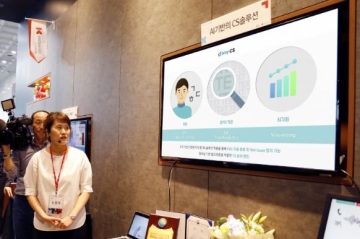
KTH Unveils AI Customer Service Analysis Solution at Data Promotion Week
KTH announced that it will showcase the big data platform 'KTH DAISY' and 'DAISY CS Solution' at the '2017 Data Promotion Week for Leading the Fourth Industrial Revolution (Data MAGIC Week)' hosted by the Ministry of Science and ICT, taking place from the 7th to 8th at the Seoul COEX InterContinental. The '2017 Data Promotion Week' is the nation's largest data-themed event designed to enhance interest in big data through participatory exhibitions such as analysis and visualization experiences and to create new business opportunities in the era of the fourth industrial revolution. In line with the recent surge in interest in artificial intelligence technology and big data technology trends, KTH is also unveiling the 'DAISY CS Solution' utilizing the big data platform 'KTH DAISY'.
2017.11.06by 김지혜 기자
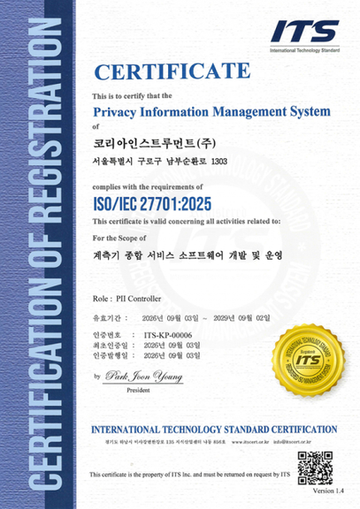
Korea Instrument, KOLAS Accredited Calibration Agency First to Simultaneously Acquire ISO/IEC 27,001·27,701
Korea Instrument has become the first among KOLAS accredited calibration agencies to simultaneously acquire ISO/IEC 27,001 and ISO/IEC 27,701 certifications. Through its proprietary platforms CWIZ Enterprise and CWIZ Partners, the company has embedded information security and personal data protection requirements across all business processes including customer information, equipment data, and calibration reports, with plans to continuously advance its management system through regular audits and security inspections.
2026.10.12by 배종인 기자

TeamViewer One, IT Incident Automation Workflow and Resolution Center Enhanced
TeamViewer has added IT incident automation capabilities and an advanced Resolution Center to its integrated digital workplace management platform 'TeamViewer ONE'. Recurrent service disruptions, configuration errors, and capacity shortages are automatically handled according to preset policies, and device status verification through script deployment can be managed in a unified interface, significantly reducing repetitive tasks for IT teams.
2026.10.12by 배종인 기자











