



Microchip Launches Microcontroller Combining CAN and CIP
 Published2017.11.14 17:05
Microchip Technology Inc. (NASDAQ: MCHP) today announced the addition of a new family of 8-bit microcontrollers (MCUs) to its PIC18 product line that combines a Controller Area Network (CAN) bus with an extensive range of Core Independent Peripherals (CIPs).
This CIP enhances system functionality while allowing easy creation of CAN-based applications without the complexities of adding software.
When using K83 MCUs in CAN-based systems, a key advantage is that CIPs provide deterministic response to real-time events, reduce design time, and are easily configured through the MPLAB® Code Configurator (MCC) tool.
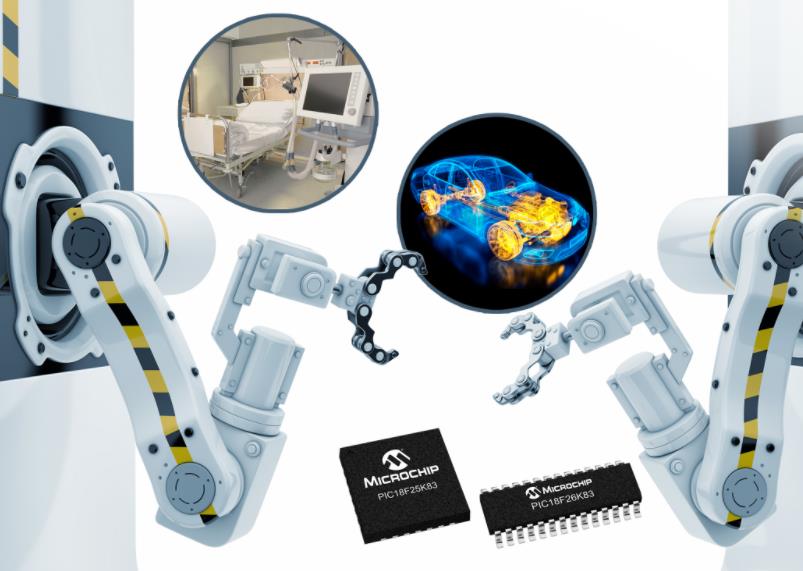
This new product family is ideal for CAN applications in the medical, industrial and automotive markets, including powered surgical tables, asset tracking, ultrasound machines, automated conveyors and automotive accessories. System designers can greatly benefit from the time savings they save by being able to configure hardware-based peripherals much more easily, as opposed to having to write and verify entire software routines to perform the task.
“Being able to configure an MCU with just a few clicks within MCC will change the way you design with CAN,” said Steve Drehobl, vice president of Microchip’s 8-bit MCU business unit. “The CIPs included in the K83 family make it easier to take advantage of communications, intelligent analog and low-power features with the same tool set used on other PIC MCUs.”
The PIC18 K83 device includes 15 CIPs that perform time-saving functions, including a Cyclic Redundancy Check (CRC) with memory scan function to ensure the integrity of non-volatile memory, Direct Memory Access (DMA) that enables data transfer between memory and peripherals without CPU intervention, Windowed Watchdog Timer (WWDT) for triggering system resets, a 12-bit analog-to-digital converter (ADC2) with built-in computation that automatically performs analog signal analysis for real-time system response, and a Complementary Waveform Generator (CWG) that implements high-efficiency synchronous switching for motor control.
Comments
Related news
Microchip Launches Five Flexible USB 2.0 Smart Hub ICs
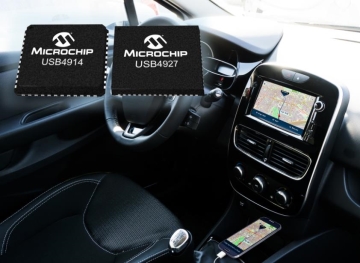
Microchip Technology announced the launch of five new USB 2.0 smart hub ICs that offer unique options. These devices, available across diverse architectures, provide significantly enhanced flexibility to meet automotive manufacturers' design requirements and satisfy consumer demand for systems that are easy to use and understand. These five new devices support multiple architectures, enabling developers to easily interface designs with all major smartphone operating systems. Using this system, the graphical user interface of a smartphone or tablet can be displayed on the vehicle screen, voice commands can be integrated within the vehicle, and simultaneously the mobile device can be charged. Additionally, driver assistance applications from mobile handsets can be integrated into the vehicle's infotainment system. Microchip's new smart hub IC enables hubs to be cascaded to second and third-row seats, with simultaneous data transmission and charging possible at all ports. With dual USB ports, one port can connect a smartphone or tablet to the head unit while the remaining port allows for free charging and data upload/download.
2017.11.01by 김지혜 기자
Microchip Launches 2-Pin EEPROM with 2.7V to 4.5V Operating Voltage Range
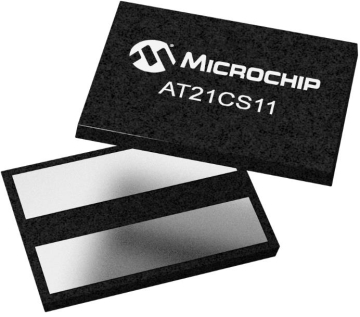
Microchip Technology has announced the launch of a single-wire 2-pin EEPROM (Electrically Erasable Programmable Read-Only Memory) device with an operating voltage range of 2.7V to 4.5V. The AT21CS11 is well-suited for remotely identifying and authenticating targets in products such as cartridges and cables where electronic component space is limited. The AT21CS11 features a pre-programmed unique serial number and five EEPROM memory sections. Since OEMs can permanently lock some or all of the memory sections, product tracking and attachment identification become possible for counterfeit prevention. This EEPROM is ideal for customers who require product warranty or anti-counterfeiting functionality and need to ensure that products continue to operate properly through authenticated replacement parts.
2017.11.09by 김지혜 기자

Microchip Targets the Automotive Market with a Broad Portfolio
Microchip Technology, a semiconductor company known for microcontrollers (MCU), announced that it is strengthening its presence in the automotive sector. Over the past several years, Microchip has prepared for networking, touch display, LED lighting, and ADAS through staged acquisitions and mergers. Willie Fitzgerald, Director of Marketing for Microchip's Automotive Product Group, stated that "automotive accounts for 25% of Microchip's total revenue, second only to industrial," and "ranks 8th in the overall automotive semiconductor market." As a strategy to grow its automotive business, Microchip acquired SMSC in 2012 to secure Ethernet and wireless audio technologies, acquired EqcoLogic in 2013 to obtain equalizer and coaxial transceiver technologies, and acquired Atmel in 2016 to secure MCU, wireless, and automotive security technologies.
2017.11.10by 김지혜 기자

Intel Unveils Next-Generation 'Core Ultra Series 3' and vPro Platform for Enterprise PCs
Intel has officially unveiled the "Intel Core Ultra Series 3" for next-generation enterprise PCs and the latest vPro platform, addressing a wide range of demands from enterprise notebooks to high-performance workstations.
2026.03.26by 배종인 기자

ROHM Launches ESD Protection Diode Compatible with High-Speed Interfaces of 10Gbps or Higher
Semiconductor specialist ROHM has developed the 'RESDxVx series' of ESD (electrostatic discharge) protection diodes capable of responding to next-generation high-speed data communication environments exceeding 10Gbps, simultaneously enhancing both signal quality maintenance required in high-speed interfaces and IC protection performance.
2026.03.26by 배종인 기자











