


ETRI Creates Smart Factories with NB-IoT
 Published2017.12.06 15:48
As domestic researchers succeed in applying mobile communication technology to smart factories, the path to wireless remote control of factories is expected to open in the future.
The Electronics and Telecommunications Research Institute (ETRI) has successfully demonstrated an industrial Internet of Things (IIoT) service by applying mobile communication technology to a smart factory production automation system for the first time in Korea.
In the meantime, industrial sites such as factories have applied IT on their own. Wired communication technology, which is widely used in factory sites, is more reliable than wireless communication, but it is not suitable for mobile work, so there is a lot of room for improvement in wiring and safety. Therefore, there has been the inconvenience of having to re-install wired communication throughout the factory when the factory is relocated due to changes in the process or when machines or robots are moved.
In particular, wireless communication technologies such as Bluetooth and Wi-Fi used in factories have a short communication range and cannot be used outside of a certain area, making it difficult to use in large factories.
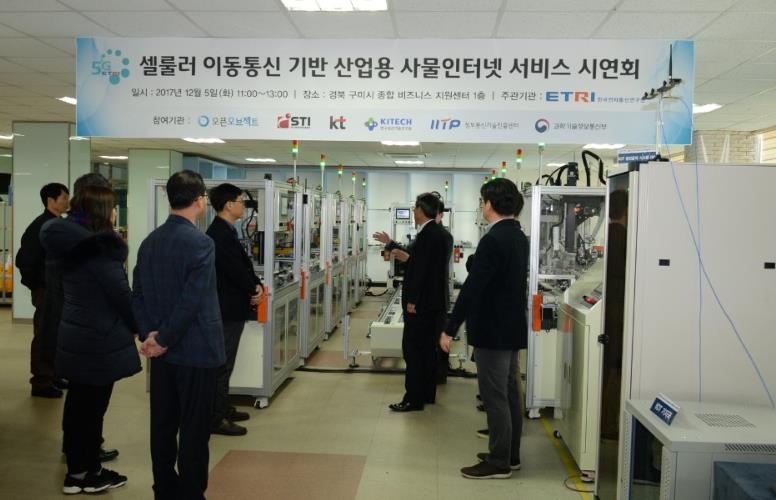
The research team took off their boots to solve these difficulties. They applied smartphone-style cellular mobile communication technology to smart factories, enabling stable communication within the radius served by base stations. It opened the way for communication to become possible not only within the factory, but also in the logistics and distribution stages between the factory and the consumer.
ETRI announced that it successfully completed the 'Cellular Mobile Communication-based Industrial Internet of Things Service Demonstration' held at the Gumi City Comprehensive Business Support Center in Gyeongbuk Province on the 5th.
In February, ETRI succeeded in producing a prototype of a narrowband IoT terminal based on international standards. NB IoT terminals are a technology that enables low-power, long-distance wireless communication essential for IoT. NB IoT technology expands the base station communication radius and can support more than 50,000 terminals within 1㎢.
The research team utilized the base station system for the Industrial Internet of Things (IIoT) that they developed at the demonstration. In addition, they demonstrated a production automation monitoring service using KT's commercial terminal: a terminal that uses narrowband IoT and is sized like a fist (5.5cm x 10cm).
Data collected from noise and movement detection sensors installed on the test bed's production line were transmitted via commercial terminals to the base station and service platform developed by the research team.
The level of noise generated from the production line and the status of manufactured goods moving according to the process were monitored in real time. The existing production management system (MES) installed for factory automation Production management system (MES): It stands for Manufacturing Execution System and not only executes the process unit production plan of all resources (personnel, equipment, materials) in the production process on site, but is also linked to the factory information system that handles production-related quality data.
In the future, when commercialized, 5G mobile communication technology and smart factories will meet to build an industrial wide-area network of things. In other words, specific sensors are attached to all devices according to the characteristics of each factory, and factory information is managed through a wide area network.
In addition, by utilizing mobile communication technology and mobile robots, work can be changed in real time according to the order quantity, thereby maximizing production volume. Accordingly, customized production according to the needs of various consumers is expected to become easier.
This technology was developed with the support of the “Development of low-latency, high-reliability, and hyper-connectivity integrated core technologies to overcome 5G performance limitations for building cellular-based industrial automation systems” project of the Ministry of Science and ICT and the Information and Communications Technology Promotion Center (IITP) since March of last year.
The research team plans to actively foster domestic small and medium-sized enterprises by developing industrial base stations and low-power IoT terminals based on 5G mobile communication technology, which will occupy a large portion of the future industrial IoT market.
ETRI’s Jeong Hyeon-gyu, head of the 5G Giga Service Research Division, said, “We believe that the industrial IoT solution based on mobile communication technology developed by ETRI will be utilized as an innovative tool for building smart factories for production automation. We will focus on improving communication reliability in factories with complex processes, increasing technology utilization, and expanding the base of smart factories.”
Comments
Related news
ETRI Helps Formulate National Land Plans by Combining AI and Big Data
ETRI (Electronics and Telecommunications Research Institute) announced that it has concluded a business cooperation agreement with the Korea Research Institute for Human Settlements at its headquarters on "technology exchange for future analysis and prediction in the housing and urban construction sectors." With this cooperation as an opportunity, ETRI will formally discuss the introduction of artificial intelligence simulation-based future analysis and prediction technologies in the housing and urban construction sectors for the efficient utilization, development, and conservation of scientific national resources. Through this, both institutions plan to cooperate in advancing demand analysis and prediction technologies in the housing and urban construction sectors by incorporating ICT into Korea's housing and urban construction fields, in response to changes in regional population and changes in economic conditions of the nation and households. The institute plans to utilize its artificial intelligence technology in establishing territorial planning policies.
2017.11.03by 김지혜 기자
ETRI develops technology to create 360-degree VR content using smartphones
Domestic researchers have developed a technology that enables the creation of high-definition 360-degree VR (virtual reality) content using smartphones. ETRI (Electronics and Telecommunications Research Institute) has partnered with NextIon, a virtual reality solution provider, to develop and successfully commercialize YouVR technology, which enables the production of 360-degree VR content in a mobile environment without dedicated hardware. Users can download and utilize a dedicated app. Previously, producing 360-degree VR content required dedicated hardware such as a multi-camera rig—a device that precisely combines multiple cameras. Additionally, stitching software was necessary to connect photographs simultaneously captured by multiple cameras, as well as software to stitch and join multiple video frames together.
2017.11.10by 김지혜 기자
ETRI Approves International Standard to Promote Big Data Distribution
The Korea Electronics and Telecommunications Research Institute (ETRI) announced that it received approval for an international standard to promote the distribution and activation of big data at an International Telecommunication Union (ITU) standardization conference held in Geneva, Switzerland last month. The institute also announced that it achieved results by proposing and having two new agenda items adopted in the big data and cloud computing fields. ETRI explained that the 'Big Data Exchange Framework and Requirements (ITU-T Y.3601)' standard, which it has led development of for the past three years, received final approval at the Future Networks standardization research group (SG13) standardization conference. The standard was achieved with the participation of Lee Gang-chan, head of the Service Standards Research Department, and Ren Min-jiao, principal research engineer, since ETRI principal research engineer Ha Su-wook took on the role of editor starting in 2015.
2017.11.30by 김지혜 기자
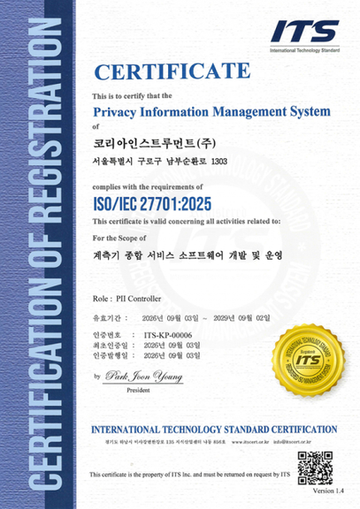
Korea Instrument, KOLAS Accredited Calibration Agency First to Simultaneously Acquire ISO/IEC 27,001·27,701
Korea Instrument has become the first among KOLAS accredited calibration agencies to simultaneously acquire ISO/IEC 27,001 and ISO/IEC 27,701 certifications. Through its proprietary platforms CWIZ Enterprise and CWIZ Partners, the company has embedded information security and personal data protection requirements across all business processes including customer information, equipment data, and calibration reports, with plans to continuously advance its management system through regular audits and security inspections.
2026.10.12by 배종인 기자

TeamViewer One, IT Incident Automation Workflow and Resolution Center Enhanced
TeamViewer has added IT incident automation capabilities and an advanced Resolution Center to its integrated digital workplace management platform 'TeamViewer ONE'. Recurrent service disruptions, configuration errors, and capacity shortages are automatically handled according to preset policies, and device status verification through script deployment can be managed in a unified interface, significantly reducing repetitive tasks for IT teams.
2026.10.12by 배종인 기자











