


You must understand the AI value chain to apply it to business.
 Published2017.12.12 17:37
An event was held to forecast the present and future of artificial intelligence (AI) and to examine domestic AI research achievements and corporate trends.
The '2017 International Artificial Intelligence Conference' was held at the Yongsan Dragon City Hotel on the 12th. As an event aimed at exploring ways to develop the domestic artificial intelligence industry, it was conducted under three major themes: the future of artificial intelligence, new horizons of artificial intelligence, and artificial intelligence and industry.
The event began with a keynote lecture by Professor Tom Mitchell of Carnegie Mellon University (CMU) on the theme of 'The Present and Future of Artificial Intelligence,' followed by a panel discussion featuring six domestic and international speakers on the theme of 'Future Changes Opened by Artificial Intelligence.' In the second session, Professor Noah Smith of the University of Washington introduced new optimization language modeling methodologies and their potential applications under the theme of 'New Trends in Natural Language Processing.'
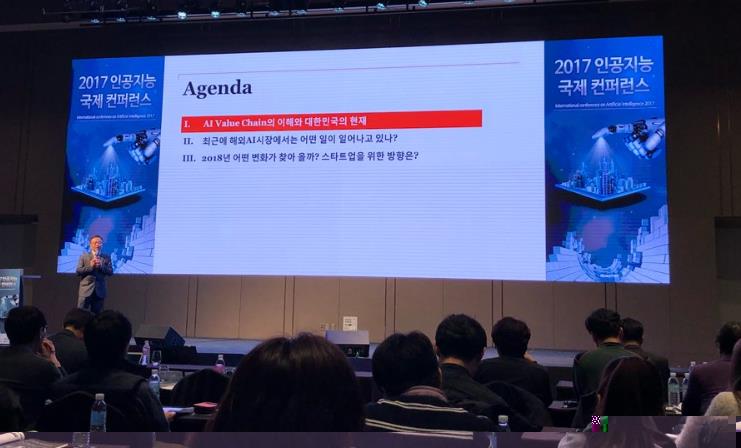
In the final session, there were presentations on the global artificial intelligence market and industrial changes. PWC Managing Director Park Dong-kyu stated, “Interest in artificial intelligence is increasing.” "Accordingly, we are also experiencing trial and error due to differences in understanding," he said, adding, "It is important to understand the value chain of artificial intelligence."
The value chain consists of six stages: the paper stage for developing AI algorithms, the code stage for applying AI algorithms domestically (such as localization), the initialized code stage for introducing source technologies and initial learning, the platform stage for developing and building platforms, the solution stage for applying business concepts, and the business system stage for customizing and in-depth learning.
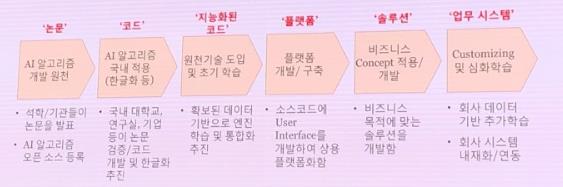
Executive Director Park stated, “While it is possible to skip steps, it is important to have a value chain,” adding, “The stages of developing AI algorithms, business concepts, and customization are lacking. Recently, startups have been in the process of becoming platforms based on government technology, but they have not yet reached the business realm.”
He said, “Many people ask whether we need to hire PhD-level personnel, and they are necessary as we move toward the left side of the value chain, that is, the algorithm development stage.” He added, “Conversely, as we move toward the right side, the business stage, we need players who can apply technology to business rather than just developing technology. AI will also move toward solving business issues.”
He continued, “If general-purpose AI platforms emerged last year, small-scale platforms tailored to businesses have appeared this year,” adding, “It is important to secure capabilities aligned with the focus areas of stakeholders. A mindset of trying to do everything from start to finish is problematic.” He pointed out, "We need to adopt and apply what can be applied, and for what cannot, we must shift toward fostering startups."
At the event, an awards ceremony was held for the three teams that achieved excellent results in the '2017 Artificial Intelligence R&D Challenge,' which took place on December 8 under the theme of 'Finding Fake News.' The Deepest team, a joint team of ESTsoft and Zoom Internet, took first place, the I-WAZ team led by Professor Kang Jang-mook of Namseoul University took second place, and the Nua team took third place.
Kim Yong-soo, Vice Minister of Science and ICT, emphasized, “We will create new industries by promoting intelligent innovation projects in various industrial sectors such as medical, manufacturing, cities, and transportation through the advancement of artificial intelligence intelligent technologies.”
Comments
Related news
NVIDIA and GE Accelerate AI Adoption in Healthcare
Nvidia announced that it will introduce cutting-edge artificial intelligence to 500,000 GE Healthcare medical imaging devices worldwide in partnership with GE Healthcare, with which it has maintained close cooperation for ten years, to accelerate the speed of medical data processing. The partnership unveiled at the 103rd Annual Meeting of the Radiological Society of North America (RSNA) includes the introduction of a new Revolution Frontier CT powered by Nvidia technology, performance improvements to the Vivid E95 4D Ultrasound equipment, and the development of GE Healthcare's Applied Intelligence analytics platform.
2017.11.29by 김지혜 기자

KT, “Now order ice cream from home by voice”
KT announced that it is launching a service that allows customers to order Baskin-Robbins ice cream by voice through its AI TV 'Giga Genie' by linking it with SPC Group's 'Happy Order'. 'Happy Order' is a mobile ordering service provided by SPC Group that enables customers to order various SPC brand products including bakery items, ice cream, hamburgers, pizza, and coffee through the 'Happy Point' app and pick them up at stores or have them delivered. KT will first provide a Baskin-Robbins ice cream cake pre-reservation service through the Happy Order service linked to Giga Genie until the 15th. For example, when a customer says "Genie, order me a Baskin-Robbins ice cream cake," a push notification message is sent to the Giga Genie app installed on the mobile device. Clicking the notification message launches the Happy Point app and connects to the Christmas ice cream cake reservation page for Giga Genie customers. Pre-ordered ice cream can be picked up at stores from the 19th to the 24th.
2017.12.04by 김지혜 기자

NVIDIA Provides GPU and Technology Support to KISTI for HPC and AI Research
Nvidia is providing free access to its GPUs for testing to the Korea Institute of Science and Technology Information (KISTI), which has demonstrated outstanding technical achievements in high-performance computing (HPC) and artificial intelligence (AI) research. Additionally, Nvidia will provide remote support for its latest technologies such as V100. Nvidia explained the background, stating that after reviewing the operational cooperation between both parties and collaborative projects between the National Center for Atmospheric Research (NCAR) and KISTI, it decided to support KISTI's future research activities, having highly evaluated KISTI's accomplishments in the HPC and AI research fields. In particular, Nvidia praised KISTI for leading the application of HPC and AI in weather and climate prediction research, and for demonstrating the potential of GPUs in the process of developing high-performance and highly scalable models to address extreme weather caused by climate change.
2017.12.07by 김지혜 기자
[e4ds Tech Day 2026 ⑨] Sim Sang-gyu, Autocrypt CTO: "In the Physical AI Era, Automotive Security Must Extend Beyond the Vehicle"
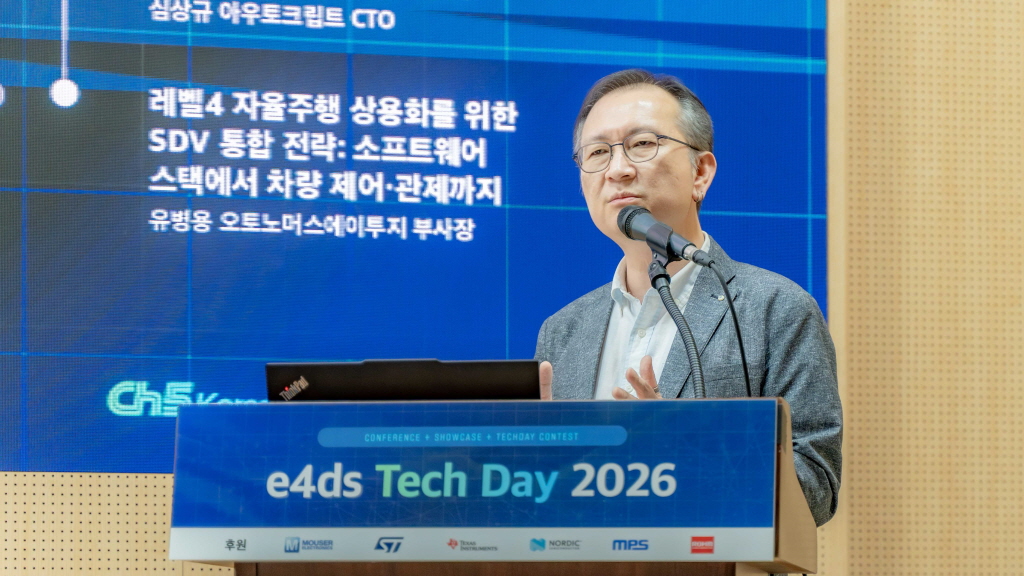
At e4ds Tech Day 2026, Sim Sang-gyu, CTO of Autocrypt, explained automotive cybersecurity strategies in the era of Physical AI and SDV (Software-Defined Vehicle). Automobiles are evolving as part of an ecosystem connected to AI, cloud, chargers, IoT, and robots, and he emphasized that the scope of security must expand beyond the vehicle interior to the entire connected environment. In particular, AI model tampering, adversarial attacks, OTA updates, and EV charger hacking were identified as major threats. He explained that response measures require zero trust, AI model integrity protection, intrusion detection, Security by Design and Default, and full lifecycle security management, and that proactive security system establishment beyond regulatory compliance is critical for securing future mobility competitiveness.
2026.10.12by 배종인 기자
NVIDIA to Invest $1 Billion in U.S. Science Over Next Five Years
NVIDIA has announced plans to invest $1 billion over the next five years to strengthen U.S. scientific and technological competitiveness. The company will enhance cutting-edge artificial intelligence research and development capabilities in key areas including quantum computing, healthcare, and energy security, while expanding support for higher education research institutions and cloud service providers. NVIDIA is participating as a major industry partner in the White House Office of Science and Technology Policy's Genesis Mission, and is promoting supercomputer construction in collaboration with national laboratories including Argonne and Los Alamos.
2026.10.12by 배종인 기자











