


Have you ever seen a TV that you can control with your voice?
 Published2018.01.03 12:25
LG Electronics will unveil its 2018 ThinQ TVs, including the artificial intelligence (AI)-powered 'OLED TV ThinQ' and 'Super Ultra HD TV ThinQ', at CES 2018.
'LG ThinQ TV' provides a more convenient and diverse TV usage experience by being equipped with 'DeepThinQ', an independent artificial intelligence platform, and Google's artificial intelligence secretary 'Google Assistant'.
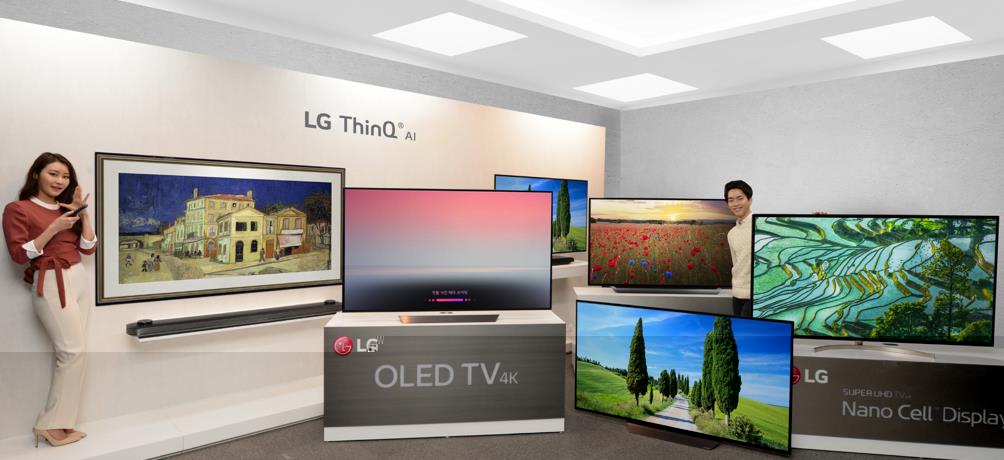
Users can easily control their TV, search for content, and operate IoT-based home appliances such as air purifiers and air conditioners using just their voice.
A new TV experience with AI-powered 'ThinQ TV'
LG ThinQ TVs utilize natural language voice recognition to easily control various TV functions, such as changing screen modes, changing channels, and adjusting the volume. They also easily connect to other devices, such as TVs, soundbars, Blu-ray players, and game consoles.
Previously, users had to go through complicated steps of pressing buttons multiple times to change TV functions or settings, but with LG's AI TV, users can simply press the voice recognition button on the Magic Remote and then give a command. For example, you can control the TV with just your voice, saying things like “Change to cinema mode,” “Turn off the program I’m watching when it’s over,” and “Connect to a game console.”
LG ThinQ TV also makes content search convenient. For example, saying, "Find movies starring Scarlett Johansson" will retrieve related videos from TV shows, VOD services, YouTube, and more. It will also answer questions like, "Who is the main character in the drama I'm watching?" or "Tell me the plot of this drama," by checking the Electronic Program Guide (EPG) for information.
You can also control IoT-based home appliances that are connected to Google, such as air purifiers, air conditioners, robot vacuums, and smart lighting. For example, saying "Turn on Air Purifier" will turn on the air purifier. Starting with the United States, Google Assistant is planning to expand its availability to other countries.
OLED TVs with even more perfect picture quality, equipped with the proprietary picture quality chip "Alpha 9."
This year, LG Electronics will equip its flagship OLED TV models with its proprietary "Alpha 9" picture quality chip, delivering even more perfect OLED picture quality. "Alpha 9" further enhances OLED TV's already impressive performance, delivering vivid and realistic picture quality.
OLED TVs with Alpha 9 technology have reduced noise by half compared to existing products. A total of 4 stages of noise reduction processing removes fine impurities on the screen to provide a “clean image.”
.jpg)
Additionally, it analyzes video data to improve contrast ratio, clarity, and three-dimensionality, enabling the expression of more natural and "clear images."
Color correction algorithms have become more sophisticated. Alpha 9 can express even more "accurate colors" by dividing the reference color coordinates by more than seven times, helping to express accurate colors.
OLED TVs equipped with Alpha 9 support 4K resolution HDR (High Dynamic Range) and HFR (High Frame Rate) video, delivering smooth motion without screen tearing. HFR videos can produce up to 120 frames per second, five times more than movies, which are typically produced at 24 frames per second. With more frames per second, even the swift footsteps of a running athlete can be seen clearly and naturally, without blurring.
Super Ultra HD TV combines Nano Cell technology with Full Array Local Dimming technology.
It will also introduce a Super Ultra HD TV that adds 'Full Array Local Dimming' technology to Nano Cell technology.
Nanocell, which debuted earlier this year, utilizes microscopic molecular structures measuring approximately 1 nanometer (nm). These ultra-fine molecules precisely control color wavelengths, enabling the expression of a wider range of colors with greater accuracy. LG Electronics added full-array local dimming technology here to improve the contrast ratio and light bleeding, which are weaknesses of LCD TVs.
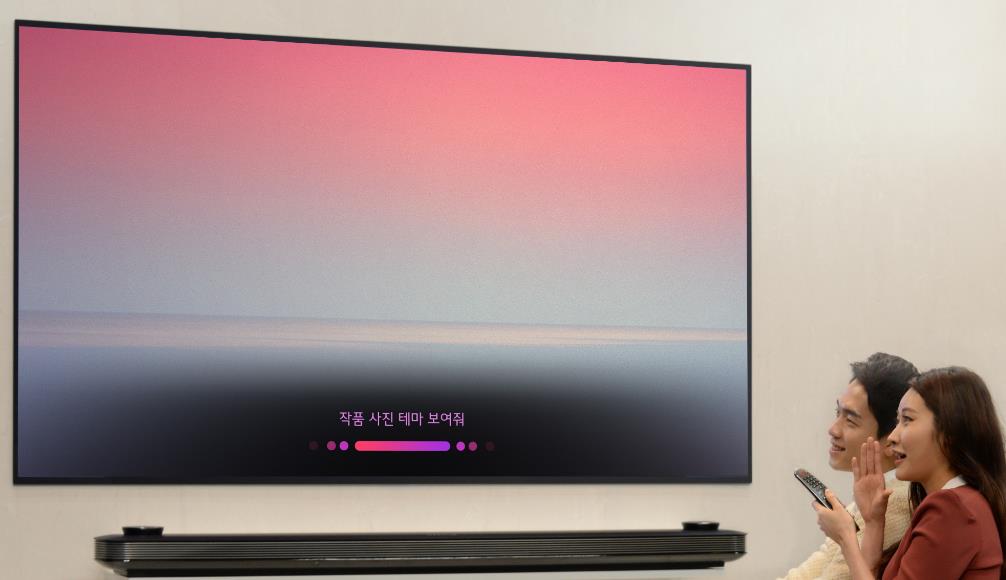
Local dimming is a technology that improves a TV's contrast ratio by partially turning the backlight's LED light sources on and off. For example, the LED light sources are turned off in dark areas of the screen and turned on in bright areas.
The new product uses a full-layout (direct-behind) method, which densely distributes LEDs across the entire back of the screen, rather than an edge-mounted method that places LEDs along the edges of the screen. Compared to the edge-mounted method, the full-layout method allows for more detailed screen division, making it more advantageous for "local dimming."
Perfect HDR image implementation regardless of standard/genre
2018 OLED TVs and Super Ultra HD TVs perfectly reproduce HDR images in various formats, including 'Dolby Vision', 'HDR 10', and 'HLG (Hybrid Log-Gamma)'.
Dolby Vision is the most widely adopted HDR format by Hollywood production companies like Netflix, Warner Bros., Universal, and MGM. When implementing HDR, proprietary image quality information (metadata) is embedded to make dark areas darker and bright areas brighter. While HDR10 uniformly applies image quality information to the entire video, Dolby Vision embeds image quality information on each frame, allowing for more precise adjustments.
LG Electronics also installed the 'Active HDR' function in its new product, which automatically and precisely corrects videos produced in HDR10. Active HDR uses 'Enhanced Dynamic Tone Mapping' technology to add additional picture quality information to each frame of existing HDR images, creating a clearer and sharper screen.
LG Electronics is expanding the application of the surround sound system 'Dolby ATMOS', which was applied only to OLED TVs last year, to Super Ultra HD TVs.
Dolby Atmos makes sounds appear to come from in front, behind, or above the viewer, based on the movement and position of objects on screen. For example, when an airplane flies over a character's head, the sound is projected from above the viewer, creating a more three-dimensional and realistic sense of space.
LG Electronics HE Business Division President Kwon Bong-seok emphasized, “We will provide a new experience that cannot be felt in existing TVs with artificial intelligence and more perfect picture quality.”
Comments
Related news

KT DS "Giga Genie can order food for you too"
KT CS announced that the lifestyle-focused search platform 'Cockcock114' app is implementing an integrated advertising service for small business owners through KT Giga Genie. The integrated advertising service displays flyers, discount information, and operating hours together when searching for delivery restaurants on Giga Genie and the Cockcock114 app, promoting businesses. The strength is the ability to simultaneously promote stores on both Giga Genie, which recently surpassed 430,000 subscriptions, and Cockcock114, which recorded 2.7 million cumulative downloads. Upon subscribing to the service, registered businesses are prioritized for exposure on the TV screen connected to KT Giga Genie and on Cockcock114, and promotional images are also displayed.
2017.12.13by 김지혜 기자
.jpg)
Samsung Electronics Adds Accessibility Features to Smart TVs
Samsung Electronics will significantly enhance accessibility for people with visual and hearing impairments across all of its UHD TV products, including the 2018 QLED TV lineup. Samsung Electronics has made efforts to improve TV viewing accessibility by listening to opinions from major disability advocacy organizations in Korea and other countries. In recognition of these efforts, the company has set a record of winning the CES Innovation Award in the 'Accessibility' category for four consecutive years starting from 2015. A total of four new accessibility-related features have been added to Samsung's 2018 QLED TV and UHD TV models.
2017.12.27by 김지혜 기자
CES 2018 Shows Artificial Intelligence Used in Everyday Life
LG Electronics will establish a large-scale "LG ThinQ Zone" at CES 2018, which opens on the 9th in Las Vegas, USA. The company will deliver a differentiated and integrated artificial intelligence experience unique to LG Electronics to approximately 190,000 visitors from around the world. The "LG ThinQ Zone" covers a total area of 624 square meters (m²), making it the largest exhibition zone in the LG Electronics booth, accounting for approximately one-third of the total booth area (2,044 square meters). The artificial intelligence brand 'ThinQ' is essentially the main protagonist of the LG Electronics exhibition hall. To this end, LG Electronics has significantly reduced the scale of exhibition zones that had previously been organized by individual products such as TVs, refrigerators, and washing machines.
2018.01.02by 김지혜 기자

[e4ds Tech Day 2026 ⑨] Sim Sang-gyu, Autocrypt CTO: "In the Physical AI Era, Automotive Security Must Extend Beyond the Vehicle"
At e4ds Tech Day 2026, Sim Sang-gyu, CTO of Autocrypt, explained automotive cybersecurity strategies in the era of Physical AI and SDV (Software-Defined Vehicle). Automobiles are evolving as part of an ecosystem connected to AI, cloud, chargers, IoT, and robots, and he emphasized that the scope of security must expand beyond the vehicle interior to the entire connected environment. In particular, AI model tampering, adversarial attacks, OTA updates, and EV charger hacking were identified as major threats. He explained that response measures require zero trust, AI model integrity protection, intrusion detection, Security by Design and Default, and full lifecycle security management, and that proactive security system establishment beyond regulatory compliance is critical for securing future mobility competitiveness.
2026.10.12by 배종인 기자
NVIDIA to Invest $1 Billion in U.S. Science Over Next Five Years
NVIDIA has announced plans to invest $1 billion over the next five years to strengthen U.S. scientific and technological competitiveness. The company will enhance cutting-edge artificial intelligence research and development capabilities in key areas including quantum computing, healthcare, and energy security, while expanding support for higher education research institutions and cloud service providers. NVIDIA is participating as a major industry partner in the White House Office of Science and Technology Policy's Genesis Mission, and is promoting supercomputer construction in collaboration with national laboratories including Argonne and Los Alamos.
2026.10.12by 배종인 기자











