



Samsung and Apple ranked first and second in global semiconductor purchases in 2017.
 Published2018.01.26 10:22
Top 10 OEMs Expected to Account for More Than 45% of Semiconductor Purchases by 2021
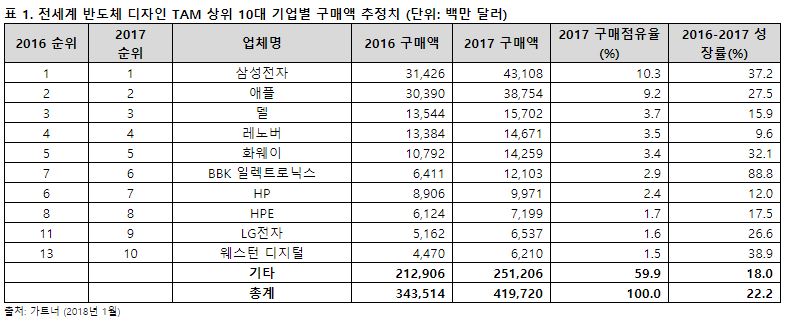
According to Gartner, Samsung Electronics and Apple ranked first and second, respectively, in terms of global semiconductor purchase share in 2017. The two companies' semiconductor purchases in 2017 reached $81.8 billion, a $20 billion increase from the previous year, accounting for 19.5% of the total.
Gartner Principal Analyst Masatsune Yamaji said, "Samsung Electronics and Apple have maintained the top two positions in semiconductor purchase indicators since 2011, and their share of semiconductor purchases also increased sharply in 2017. The two companies exert significant influence on technology and pricing trends across the semiconductor industry."
Eight of the top ten companies from 2016 retained their positions in 2017, with the top five remaining unchanged. LG Electronics returned to the top ten, taking ninth place, followed by Western Digital, which entered the top ten for the first time in 2017 after increasing its semiconductor purchases by $1.7 billion. BBK Electronics, which increased its semiconductor purchases by approximately $5.7 billion, ranked sixth.
The surge in DRAM and NAND flash memory prices significantly impacted the rankings of semiconductor buyers in 2017. The memory chip shortage and the risk of rising memory prices weighed on many original equipment manufacturers (OEMs), including large players. Supply shortages were experienced not only in the memory IC market but also in other semiconductor markets, such as microcontrollers and discrete components, as well as the passive component market. While this benefited suppliers, it created problems for OEMs. Conversely, some leading OEMs differentiated their products with captive silicon solutions. The growing consumption of captive chips poses a significant risk to the growth of commercial chip manufacturers.
Semiconductor purchases by the top 10 OEMs have seen significant growth, with their share of semiconductor purchases approaching 40% in 2017, up from 31% a decade ago. Gartner projects this trend will continue, with the top 10 OEMs accounting for over 45% of total semiconductor purchases by 2021.
“With the top 10 semiconductor buyers increasing their share of purchases, chipmakers’ technology product marketing leaders should adopt a strategy of focusing on top customers,” said Yamaji. “They should leverage online technical support capabilities to prioritize direct sales and technical support resources for top customers, while outsourcing other customer support.”
Comments
Related news

Samsung Electronics and Apple are the world's major semiconductor buyers... Purchase volume declined compared to the previous year.
Gartner Inc., a leading global IT consulting firm, announced that Samsung Electronics and Apple maintained their position as the world's largest semiconductor buyers in 2015, with a combined purchase share of 17.7% in the global semiconductor market. The two companies purchased a total of $59 billion in semiconductors in 2015, representing an increase of $800 million compared to the previous year.
2016.01.29by 신윤오 기자

Last Year's $61.7 Billion in Semiconductor Purchases: Who Are the World's Biggest Semiconductor Buyers?
IT advisory firm Gartner Inc. announced that Samsung Electronics and Apple maintained their positions as the two largest semiconductor-purchasing companies, accounting for 18.2% of the global semiconductor market in 2016 (refer to Table 1). The two companies purchased a combined total of $61.7 billion in semiconductors in 2016, representing an increase of $400 million compared to the previous year.
2017.02.03by 신윤오 기자

Gartner forecasts global IT spending to rise 4.5% in 2018
Gartner forecasted that global IT spending in 2018 would reach $3.7 trillion, representing a 4.5% increase year-over-year. Vice President John David Lovelock stated, "Global IT spending is expected to continue growing over the coming years. However, uncertainty is likely to persist as enterprises consider Brexit, the possibility of a global economic downturn, and other factors." He added, "Despite these circumstances, enterprises will continue investing in IT to drive revenue growth, though spending patterns will shift." He further explained, "Projects in digital business, blockchain, Internet of Things and big data algorithms, machine learning, and similar areas will serve as key drivers of growth."
2018.01.19by 김학준 기자

Intel Unveils Next-Generation 'Core Ultra Series 3' and vPro Platform for Enterprise PCs
Intel has officially unveiled the "Intel Core Ultra Series 3" for next-generation enterprise PCs and the latest vPro platform, addressing a wide range of demands from enterprise notebooks to high-performance workstations.
2026.03.26by 배종인 기자

ROHM Launches ESD Protection Diode Compatible with High-Speed Interfaces of 10Gbps or Higher
Semiconductor specialist ROHM has developed the 'RESDxVx series' of ESD (electrostatic discharge) protection diodes capable of responding to next-generation high-speed data communication environments exceeding 10Gbps, simultaneously enhancing both signal quality maintenance required in high-speed interfaces and IC protection performance.
2026.03.26by 배종인 기자











