


Is that scene from the movie possible if you add AI to AR?
 Published2018.01.26 16:53
Combining gesture and emotion recognition capabilities beyond voice commands will meet consumer demand
In the movie Minority Report, there is a scene where the main character projects 3D projections in the air and accesses and analyzes information using only hand gestures. It is expected that 2018 will be the year when we will see results in realizing scientific scenes that we have only seen in our imaginations. Technologies that seemed impossible, such as AR/VR, motion recognition interfaces, and self-driving cars, have already become partial realities and are moving toward complete realization. This is through the fusion of AI and AR that realizes information in front of our eyes and recognizes our movements.
According to Digieco’s 2018 Mobile Trend Report, “AI will begin to understand space and recognize people and objects within the space,” and artificial intelligence and augmented reality platforms will be the hot topics. It also said, “This will be a year in which AR technology is added to AI applied to various fields, evolving from terminals to robots.”
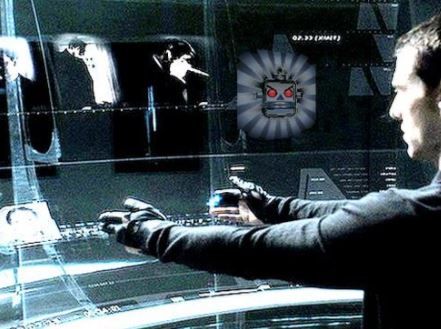
A scene from the movie Minority Report shows people accessing augmented reality information using hand gestures.
In fact, AR has been implemented through Google's ARCore and Apple's ARKit, but it seems difficult to expand with a single technology. In the early days of mobile AR, there is a need for 'chipset development for on-device AI support' to power object recognition functions such as 'Google Lens', and '3D sensor development' to add 3D depth recognition functions.
Apple developed its own 3D object recognition function chip and installed it in the iPhone X. It utilized AR by recognizing the three-dimensional structure of an object with a 3D lens and judging, processing, and transmitting the image. In order to lead the mobile trend, Samsung Electronics also recently mass-produced related semiconductors and hinted at providing an AR service based on object recognition.
Combining AI and AR through voice commands
AI speakers have shown the potential for motion control. Amazon's Alexa and Google's Amazon Echo have created an environment where basic household needs can be handled by voice, with 'shortcut button-type voice commands' being added, in addition to 'simple information search'. In addition, the introduction of AI speakers such as Apple's HomePod, KT's Giga Genie, and Kakao Mini is picking up speed.
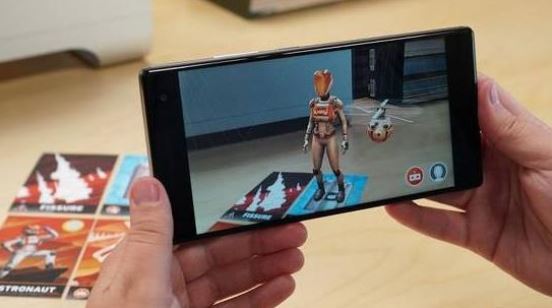
Accordingly, the 'multimodal interface' that brings up the screen through voice commands and controls it with hand movements is expected to become the core. However, it is expected that it will still take time to replace the controller with movement. Ultimately, only when movement and emotion recognition are implemented will the augmented reality terminal users expand to general consumers. The recent introduction of the Aura quadcopter drone, which can be moved by hand gestures without a controller, shows the potential of this.
In this way, 2018 is expected to be a year in which artificial intelligence, which is expanding its influence as its application expands to various fields, will be augmented with the addition of 'eyes', and it will be possible to confirm the possibility of replacing people in some fields. As domestic and foreign companies enter the market, it is expected that Internet terminals that do not have sensor technology development and artificial intelligence added, and terminals that cannot become robots will gradually be eliminated.
Comments
Related news
Why AR, Expected to Surpass the VR Market, Is Attracting Attention in Terms of Commercialization
Among the technologies showcased in Apple's new iPhone X, released in its 10th anniversary, the standout technology is 'facial recognition'. This technology is implemented through the TrueDepth camera system, a 3D camera based on a 3D sensing module. There is another technology made possible by a 3D camera that measures depth. That is 'augmented reality (AR)'. In June, Apple unveiled 'ARKit', an augmented reality platform, at its developer conference 'WWDC 2017'. Subsequently, it announced that it was developing an app utilizing AR technology through collaboration with IKEA. The iPhone X is equipped with an OLED display and a 3D depth camera for AR implementation. Market research firm Counterpoint Research predicted that the AR market would reach 60 billion dollars by 2021 in next-generation technology competition, growing faster than VR. Why is AR garnering attention from a business perspective?
2017.10.11by 김지혜 기자

PTC CEO Jim Heppelman: “Why Every Organization Needs an Augmented Reality (AR) Strategy”
PTC announced that its CEO Jim Heppelmann has presented the impact of augmented reality (AR) technology on business and new value it will bring to industrial markets through a contribution to the world-renowned business journal Harvard Business Review (HBR). PTC CEO Jim Heppelmann previously co-authored two articles with Professor Michael Porter for Harvard Business Review, addressing how smart connected products are transforming competition and corporate structures. In this contribution, based on research findings, he addresses the roadmap that enterprises should prepare before implementing AR, as well as critical decision points they will face when integrating AR technology into business strategy and operations.
2017.11.06by 김지혜 기자
.jpg)
VMware Announces 7 Top IT Predictions for 2018
VMware (CEO: Pat Gelsinger) has released a report titled "Seven IT Outlooks for 2018." The report was written by Bask Iyer, Chief Information Officer (CIO) of VMware and Dell Technologies, and contains 2018 IT market outlooks and trends that CIOs should pay attention to, centered on people, processes, and technology. CIO Bask Iyer stated that synergistic effects can be achieved only when three core elements—people, processes, and technology—are organically combined and operated together, and presented seven trends based on this foundation. He identified the following as 2018 IT trends: △expansion of IT talent pipelines, △changes in IT industry careers, △mindset shift for digital transformation, △activation of collaboration-based projects, △creation of continuous learning environments, △application-based business innovation, and △rapid growth of artificial intelligence.
2017.12.25by 김지혜 기자

ESP32 Development Environment Selection and GPS Application Implementation
The ESP32 is a microcontroller that integrates Wi-Fi, Bluetooth, 12-bit ADC, capacitive touch, PWM, DAC, and UART in a single SoC. However, the abundance of features does not by itself solve the designer's problems. The real challenges lie in selecting the appropriate development environment, determining which pins can be used and which must be avoided, and converting raw data from modules into usable information. This document addresses ESP32 peripheral constraints (ADC2 and Wi-Fi coexistence limitation, UART1 occupancy, ADC non-linear regions), the trade-offs between Arduino IDE and ESP-IDF, and the process from connecting NEO-6M/NEO-M8N GPS modules to UART2, parsing NMEA sentences, and visualizing routes in Google Earth, all organized based on documented references.
2026.10.12by 편집부
[e4ds Tech Day 2026 ⑨] Sim Sang-gyu, Autocrypt CTO: "In the Physical AI Era, Automotive Security Must Extend Beyond the Vehicle"
At e4ds Tech Day 2026, Sim Sang-gyu, CTO of Autocrypt, explained automotive cybersecurity strategies in the era of Physical AI and SDV (Software-Defined Vehicle). Automobiles are evolving as part of an ecosystem connected to AI, cloud, chargers, IoT, and robots, and he emphasized that the scope of security must expand beyond the vehicle interior to the entire connected environment. In particular, AI model tampering, adversarial attacks, OTA updates, and EV charger hacking were identified as major threats. He explained that response measures require zero trust, AI model integrity protection, intrusion detection, Security by Design and Default, and full lifecycle security management, and that proactive security system establishment beyond regulatory compliance is critical for securing future mobility competitiveness.
2026.10.12by 배종인 기자











